




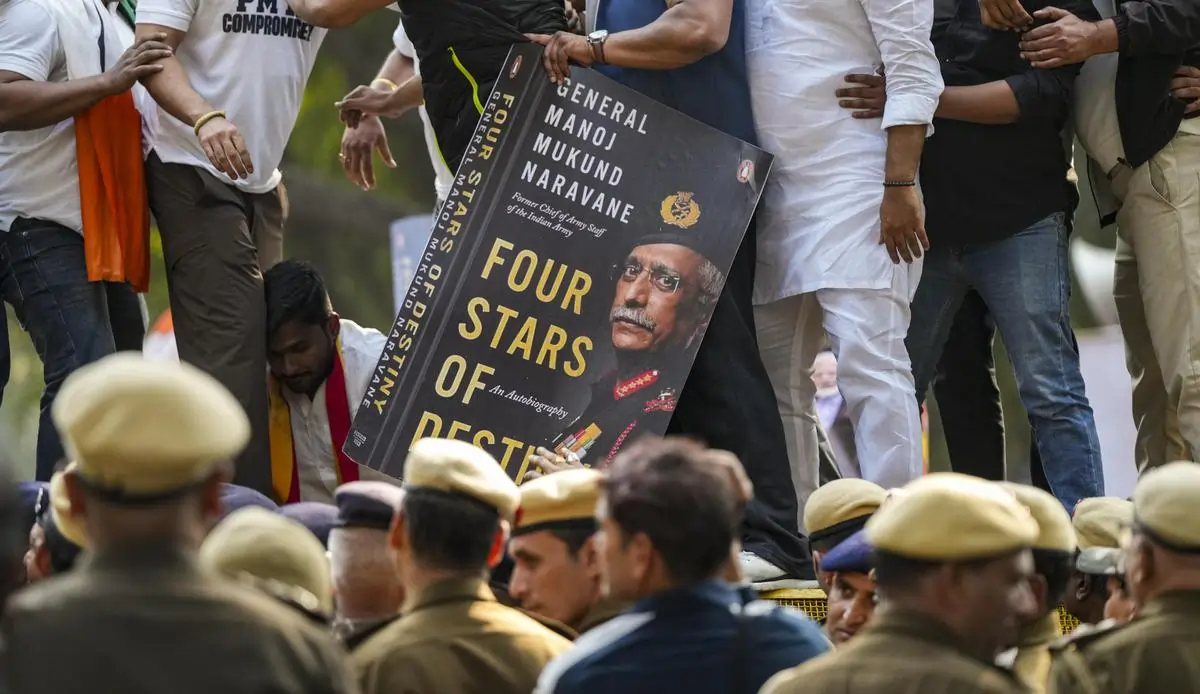
Amid the ongoing controversy regarding General Manoj Mukund Naravane’s unpublished memoir, “Four Stars of Destiny,” the Ministry of Defence is in the process of developing comprehensive guidelines for armed forces personnel, both serving and retired, who wish to publish books.
Senior defence officials have confirmed the initiative, highlighting that the forthcoming framework will clarify the approval process necessary before any manuscript can be published. Recent discussions within the ministry included detailed presentations and focus on aligning existing service rules with statutory requirements, notably the Official Secrets Act, which governs the disclosure of sensitive information.
Currently, there is no unified law overseeing book publication by retired military officers. While serving personnel must adhere to stringent service regulations that require prior written permission for literary and commercial undertakings, retired officers operate in a more ambiguous legal area. Importantly, the Official Secrets Act applies indefinitely, prohibiting the unauthorized disclosure of classified and sensitive operational details that could jeopardize national security.
For those still in service, the rules regarding publication are notably rigorous. Any proposal for writing or publishing must pass through the chain of command, requiring approvals that may involve Army Headquarters or the Defence Ministry, contingent upon the manuscript’s content. Explicitly sensitive topics—including operational plans, intelligence functionalities, equipment capabilities, internal procedures, and foreign relations—are strictly off-limits. Even fictional narratives could face scrutiny if they resemble real-life operations or include identifiable specifics.
Meanwhile, retired officers, while no longer bound by the Army Act in matters of publication, are still advised to exercise caution and seek clearance from the Defence Ministry when addressing operational or sensitive topics. Lieutenant General (retd.) D.P. Pandey emphasized that retired officers, though on a civilian level, remain accountable under the Official Secrets Act. Material that is already publicly accessible can typically be written about freely, but authors need prior approval for sensitive topics.
The renewed push for formalized guidelines comes in light of the controversy surrounding General Naravane’s memoir, which remains unpublished. Both he and his publisher, Penguin Random House India, have clarified that no copies—print or digital—have been circulated, even amid reports suggesting otherwise. The situation has also sparked political discourse, amplifying calls for clearer publication norms.
Officials have indicated that the forthcoming guidelines are aimed at eliminating confusion while safeguarding national security interests. The framework is anticipated to provide clarity for both current members of the military and veterans, ultimately establishing consistent and transparent procedures for the review and approval of defence-related manuscripts in the future.


