




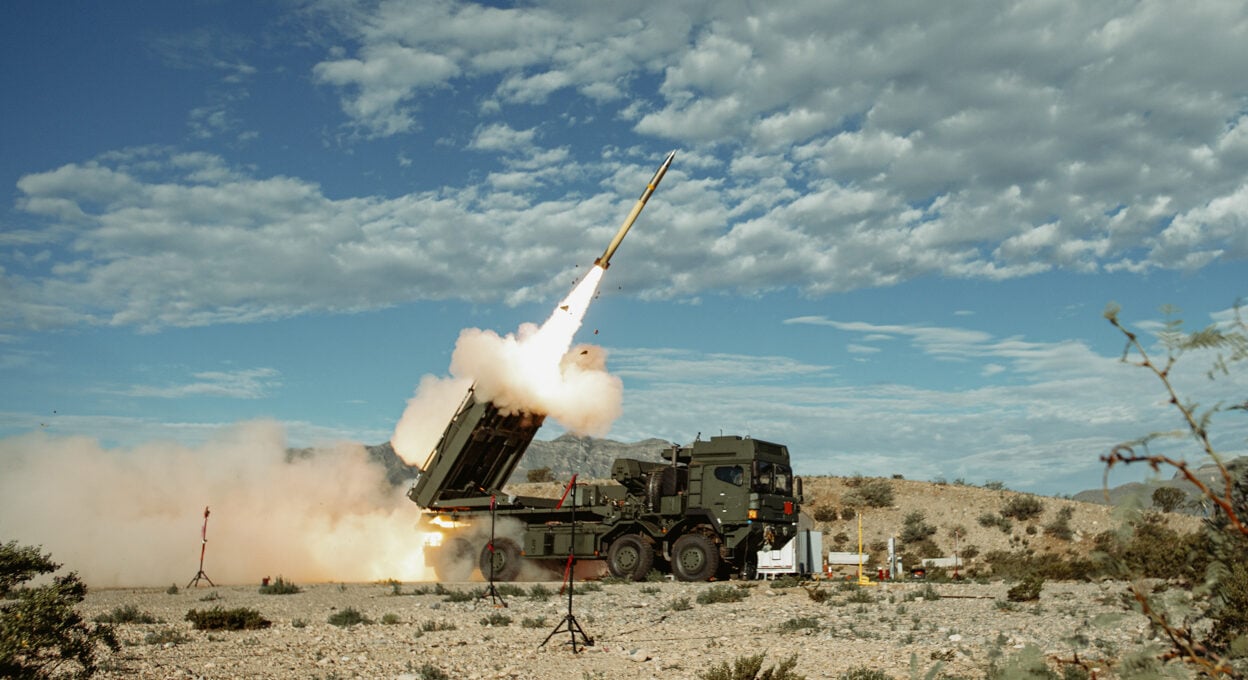
The Global Mobile Artillery Rocket System (GMARS) represents a significant advancement in rocket artillery technology, specifically tailored for high-intensity, peer-level warfare. This innovative system builds upon the successes and combat lessons derived from the High Mobility Artillery Rocket System (HIMARS) and the Multiple Launch Rocket System (MLRS), elevating the art of warfare through the integration of heavier payloads, enhanced firing rates, and impressive long-range capabilities.
The development of GMARS was prompted by the evolving demands of modern land warfare. Traditional rocket artillery systems have often fallen short in terms of range and impact, especially as adversaries increasingly move critical assets further from the frontline and improve their air defense systems. Recognizing this gap, defense contractors Lockheed Martin and Rheinmetall collaborated to create GMARS, ensuring that it can deliver high-volume precision fires while maintaining the mobility necessary to evade counterstrikes. This evolution signifies a shift in military strategy, emphasizing deep fires as essential, rather than simply supportive, capabilities.
Unveiled in 2023, GMARS integrates decades of operational experience in Western rocket artillery, melding proven US munitions with advanced European vehicle technology. This synthesis aligns with NATO’s renewed focus on preparing for large-scale, high-intensity conflict scenarios.
A standout feature of GMARS is its capability for massed firepower and long-range strikes. Unlike its predecessors, GMARS is engineered from inception to provide superior payload capacity, addressing common criticisms associated with lighter systems, such as limitations on salvo size and the sustainability needed for prolonged engagements. This upgraded capacity enables ground forces to influence engagements beyond immediate front lines, enhancing deterrence and enabling coordinated operations across various military domains, including land, air, and maritime.
Moreover, GMARS features two full launch pods capable of firing both Guided Multiple Launch Rocket System (GMLRS) rockets and longer-range missiles in rapid succession. This design allows for a higher onboard payload, facilitating faster saturation of targets and greater flexibility in strike planning. Notably, GMARS remains fully compatible with existing US and NATO rocket inventories, including enhanced versions of GMLRS and Army Tactical Missile Systems (ATACMS). This compatibility not only reduces logistical friction but also accelerates the system’s incorporation into existing military frameworks.
In the context of modern warfare, GMARS provides a vital ground-based countermeasure against advanced adversary threats, particularly those leveraging anti-access and area-denial (A2/AD) strategies. Its mobility allows rapid repositioning, while its extended range enables operations outside of many enemy target envelopes, enhancing survival prospects for the unit.
However, GMARS does come with trade-offs, particularly in terms of its logistical requirements. Its heavier configuration necessitates more meticulous planning for transportation and concealment compared to lighter launch systems. Therefore, while GMARS is road-mobile, its optimal employment is likely in organized, high-intensity operations rather than in swift expeditionary missions.
While not intended to replace HIMARS, GMARS serves as a vital complement, suited for sustained, high-tempo combat scenarios where fire density is crucial. Particularly for European forces, GMARS offers a method to develop deep-strike capabilities independent of reliance on airpower alone, thereby complicating adversary planning and enhancing deterrent measures.
NATO member countries are actively evaluating GMARS for integration into their artillery brigades, especially appealing to those facing long-range threats. The program has made significant strides, demonstrating its capabilities during its first live-fire test, and positions GMARS to become a cornerstone for allied deep-strike operations in multi-domain environments.
Ultimately, the introduction of GMARS reflects a broader strategic shift back toward conventional deterrence, re-establishing long-range fires as a central force in shaping battlefield dynamics. This system is less about reinventing military tactics and more about scaling effective, existing technology to address increasingly complex warfare challenges.


