




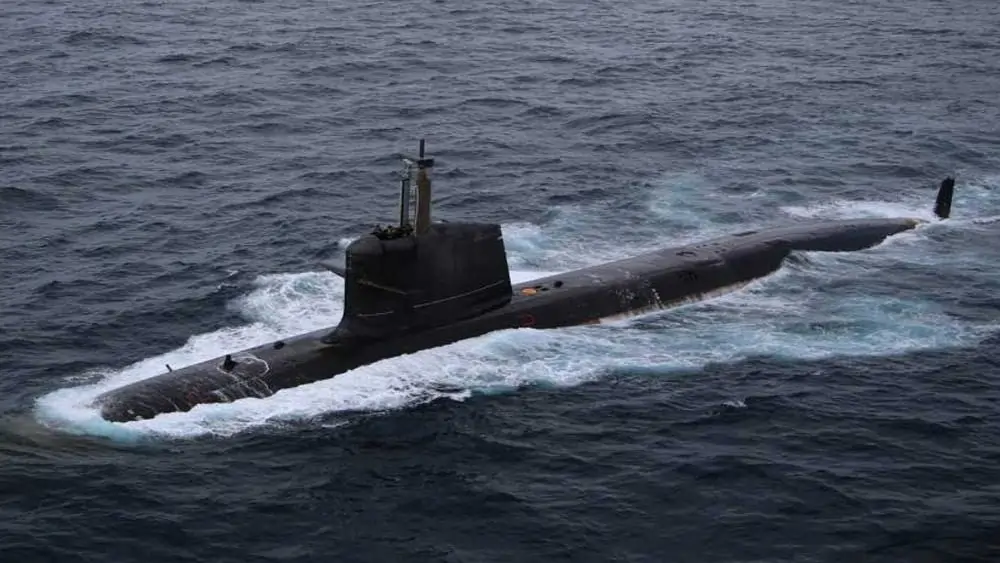
India is set to enhance its naval capabilities significantly with the upcoming commissioning of the INS Aridhaman, which is poised to become the country’s third nuclear-powered ballistic missile submarine (SSBN). This milestone is anticipated to take place between April and May 2026, marking a crucial addition to India’s nuclear triad and its second-strike capability.
The INS Aridhaman, a product of the Advanced Technology Vessel (ATV) programme, has been constructed at the Ship Building Centre in Visakhapatnam. Weighing in at 7,000 tonnes, the submarine has recently completed its final stages of sea trials and is prepared for induction into service. The Chief of the Naval Staff has confirmed that commissioning will occur soon, following the successful completion of trials in late 2025.
This submarine represents a significant upgrade over previous vessels in its class. Unlike its predecessors, INS Arihant and INS Arighaat, which were fitted with four missile tubes, the Aridhaman boasts eight vertical launch tubes. This design allows it to house up to 24 K-15 Sagarika missiles, which have a range of 750 km, or a combination of longer-range K-4 missiles capable of reaching 3,500 km and the anticipated K-5 missiles that could extend up to 6,000 km. This advancement effectively doubles the firepower of its forerunners.
INS Aridhaman is powered by an 83 MW compact light-water pressurized nuclear reactor, which has been adapted from the Kalpakkam prototype. This reactor provides the submarine with greater endurance, a reduced acoustic signature, and improved stealth capabilities. Capable of achieving submerged speeds of approximately 24 knots, the vessel’s operational range is largely dictated by crew endurance and logistical support rather than fuel limitations, thereby enhancing its survivability during deterrent patrols.
The induction of INS Aridhaman will allow the Indian Navy to operate three Arihant-class SSBNs at the same time for the first time. This capability significantly bolsters India’s ability to maintain a continuous at-sea nuclear deterrent—an essential component of its no-first-use policy. Furthermore, a fourth SSBN of this class is currently undergoing sea trials and is expected to be inducted by early 2027, further strengthening India’s underwater nuclear arsenal.


