




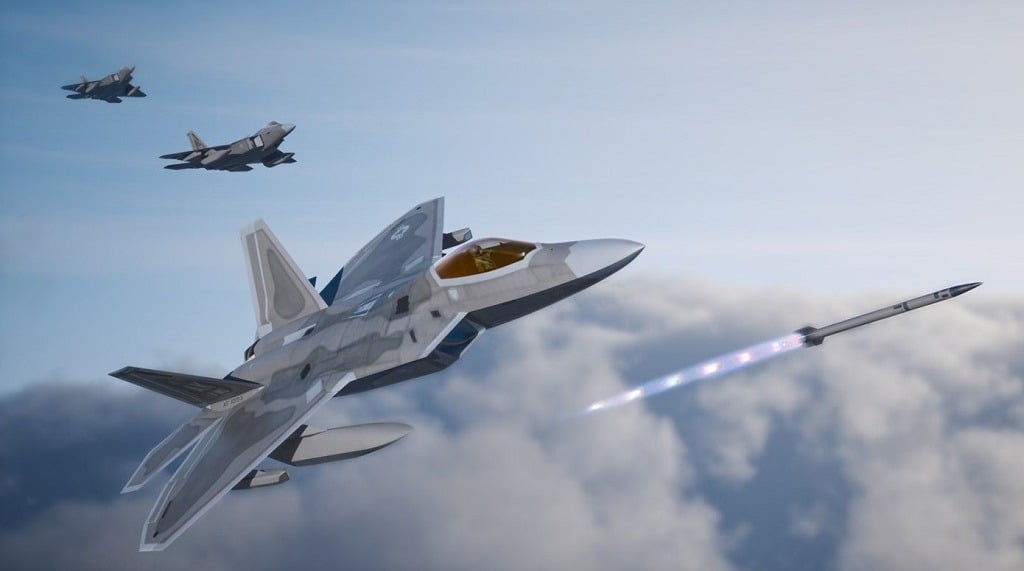
Modern air combat has evolved to require weapons that surpass adversaries in range, maneuverability, and longevity. One of the US military’s responses to this demand is the AIM-260 Joint Advanced Tactical Missile (JATM), which aims to extend the operational reach of fighter aircraft, enabling them to neutralize threats before they become visible on radar.
Developed by Lockheed Martin, the AIM-260 JATM is designed to be the next-generation beyond-visual-range air-to-air missile, securing air superiority against rapidly advancing foreign threats. This missile is set to complement or replace the AIM-120 Advanced Medium-Range Air-to-Air Missile (AMRAAM) and reflects a broader shift in US air combat strategy that focuses on engagement at extended distances and maintaining an advantage over adversaries equipped with sophisticated aircraft and electronic warfare systems.
The design philosophy of the AIM-260 prioritizes enhanced capabilities while keeping many technical specifications classified. Notably, it boasts a significantly greater range than the AIM-120D, allowing US fighters to engage adversaries from safer distances, particularly critical in environments fraught with advanced surface-to-air missiles and electronic countermeasures. One of its standout features is its compatibility with internal weapon bays of stealth aircraft like the F-22 Raptor and the F-35 Lightning II, ensuring the stealth profile of these aircraft remains intact.
While specific details of the AIM-260 remain under wraps, the missile reportedly incorporates several advanced features, including an enhanced seeker designed for challenging electronic warfare environments, a two-way datalink to facilitate mid-course updates, and robust resistance against jamming. Its propulsion system is engineered for long-range, energy-intensive engagements, emphasizing flexibility and resilience in guidance rather than sheer speed.
The AIM-260 has been tailored for use across both the US Air Force and Navy, with the Air Force spearheading its operational integration. The F-22 Raptor is expected to be the first platform to utilize this missile, with future compatibility in the F-35 and new aircraft developed under the Next Generation Air Dominance program. However, the AIM-260 is not intended to completely replace the AIM-120, which will continue to serve in various roles. Instead, it is expected to be deployed in high-end threat scenarios, reserving the AIM-120 for broader, less contested engagements.
Historically, the AIM-120 AMRAAM has been pivotal in US and allied air-to-air operations, but emerging threats from countries like China and Russia—especially with the introduction of long-range missiles such as China’s PL-15—have challenged this dominance. In light of these advancements, the US Air Force initiated the JATM program, culminating in the AIM-260, designed to enhance reach, decrease engagement timelines, and enable better survivability in high-stakes combat situations.
In modern air combat, victory often belongs to the side that can detect, track, and engage first. The AIM-260 is engineered to enhance this capability, pushing engagement boundaries further out and compelling adversaries to adopt defensive postures before they can launch their weapons. This extended reach bolsters distributed operations and sensor-shooter separation concepts, whereby targeting data may be relayed from various platforms, allowing engagements without direct line-of-sight to a target.
The development of the AIM-260 has been characterized by a low profile. Unlike earlier missile programs, there has been a notable absence of public test footage or detailed performance summaries. This discretion underscores the understanding that maintaining information superiority is crucial, as revealing specifics can diminish deterrent capabilities. The missile is projected to be operational by the mid-to-late 2020s, in line with overall modernization objectives across the US air combat domain.
By enhancing engagement ranges, boosting survivability against electronic warfare, and ensuring seamless integration with stealth platforms and networked sensors, the AIM-260 plays a crucial role in preserving air superiority for US and allied forces. Amidst increasingly complex air combat scenarios, the AIM-260 endeavors to restore distance, dominance, and a decisive edge in the skies.


