




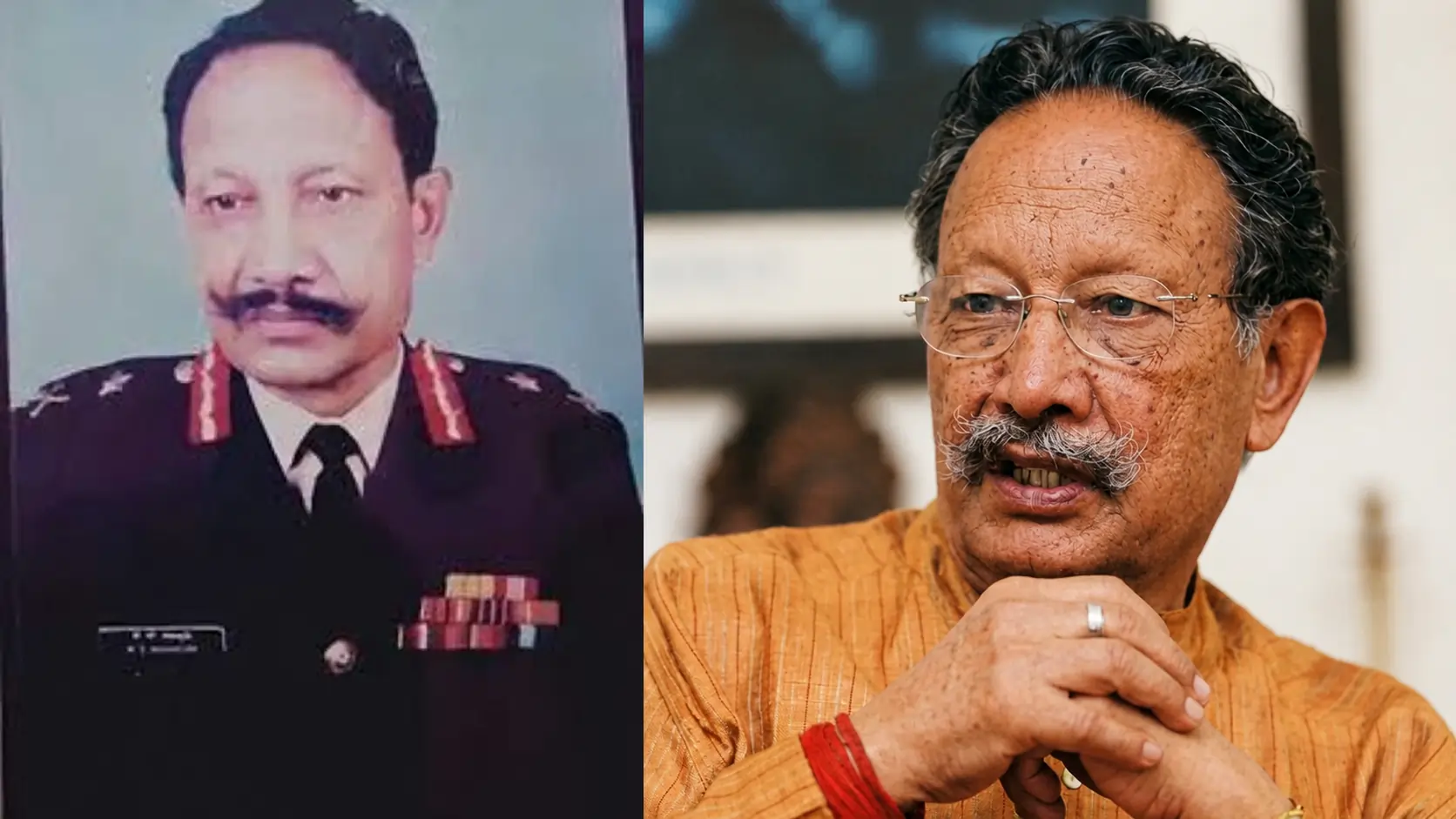
Major General (Retired) Bhuvan Chandra Khanduri, a prominent figure in Indian politics and military, passed away early on Tuesday at Max Super Speciality Hospital in Dehradun. He was 91 years old and had been undergoing treatment for a prolonged illness, as confirmed by his son, Manish Khanduri. His death has evoked deep sorrow across various circles, including political, administrative, and military, both in Uttarakhand and beyond.
Khanduri was born on October 1, 1934, in Dehradun to a family known for its dedication to public service—his father, Shri Jai Ballabh Khanduri, was a journalist, while his mother, Smt. Durga Devi Khanduri, was a social activist. His commitment to service began when he joined the Indian Army’s Corps of Engineers in 1954, marking the start of a distinguished military career that spanned 37 years. He rose to the rank of Major General by the time he retired in 1991.
Throughout his military tenure, Khanduri held several significant roles, including Commander of a Regiment during the 1971 Indo-Pak War, Chief Engineer, and Additional Director General at Army Headquarters. His service was honored with the prestigious Ati Vishisht Seva Medal (AVSM) in 1982, acknowledging his exemplary contributions to the Indian Armed Forces.
After his military retirement, Khanduri transitioned to a political career and became an influential leader within the Bharatiya Janata Party (BJP). He represented the Garhwal parliamentary constituency multiple times in the Lok Sabha, serving terms in 1991, 1998, 1999, and from 2014 to 2019. His political career included the role of Union Minister for Road Transport and Highways from 2000 to 2004. Under the leadership of Prime Minister Atal Bihari Vajpayee, he played a crucial role in implementing significant infrastructure projects, notably the National Highways Development Project, which included ambitious initiatives such as the Golden Quadrilateral.
Khanduri also served twice as the Chief Minister of Uttarakhand—from March 2007 to June 2009 and again from September 2011 to March 2012. His governance focused on transparency, reform, and public welfare, with initiatives like strengthening the Lokayukta to tackle corruption and launching the free 108 ambulance service to enhance emergency healthcare access.
He was known for his simple lifestyle and integrity, often choosing to walk instead of using official vehicles, earning admiration across party lines for his unpretentious mannerisms.
In reaction to his passing, Uttarakhand Chief Minister Pushkar Singh Dhami expressed that this loss was “irreparable” for both state and national politics. He honored Khanduri’s dedication to public service and highlighted his contributions to Uttarakhand’s development and governance. Prime Minister Narendra Modi, along with various other national and state leaders, also paid tribute to Khanduri, acknowledging his commitment to his country in both military and political roles.
Khanduri leaves behind a remarkable legacy characterized by selflessness and a steadfast commitment to the welfare of the people of Uttarakhand. His journey from a distinguished military career to principled political leadership serves as an inspiration for many.
He is survived by his wife, son Manish Khanduri, and daughter Ritu Khanduri Bhushan. Further details regarding his last rites are yet to be announced, with the state and nation grieving the loss of a true stalwart who dedicated his life to serving the country.


