




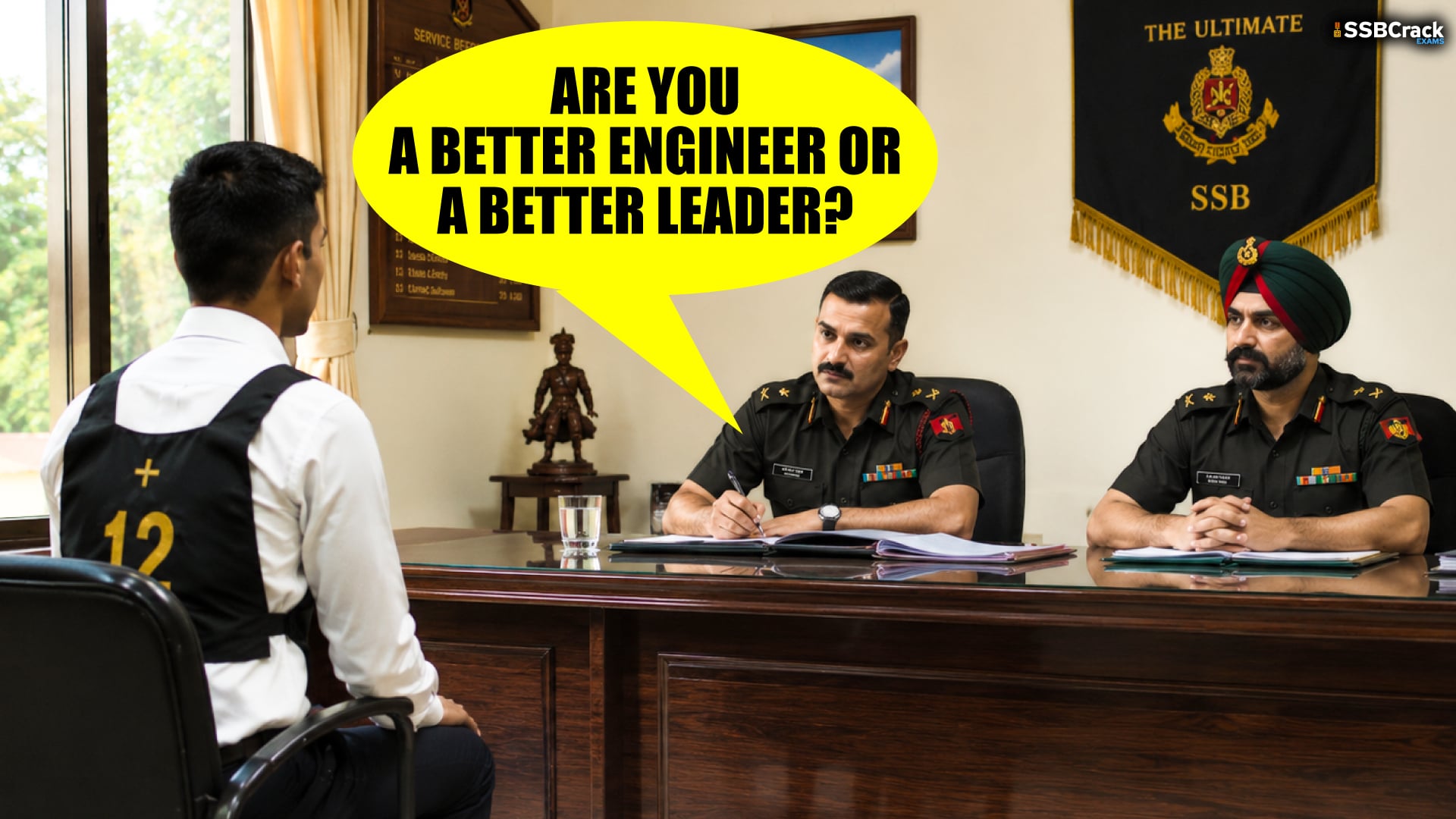
Engineering graduates appearing for the SSB Interview are often asked questions that test their technical knowledge, practical intelligence, problem-solving ability, leadership potential, and motivation to join the Armed Forces.
The interviewer may ask why you chose engineering, why you want to join the Armed Forces after engineering, how your technical knowledge will help you as an officer, and whether you understand the role of technology in modern warfare.
A technical degree can become a strong advantage in the SSB Interview, but only when you connect it with officer-like qualities such as responsibility, teamwork, decision-making, discipline, courage, and clarity of thought.
In this article, we will discuss 20 important SSB Interview questions for engineering graduates, along with why each question is asked, how to answer it, and a sample answer.
1. Why do you want to join the Armed Forces after engineering?
Why it is asked:
To check your motivation, clarity of career choice, and whether you are genuinely interested in the Armed Forces or simply looking for a job after engineering.
How to answer:
Connect your engineering background with leadership, technology, discipline, adventure, responsibility, and national service. Avoid saying that you did not get placement or that you are joining only for job security.
Sample Answer:
I want to join the Armed Forces because it offers a unique combination of leadership, discipline, technology, adventure, and service to the nation. As an engineering graduate, I have developed problem-solving ability, logical thinking, and technical understanding. I believe these qualities can help me contribute effectively as an officer. The Armed Forces also provide early responsibility and the opportunity to lead people with a larger purpose, which strongly motivates me.
2. Why did you choose engineering?
Why it is asked:
To understand your decision-making ability, academic interest, and whether you take responsibility for your choices.
How to answer:
Give a genuine reason. Mention interest in technology, machines, coding, structures, electronics, innovation, or problem-solving. Do not blame parents, marks, or social pressure.
Sample Answer:
I chose engineering because I was interested in understanding how things work and how practical problems can be solved through science and technology. Engineering helped me develop a structured and logical way of thinking. It also taught me teamwork, planning, time management, and practical application of knowledge through projects and assignments.
3. What is the connection between engineering and the Armed Forces?
Why it is asked:
To check whether you understand the practical role of technology in defence and whether you can connect your education with military requirements.
How to answer:
Talk about modern warfare, weapons, vehicles, aircraft, ships, drones, radars, communication systems, cyber security, bridges, logistics, and maintenance.
Sample Answer:
Engineering and the Armed Forces are closely connected because modern defence forces depend heavily on technology. Engineering is used in weapons systems, aircraft, ships, vehicles, radars, communication networks, drones, cyber systems, logistics, and infrastructure. An engineer can understand technical systems better, solve field problems, and manage equipment efficiently. This knowledge can help an officer take practical and informed decisions.
4. Why should the Armed Forces select an engineer like you?
Why it is asked:
To assess your self-awareness, confidence, and understanding of what qualities you bring to the organisation.
How to answer:
Mention technical knowledge along with officer-like qualities such as leadership, teamwork, adaptability, discipline, responsibility, and willingness to learn.
Sample Answer:
The Armed Forces should select me because I bring a combination of technical knowledge, logical thinking, teamwork, adaptability, and willingness to lead. Engineering has trained me to analyse problems and find practical solutions. Along with that, I am physically active, disciplined, and ready to learn military skills. I believe I can use my education and personality to become a responsible and dependable officer.
5. What is your engineering branch and why did you choose it?
Why it is asked:
To test your interest in your own branch and whether you can justify your academic path.
How to answer:
Explain your branch in simple language and mention its practical applications. Do not give a very technical or memorised answer.
Sample Answer:
I belong to Mechanical Engineering. I chose this branch because I was interested in machines, engines, vehicles, design, and manufacturing. Mechanical engineering has applications in automobiles, aircraft, weapons, power systems, and maintenance. It gave me a broad understanding of how mechanical systems function and how they can be improved or repaired.
Branch-wise variation:
For Computer Science, you can say you chose it because of your interest in programming, cyber security, artificial intelligence, data, and software development.
For Electronics, you can say you were interested in circuits, communication systems, sensors, radar, and embedded systems.
For Civil Engineering, you can say you were interested in construction, infrastructure, bridges, roads, and structural planning.
For Electrical Engineering, you can say you were interested in power systems, electrical machines, control systems, and energy management.
6. How will your engineering knowledge help you as an officer?
Why it is asked:
To check whether you can apply your education in real-life situations instead of treating engineering only as a degree.
How to answer:
Focus on practical use: equipment handling, maintenance, troubleshooting, planning, technical understanding, and resource management.
Sample Answer:
My engineering knowledge will help me understand technical systems and solve practical problems logically. As an officer, I may have to manage vehicles, weapons, communication systems, equipment, or infrastructure. Engineering has taught me troubleshooting, planning, teamwork, and resource management. These qualities are useful in both field and peace areas, especially when quick and practical decisions are required.
7. What was your final year project?
Why it is asked:
To test your practical knowledge, involvement, teamwork, and honesty. The interviewer may ask follow-up questions from your project.
How to answer:
Explain the aim of the project, your role, the method used, challenges faced, and what you learned. Keep it simple and honest.
Sample Answer:
My final year project was based on developing a smart monitoring system. The aim was to collect data, analyse it, and provide useful output for better decision-making. My role included research, design, testing, and coordination with my team members. This project taught me the importance of planning, teamwork, testing, patience, and presenting technical ideas in a simple manner.
8. What difficulties did you face during your engineering project?
Why it is asked:
To understand your problem-solving ability, patience, teamwork, and response under pressure.
How to answer:
Mention a genuine difficulty and explain how you solved it. Do not blame teammates, teachers, or college.
Sample Answer:
During our project, the main difficulty was managing time and resources. Sometimes components were not available, and at times our design did not work as expected. We divided the work properly, tested the system step by step, and took guidance from our faculty. This experience taught me that practical work requires patience, teamwork, and repeated improvement.
9. What is your favourite engineering subject and why?
Why it is asked:
To check whether you studied with interest and whether you can explain a technical subject clearly.
How to answer:
Choose a subject you genuinely know. Be ready for follow-up questions. Connect it with real-life or defence applications.
Sample Answer:
My favourite subject is Control Systems because it explains how systems can be monitored and controlled automatically. It has applications in aircraft, missiles, robotics, industrial automation, and defence technology. I liked this subject because it connects theory with practical applications and shows how machines can be made more accurate and reliable.
10. Which engineering subject did you find difficult?
Why it is asked:
To check honesty, self-improvement, and attitude toward weaknesses.
How to answer:
Mention one subject, explain why it was difficult, and show how you improved. Do not say that you had no difficult subject.
Sample Answer:
I found Signals and Systems difficult in the beginning because it involved mathematical analysis and abstract concepts. I improved by revising the basics, solving more numerical problems, and taking help from teachers and friends. This taught me that difficulty can be handled through regular practice and the right approach.
11. What is the role of technology in modern warfare?
Why it is asked:
To judge your awareness of current military trends and your ability to think beyond textbooks.
How to answer:
Mention drones, satellites, cyber warfare, radars, AI, electronic warfare, precision weapons, secure communication, and surveillance.
Sample Answer:
Technology plays a very important role in modern warfare. Today, wars are not fought only with manpower but also with drones, satellites, cyber systems, radars, electronic warfare, artificial intelligence, precision weapons, and secure communication. Technology improves surveillance, accuracy, coordination, and decision-making. However, trained soldiers and strong leadership remain equally important.
12. What is artificial intelligence and how can it help the Armed Forces?
Why it is asked:
To test your awareness of emerging technology and its defence applications.
How to answer:
Give a simple definition first, then mention applications such as surveillance, target recognition, cyber defence, logistics, predictive maintenance, and unmanned systems.
Sample Answer:
Artificial intelligence is the ability of machines to perform tasks that normally require human intelligence, such as learning, analysing data, recognising patterns, and making decisions. In the Armed Forces, AI can help in surveillance, target recognition, cyber defence, logistics, predictive maintenance, unmanned systems, and battlefield decision support. It can reduce risk to soldiers and improve operational efficiency.
13. What is cyber warfare?
Why it is asked:
To check your understanding of modern non-contact warfare and digital security.
How to answer:
Explain it in simple terms. Mention that cyber attacks can target communication, data, banking, defence networks, and critical infrastructure.
Sample Answer:
Cyber warfare means the use of digital attacks against a country’s computer systems, networks, communication systems, defence infrastructure, or critical services. It can be used to steal information, disrupt operations, spread misinformation, or damage important systems. Since modern militaries depend heavily on networks and data, cyber security has become an important part of national security.
14. What are drones and why are they important for the military?
Why it is asked:
To assess your awareness of current battlefield technology and practical military applications.
How to answer:
Define drones simply and explain their use in surveillance, reconnaissance, logistics, target tracking, and precision strikes.
Sample Answer:
Drones are unmanned aerial vehicles that can be remotely controlled or programmed to operate automatically. They are important for the military because they can be used for surveillance, reconnaissance, target tracking, logistics, and precision strikes. They reduce risk to soldiers and provide real-time information from difficult or dangerous areas.
15. What is the difference between a leader and a manager?
Why it is asked:
To check your understanding of leadership, responsibility, and people management.
How to answer:
Keep it practical. A manager organises resources; a leader motivates people and takes responsibility. An officer needs both qualities.
Sample Answer:
A manager focuses on planning, organising, and completing tasks efficiently. A leader inspires people, takes responsibility, guides the team, and motivates others to achieve a common goal. In the Armed Forces, an officer needs both qualities. He must manage resources properly and also lead his men with courage, confidence, and personal example.
16. Tell us about a situation where you showed leadership during engineering.
Why it is asked:
To check whether you have demonstrated leadership in real life, not just in theory.
How to answer:
Use a real incident from project work, college event, sports, internship, or team activity. Explain the situation, your action, and the result.
Sample Answer:
During our final year project, our team faced delays because the initial design was not working properly. I took the initiative to divide the work again, set small targets, and coordinate with each member. I also contacted our faculty guide for technical suggestions. As a result, we completed the project on time. This experience taught me that leadership means taking responsibility and keeping the team motivated during difficulties.
17. Why not pursue a corporate job after engineering?
Why it is asked:
To test whether you are genuinely interested in the Armed Forces or simply avoiding the private sector.
How to answer:
Respect corporate jobs but explain why the Armed Forces match your personality, goals, and values better.
Sample Answer:
A corporate job is also a good career option, but my interest is more towards a challenging and purposeful life. I want a career that gives me responsibility, leadership, discipline, physical activity, teamwork, and service to the nation. The Armed Forces offer all these qualities. I believe my engineering background can be used meaningfully in a defence environment where technology and leadership both are important.
18. What are your strengths as an engineering graduate?
Why it is asked:
To assess self-awareness, confidence, and whether your strengths are useful for officer training.
How to answer:
Mention 3–4 strengths and support them with engineering-related experience.
Sample Answer:
My strengths as an engineering graduate are logical thinking, problem-solving, teamwork, adaptability, and willingness to learn. Engineering has trained me to approach problems systematically and find practical solutions. Working on projects and assignments also improved my coordination and time management. I believe these qualities will help me as an officer.
19. What are your weaknesses?
Why it is asked:
To test honesty, self-awareness, and willingness to improve.
How to answer:
Mention a real but manageable weakness. Show improvement. Avoid negative qualities like anger, laziness, lack of discipline, dishonesty, or poor teamwork.
Sample Answer:
Earlier, I used to spend too much time perfecting small details, which sometimes affected my speed. I have worked on this by setting time limits and prioritising important tasks first. Now I try to maintain a balance between quality and timely completion. This has helped me become more practical and efficient.
20. Where do you see yourself in the Armed Forces after 10 years?
Why it is asked:
To check your ambition, long-term seriousness, and understanding of military life.
How to answer:
Do not sound overconfident. Mention growth as a responsible, experienced, professionally competent officer.
Sample Answer:
After 10 years, I see myself as a mature, responsible, and professionally competent officer with good field experience and leadership ability. I would like to command and guide my team effectively, keep learning modern military technology, and contribute to the organisation with dedication. My aim would be to become an officer whom seniors can trust and juniors can look up to.
Conclusion
Engineering graduates are not selected in the SSB Interview only because they hold a technical degree. They are selected when they show officer-like qualities such as practical intelligence, clarity of thought, honesty, responsibility, teamwork, discipline, and leadership potential.
Your engineering background can become a strong advantage if you connect it with real-life problem-solving, modern warfare, technology, and the responsibilities of an officer.
So, prepare your technical basics, know your final year project properly, stay updated about defence technology, and most importantly, remain honest and natural in your answers. The SSB Interview is not looking for memorised replies. It is looking for a genuine personality with the potential to become a responsible officer.


