




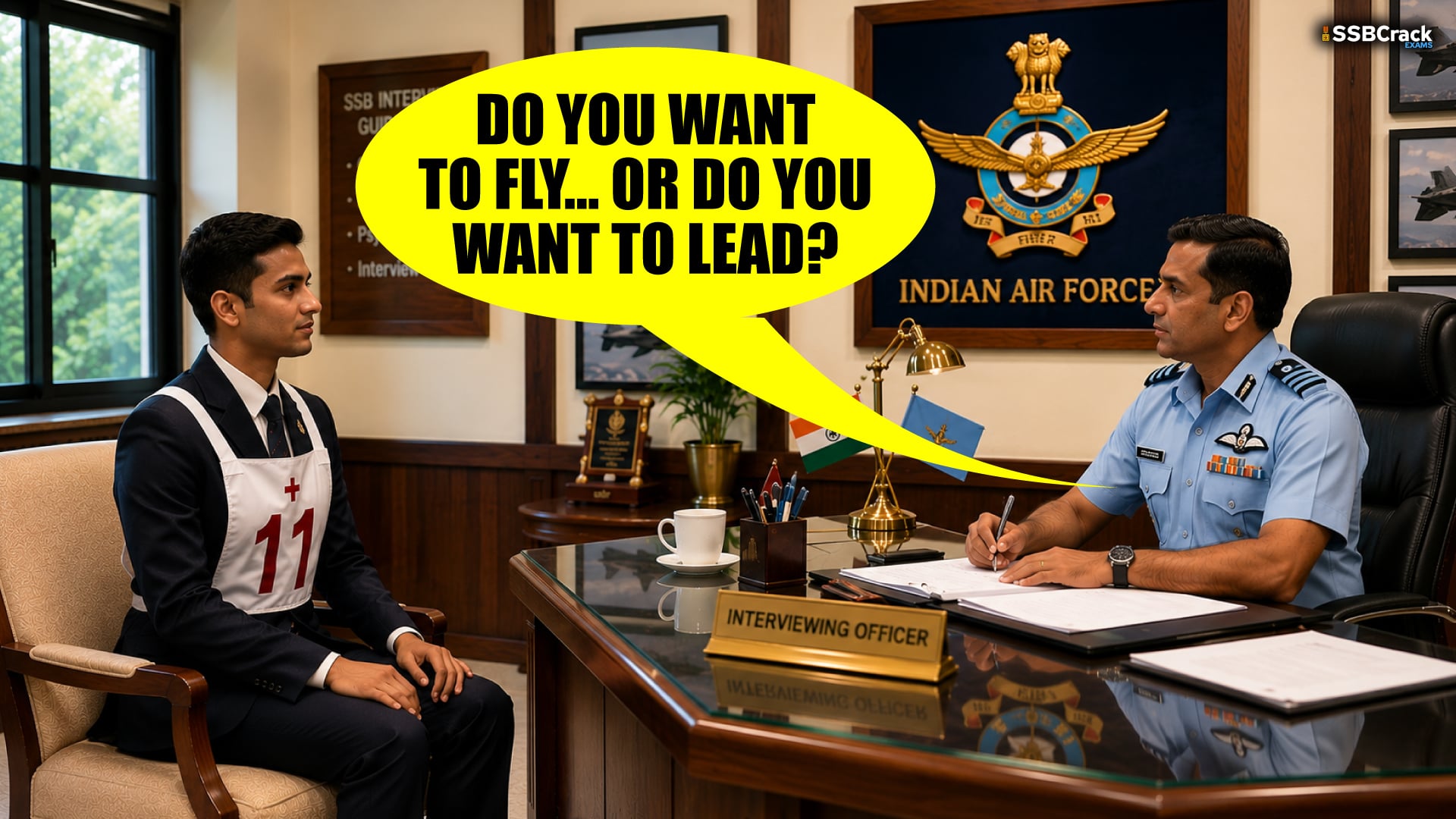
The Indian Air Force is a technologically advanced fighting force that protects the nation’s airspace, supports joint military operations, conducts humanitarian missions, and responds rapidly to emerging challenges. An Air Force Officer is expected to make quick decisions, remain calm under pressure, adapt to changing situations, and lead teams effectively.
During the SSB Interview, the Interviewing Officer is not merely assessing your knowledge of aircraft and military equipment. He is trying to understand your personality, leadership potential, decision-making ability, responsibility, emotional stability, and motivation to serve in one of the most demanding professions in the country.
In this article, we will discuss 20 important SSB Interview questions specifically for Air Force aspirants. We will understand why these questions are asked, how to answer them effectively, and examine sample responses that reflect the Officer Like Qualities expected in future Air Force Officers.
1. What inspired you to choose the Indian Air Force as a career?
Why it is asked
To assess your motivation and clarity of career choice.
How to answer
Mention genuine reasons related to aviation, technology, service, leadership, or national security.
Sample Answer
“I am inspired by the Air Force’s role in protecting the nation through advanced technology, rapid response capability, and professional excellence. The opportunity to serve while continuously learning and leading motivates me to join.”
2. What excites you most about Air Force life?
Why it is asked
To assess your understanding of the service.
How to answer
Focus on responsibility, challenge, teamwork, and learning.
Sample Answer
“What excites me most is the dynamic environment where quick decision-making, teamwork, discipline, and technical competence are essential every day.”
3. How would you react if you had to make an important decision with limited information?
Why it is asked
To assess judgment and decision-making ability.
How to answer
Demonstrate logical thinking.
Sample Answer
“I would assess the available information, identify possible risks, make the most reasonable decision, and remain prepared to adapt if new information becomes available.”
4. What does responsibility mean to you?
Why it is asked
To assess maturity and accountability.
How to answer
Connect responsibility with actions.
Sample Answer
“Responsibility means accepting ownership of tasks, decisions, and their outcomes while ensuring that commitments are fulfilled sincerely.”
5. Have you ever remained calm during a stressful situation?
Why it is asked
To assess emotional stability.
How to answer
Provide a real example.
Sample Answer
“During a major academic project with tight deadlines, I remained organized, prioritized tasks, and coordinated with team members to complete the project successfully.”
6. Why is attention to detail important for an Air Force Officer?
Why it is asked
To assess understanding of operational requirements.
How to answer
Relate it to safety and efficiency.
Sample Answer
“Small errors can have significant consequences in aviation and military operations. Attention to detail helps ensure safety, accuracy, and mission success.”
7. Tell me about a situation where you learned from a mistake.
Why it is asked
To assess learning ability and self-awareness.
How to answer
Focus on improvement.
Sample Answer
“After performing poorly in a competition, I analyzed my preparation methods, identified weaknesses, and improved my approach for future events.”
8. How do you prioritize multiple tasks?
Why it is asked
To assess organizational ability.
How to answer
Explain a practical method.
Sample Answer
“I evaluate urgency and importance, create a schedule, and focus on completing critical tasks first while maintaining overall efficiency.”
9. What role does technology play in modern air warfare?
Why it is asked
To assess awareness and interest.
How to answer
Mention surveillance, communication, and precision systems.
Sample Answer
“Technology enables real-time communication, surveillance, navigation, intelligence gathering, and precision operations, making it essential in modern air warfare.”
10. If your team leader made a decision you disagreed with, what would you do?
Why it is asked
To assess teamwork and discipline.
How to answer
Show respect and professionalism.
Sample Answer
“I would respectfully share my concerns if appropriate. Once a decision is finalized, I would support the team and work toward successful execution.”
11. What quality do you think is most important in a fighter pilot or Air Force officer?
Why it is asked
To assess understanding of military leadership.
How to answer
Choose one quality and justify it.
Sample Answer
“I believe sound judgment is extremely important because officers often need to make decisions quickly and responsibly under pressure.”
12. Describe a situation where you took initiative.
Why it is asked
To assess initiative and leadership.
How to answer
Use a real-life example.
Sample Answer
“When I noticed poor coordination during a college event, I volunteered to streamline communication between teams, which improved overall efficiency.”
13. What would you do if you were assigned a task beyond your current abilities?
Why it is asked
To assess confidence and willingness to learn.
How to answer
Show a growth mindset.
Sample Answer
“I would approach the task positively, seek necessary knowledge and guidance, and work diligently to develop the required skills.”
14. How do you handle competition?
Why it is asked
To assess attitude and sportsmanship.
How to answer
Focus on improvement and learning.
Sample Answer
“I view competition as an opportunity to improve my abilities, learn from others, and push myself to perform better.”
15. What does teamwork mean to you?
Why it is asked
To assess cooperative behavior.
How to answer
Highlight collective success.
Sample Answer
“Teamwork means combining individual strengths, supporting one another, and working toward a common objective with mutual trust and respect.”
16. If you had to lead a group of strangers, how would you begin?
Why it is asked
To assess leadership approach.
How to answer
Focus on communication and organization.
Sample Answer
“I would first understand the team’s strengths, communicate objectives clearly, encourage participation, and create an environment of trust and cooperation.”
17. What is one challenge facing modern India that concerns you?
Why it is asked
To assess awareness and analytical thinking.
How to answer
Provide a balanced perspective.
Sample Answer
“I believe developing skilled human resources through quality education is a major challenge because it directly influences national growth and competitiveness.”
18. How do you maintain self-discipline?
Why it is asked
To assess personal habits.
How to answer
Discuss daily routines and consistency.
Sample Answer
“I maintain self-discipline by following a schedule, setting goals, managing my time effectively, and staying committed to my responsibilities.”
19. What would success in the Air Force mean to you?
Why it is asked
To assess aspirations and values.
How to answer
Focus on service and leadership.
Sample Answer
“Success would mean serving the nation effectively, continuously improving my professional competence, and earning the trust and respect of my team.”
20. Why should the Air Force select you?
Why it is asked
To assess confidence and suitability.
How to answer
Connect your qualities with officer requirements.
Sample Answer
“I possess qualities such as responsibility, adaptability, perseverance, teamwork, and a strong willingness to learn. I am prepared to work hard and develop into an effective Air Force officer.”
Common Traits Seen in Recommended Air Force Aspirants
They demonstrate quick and logical thinking.
They remain calm under pressure.
They possess strong self-discipline.
They show initiative and responsibility.
They communicate clearly and confidently.
They are adaptable and eager to learn.
They display leadership potential.
They understand the importance of teamwork.
Common Mistakes to Avoid
Giving memorized answers.
Overemphasizing the glamour of flying.
Ignoring the leadership aspect of the officer’s role.
Providing unrealistic examples.
Avoiding discussion of failures.
Showing poor awareness of national and military issues.
Being overly aggressive or overconfident.
Closing Lines
Remember, the SSB Interview is not designed to find candidates who already possess every skill required of an Air Force Officer. It is designed to identify individuals who have the potential to develop into capable leaders.
The Air Force can train you in aviation, operations, and military skills, but qualities such as responsibility, initiative, discipline, emotional stability, teamwork, and determination must already be visible in your personality.
Be honest, be confident, and draw your answers from your real-life experiences rather than memorized responses.
Keep dreaming big, keep improving every day, and keep flying toward your goal of becoming an Air Force Officer.
Jai Hind!


