




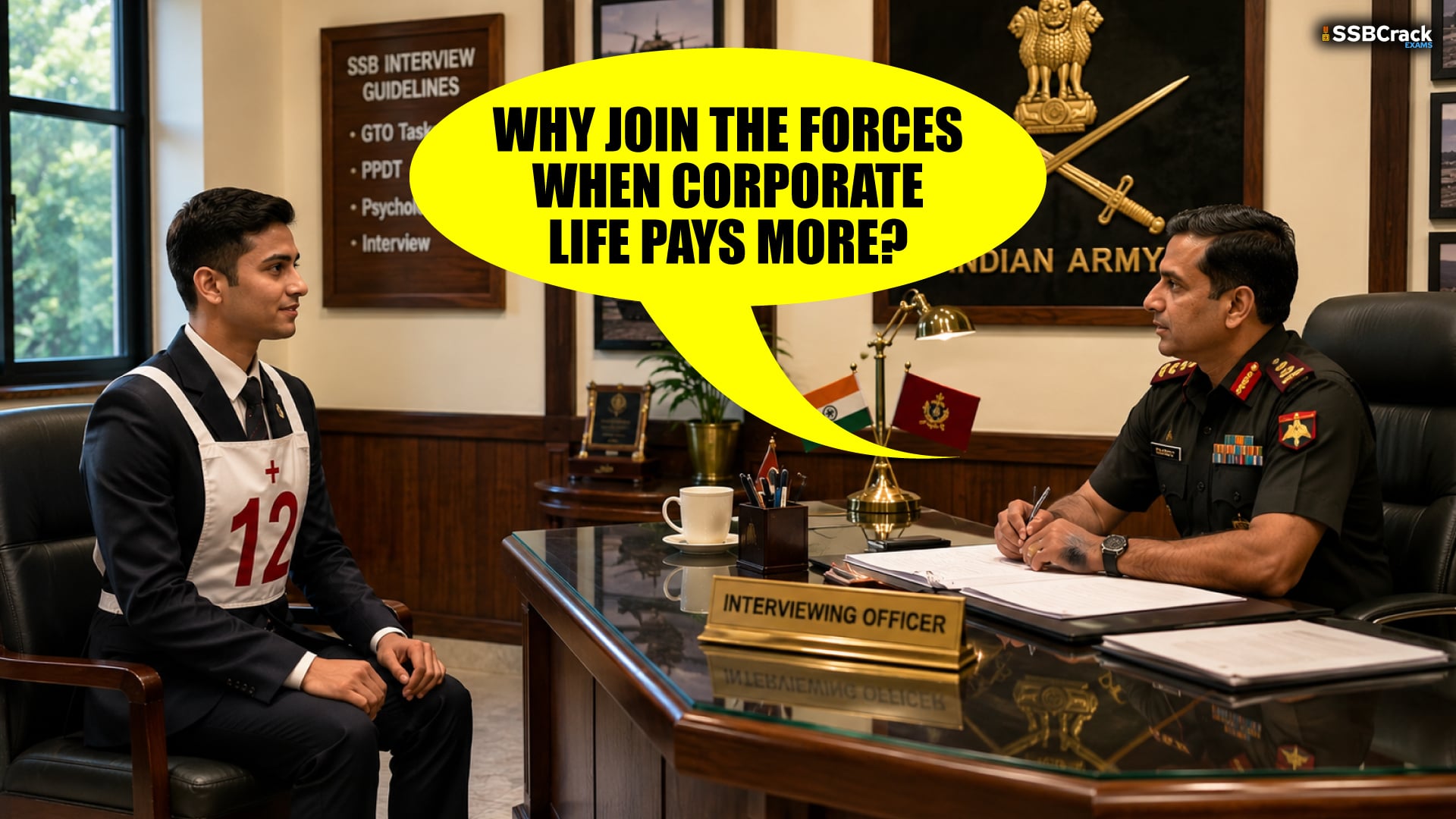
An MBA degree equips candidates with knowledge of management, leadership, strategy, and organizational behavior. However, during the SSB Interview, assessors are not evaluating your ability to manage a business alone; they are assessing whether you possess the qualities required to lead men and women in challenging situations. As an MBA graduate, you can expect questions that explore your leadership philosophy, decision-making ability, ethical standards, teamwork experiences, and career motivations.
The following questions, along with their purpose, answering approach, and sample responses, will help you prepare effectively.
1. Why did you pursue an MBA?
Why It Is Asked
To understand your career planning, interests, and decision-making process.
How to Answer
Explain your motivation clearly and logically while highlighting the skills you gained.
Sample Answer
“Sir, I pursued an MBA to develop my understanding of management, leadership, strategic thinking, and organizational behavior. I wanted to complement my academic background with managerial skills that would help me lead teams effectively and solve complex problems.”
2. After investing time and money in an MBA, why do you want to join the Armed Forces?
Why It Is Asked
To assess your commitment and genuine motivation for joining the military.
How to Answer
Connect your management education with your aspiration to serve and lead.
Sample Answer
“Sir, my MBA enhanced my management and leadership abilities, but my desire to serve the nation and lead people in challenging situations has always been stronger. The Armed Forces offer an opportunity to apply leadership in a meaningful and impactful way.”
3. What is the biggest difference between managing employees and leading soldiers?
Why It Is Asked
To assess your understanding of leadership in different environments.
How to Answer
Highlight responsibility, trust, and mission-oriented leadership.
Sample Answer
“Employees are generally motivated by career growth and incentives, whereas soldiers often operate in high-risk situations where trust, discipline, and commitment to a common mission become crucial. Military leadership demands a greater degree of responsibility and accountability.”
4. Which MBA subject do you think is most relevant to military leadership?
Why It Is Asked
To connect your academic knowledge with military requirements.
How to Answer
Select a subject and justify its relevance.
Sample Answer
“I believe Organizational Behavior is highly relevant because understanding motivation, communication, teamwork, and group dynamics is essential for leading people effectively.”
5. Tell me about a leadership failure you experienced during your MBA.
Why It Is Asked
To assess self-awareness and learning ability.
How to Answer
Focus on the lesson learned rather than the mistake itself.
Sample Answer
“During a group project, I delegated responsibilities but failed to monitor progress adequately. This led to delays in completion. The experience taught me the importance of regular communication, coordination, and follow-up.”
6. If you receive a lucrative corporate offer and a military commission simultaneously, what will you choose?
Why It Is Asked
To evaluate your priorities and sincerity.
How to Answer
Be honest and align your response with your long-term goals.
Sample Answer
“I would choose the Armed Forces because serving the nation while leading people in a challenging environment aligns with my long-term aspirations.”
7. What is one management principle that may not work effectively in military leadership?
Why It Is Asked
To assess critical thinking.
How to Answer
Compare business and military contexts thoughtfully.
Sample Answer
“Highly decentralized decision-making may not always be suitable in combat situations where rapid action, clarity of command, and coordinated execution are critical.”
8. What is more important for a leader: Strategy or Execution?
Why It Is Asked
To understand your leadership perspective.
How to Answer
Acknowledge the importance of both while explaining your reasoning.
Sample Answer
“Both are essential, but execution determines success because even the best strategy is ineffective if it cannot be implemented properly.”
9. During your MBA, what was the most difficult team conflict you handled?
Why It Is Asked
To assess teamwork and conflict-management skills.
How to Answer
Describe the situation, your actions, and the outcome.
Sample Answer
“Two team members disagreed on the project’s direction. I encouraged open discussion, focused attention on our common objectives, and helped the team reach a consensus that improved collaboration.”
10. If your team achieves results through unethical means, how would you respond?
Why It Is Asked
To assess integrity and moral judgment.
How to Answer
Prioritize ethics over short-term gains.
Sample Answer
“I would not support unethical practices. Sustainable success and trust are built on integrity, and compromising ethical standards can have serious long-term consequences.”
11. Which CEO’s leadership style do you admire and why?
Why It Is Asked
To assess leadership awareness and understanding.
How to Answer
Choose a leader whose qualities genuinely inspire you.
Sample Answer
“I admire Satya Nadella because of his emphasis on empathy, innovation, continuous learning, and his ability to transform organizational culture.”
12. If you were commanding a military unit, what management lesson from MBA would you apply first?
Why It Is Asked
To assess practical application of your learning.
How to Answer
Focus on leadership and people management.
Sample Answer
“I would prioritize understanding my team’s strengths and building trust because effective leadership begins with knowing and supporting the people you lead.”
13. What is the biggest leadership challenge facing organizations today?
Why It Is Asked
To evaluate awareness of contemporary issues.
How to Answer
Support your answer with logical reasoning.
Sample Answer
“I believe managing rapid technological change while maintaining employee engagement and adaptability is one of the biggest leadership challenges today.”
14. If you were the CEO of a company losing money, what would be your first step?
Why It Is Asked
To assess decision-making and analytical thinking.
How to Answer
Demonstrate a structured approach.
Sample Answer
“I would first conduct a detailed analysis to identify the root causes of the losses before implementing corrective measures.”
15. Which is harder to manage: Resources, Time, or People?
Why It Is Asked
To understand your leadership perspective.
How to Answer
Choose one and justify your choice.
Sample Answer
“People are the most challenging because individuals have different personalities, expectations, motivations, and emotional responses.”
16. What would your MBA classmates say is your strongest leadership quality?
Why It Is Asked
To assess self-awareness and peer perception.
How to Answer
Provide realistic examples.
Sample Answer
“They would probably describe me as dependable and approachable because I often coordinated team activities and helped resolve conflicts during projects.”
17. If given ₹100 crore to solve one national problem, where would you invest it?
Why It Is Asked
To assess social awareness and priorities.
How to Answer
Think strategically and explain the impact.
Sample Answer
“I would invest in skill development and vocational training because improving employability can contribute significantly to economic growth and self-reliance.”
18. If your subordinates dislike you but respect you, is that acceptable?
Why It Is Asked
To assess your leadership philosophy.
How to Answer
Aim for a balanced perspective.
Sample Answer
“Respect is essential for leadership, but trust and positive relationships are equally important. An effective leader should strive to be respected while remaining approachable.”
19. What is one thing MBA programs do not teach about leadership?
Why It Is Asked
To assess maturity and practical understanding.
How to Answer
Highlight the importance of real-world experience.
Sample Answer
“MBA programs provide valuable frameworks and theories, but real leadership often involves handling uncertainty, emotions, and responsibility under pressure.”
20. Why should we recommend you as an officer candidate?
Why It Is Asked
To assess confidence, self-belief, and suitability.
How to Answer
Summarize your strengths sincerely.
Sample Answer
“Sir, I possess leadership potential, communication skills, adaptability, organizational ability, and a strong desire to serve the nation. I believe these qualities will help me contribute effectively as an officer in the Armed Forces.”
Bonus Out-of-the-Box Questions for MBA Graduates
If your life were a startup, what stage would it currently be in?
This question assesses self-awareness, ambition, and future planning.
If leadership were a product, how would you market yourself?
This evaluates creativity, confidence, and communication skills.
Which is more valuable: A leader’s vision or a leader’s credibility?
This explores your leadership philosophy and priorities.
If your personality were represented through a SWOT Analysis, what would appear in each quadrant?
This tests self-analysis and honesty.
If Officer Like Qualities were shares listed on a stock exchange, which quality would investors buy the most from you?
This reveals confidence and self-perception.
Tips for MBA Graduates Appearing for SSB
- Be prepared to discuss leadership experiences, internships, and group projects.
- Demonstrate practical application of management concepts rather than theoretical knowledge alone.
- Avoid excessive corporate jargon and communicate clearly.
- Showcase ethical decision-making and integrity.
- Relate your MBA learnings to leadership, teamwork, and problem-solving.
- Remember that the assessors are looking for Officer Like Qualities, not corporate executives.
An MBA degree may strengthen your managerial and analytical abilities, but success in the SSB Interview depends on much more than academic qualifications. The assessors are interested in your character, integrity, leadership potential, decision-making ability, and willingness to take responsibility. Use your MBA experiences to demonstrate these qualities, remain authentic in your responses, and focus on showing how you can lead people in challenging situations. Approach the interview with confidence, honesty, and a positive attitude, and you will significantly improve your chances of earning a recommendation. Jai Hind!


