





In Monthly Defence Current Affairs for July 2026, we will see the latest national and international current affairs news. These important current affairs will be beneficial for your upcoming NDA, CDS, CDS OTA, AFCAT, TA, Agniveer Army, Agniveer Navy, Agniveer Air Force, Women Military Police, INET, MNS, ACC exams, SCO, PCSL, CAPF, and SSB interviews, and direct entries for Army, Navy, and Air Force like SSC Tech, TGC, JAG, NCC, TES, 10+2 Cadet. Download a PDF file about current events at the end of this article. Let us now see the Current Affairs.
Monthly Defence Current Affairs July 2026
Major Defence Leadership Appointments
- Lieutenant General Sandeep Jain, AVSM, SM assumed the appointment of Vice Chief of the Army Staff (VCOAS).
- An alumnus of the National Defence Academy (NDA), Lt Gen Sandeep Jain was commissioned into the MAHAR Regiment in June 1988.
- During his nearly 38 years of distinguished service, he has held several important command and staff appointments across diverse operational areas.
- Before becoming the VCOAS, Lt Gen Sandeep Jain served as the General Officer Commanding-in-Chief (GOC-in-C), Southern Command.
- Lieutenant General Rajesh Pushkar, AVSM, VSM assumed charge as the General Officer Commanding-in-Chief (GOC-in-C), Southern Command on 1 July 2026, succeeding Lt Gen Sandeep Jain.
- Lieutenant General Mohit Malhotra, AVSM, SM took over as the General Officer Commanding-in-Chief (GOC-in-C), Southwestern Command.
- Air Marshal Jasvir Singh Mann, AVSM, VSM assumed command as the Air Officer Commanding-in-Chief (AOC-in-C), Southern Air Command on 1 July 2026.
- He was presented with a Ceremonial Guard of Honour at the Headquarters of Southern Air Command on the occasion.
- Air Marshal P.V. Shivanand, AVSM, VM assumed the appointment of Air Officer Commanding-in-Chief (AOC-in-C), Southwestern Air Command on 1 July 2026.
- After taking charge, he paid tribute to the Bravehearts at the Southwestern Air Command War Memorial.
Indian Army Creates Integrated Battle Groups in Major Military Reform
- The Indian Army has initiated one of its most significant organisational reforms by raising five Integrated Battle Groups (IBGs) and one dedicated Fire Support Group (FSG).
- The move is aimed at transforming the Army into a faster, more agile, and technology-driven force capable of responding effectively to future security challenges. The new formations became operational on 1 July 2026 as part of the Army’s ongoing modernisation programme.The first phase of the reform has been implemented under the XVII Mountain Strike Corps, headquartered at Panagarh in West Bengal.
- This corps is primarily responsible for operations along India’s northern border with China.Unlike the traditional structure, where infantry, armour, artillery, engineers, air defence, signals, logistics, and aviation function separately, an IBG integrates these capabilities into a single formation.
- This enables rapid mobilisation, quicker decision-making, and enhanced operational flexibility across different terrains.Each IBG consists of more than 5,000 personnel and includes infantry, armoured units, artillery, engineers, air defence, signals, logistics, and surveillance assets.
- The formations are tailored according to the operational requirements of specific regions, making them suitable for both offensive and defensive operations.A newly introduced Chief Operations Officer, generally of Brigadier rank, will coordinate planning and execution within each IBG, ensuring greater synergy among different combat arms.
- The newly created Fire Support Group (FSG) has been established to provide concentrated and precise long-range firepower to the Integrated Battle Groups.Equipped with advanced artillery systems and precision-strike capabilities, the FSG is expected to significantly improve the Army’s ability to neutralise enemy positions while supporting ground operations.
- Alongside the introduction of IBGs, the Army is also restructuring its formations through initiatives such as Rudra all-arms brigades, Bhairav light commando battalions, Shaktimaan artillery regiments, and Divyastra drone and precision-strike units.
DAC Approves ₹52,000 Crore Defence Modernisation Plan to Strengthen India’s Armed Forces
- In a major boost to India’s defence preparedness, the Defence Acquisition Council (DAC), chaired by Defence Minister Rajnath Singh, granted Acceptance of Necessity (AoN) for several high value defence procurement projects on 3 July 2026. The approvals, valued at approximately ₹52,000 crore, are aimed at enhancing the operational capabilities of the Indian Army, Indian Navy, and Indian Air Force through the induction of advanced indigenous and modern defence systems.
- The decision reflects the government’s continued focus on military modernization, self-reliance under the Aatmanirbhar Bharat initiative, and strengthening India’s preparedness against evolving security challenges across land, sea, and air.
- What is Acceptance of Necessity (AoN)?
- Acceptance of Necessity (AoN) is the first and most important stage in India’s defence procurement process. It is an in-principle administrative approval granted by the Defence Acquisition Council for acquiring military equipment and weapon systems. Once AoN is approved, the concerned procurement agencies begin the detailed acquisition process, including tendering, evaluation, trials, and contract negotiations.
- Major Approvals for the Indian Army
- The DAC approved several advanced weapon systems designed to improve battlefield effectiveness, air defence, and survivability of the Army.
- AKASH TARANG Anti-UAV Electronic Warfare System
- The Army will procure the AKASH TARANG Anti-Unmanned Aerial Vehicle (UAV) Electronic Warfare System, developed to detect, track, jam, and neutralize hostile drones.
- With the growing use of drones in modern warfare, this system will provide reliable protection for military formations and critical installations against aerial threats.
- Man Portable Anti-Tank Guided Missile (MPATGM)
- The MPATGM is an indigenous third-generation anti-tank guided missile that significantly enhances the firepower of infantry units.
- The lightweight missile enables soldiers to engage and destroy enemy tanks and armored vehicles with high precision, strengthening India’s anti-armour capabilities.
- Medium Range Surface-to-Air Missile (MRSAM) System
- The MRSAM Weapon System will improve the Army’s air defence network by intercepting various aerial threats, including aircraft, helicopters, drones, and cruise missiles at medium ranges.
- The system provides layered air defence for vital military assets and operational formations.
- Very Short-Range Air Defence System (V-SHORADS)
- The Army also received approval for procuring Very Short-Range Air Defence Systems (V-SHORADS) equipped with advanced multi-spectral sensors.
- These portable missile systems are designed to engage low-flying aircraft, helicopters, and drones while remaining resistant to electronic countermeasures.
- Active Protection System for Tanks
- Modern battlefields increasingly feature anti-tank guided missiles and loitering munitions. To improve the survivability of armored vehicles, the DAC approved the acquisition of Active Protection Systems (APS) for tanks.
- The system automatically detects incoming projectiles and neutralizes them before impact, significantly increasing battlefield protection.
- Jet-Based Kamikaze Drone System
- The Army will also procure advanced Jet-Based Kamikaze Drones, also known as loitering munitions.
- These drones combine high speed, extended range, electronic warfare capabilities, and precision strike ability, making them effective and cost-efficient weapons for modern combat operations.
- Major Approvals for the Indian Navy
- The Indian Navy received approvals for advanced underwater warfare systems, unmanned aviation, and propulsion technology.
- Multi Influence Ground Mine (MIGM)
- The Navy will induct Multi Influence Ground Mines (MIGM) designed to restrict enemy naval movement.
- These intelligent sea mines respond to multiple signatures such as magnetic, acoustic, and pressure changes, making them difficult to evade and highly effective in protecting strategic maritime areas.
- Naval Shipborne Unmanned Aerial System (NSUAS)
- The DAC also approved the procurement of Naval Shipborne Unmanned Aerial Systems (NSUAS).
- Equipped with sophisticated surveillance sensors, these drones will enhance maritime domain awareness, reconnaissance, target identification, and operational monitoring over vast ocean areas.
- Land-Based Testing Facility (LBTF) for Electric Propulsion
- Approval was granted for establishing a Land-Based Testing Facility (LBTF) dedicated to electric propulsion systems.
- The facility will enable comprehensive testing and validation of motors and propulsion technologies before their integration into future naval platforms, supporting indigenous naval shipbuilding programs.
- Major Approvals for the Indian Air Force
- Fixed-Wing High Altitude Pseudo Satellite (FW-HAPS)
- The Indian Air Force will acquire Fixed-Wing High Altitude Pseudo Satellites (FW-HAPS), a cutting-edge technology that operates in the upper atmosphere for extended durations.
- These platforms function as near-space surveillance assets capable of performing:
- Persistent Intelligence, Surveillance and Reconnaissance (ISR)
- Secure telecommunications
- Remote sensing
- Long-duration monitoring of strategic regions
- Unlike conventional satellites, FW-HAPS can remain over a designated area for prolonged periods while being comparatively economical and flexible.
- Strategic Importance of the DAC Approvals
- The latest approvals represent one of the most significant defence modernization initiatives of 2026. The acquisitions will:
- Strengthen India’s multi-layered air defence capabilities.
- Improve protection against drone and missile threats.
- Enhance the Army’s anti-armour and electronic warfare capabilities.
- Boost maritime surveillance and underwater warfare preparedness.
- Expand long-endurance intelligence and reconnaissance capabilities.
- Increase the survivability of tanks and frontline military assets.
- Promote indigenous defence manufacturing under the Aatmanirbhar Bharat initiative.
Adani Defence to Invest ₹2,500 Crore in Missile Manufacturing Complex
- In a major boost to India’s indigenous defence manufacturing capabilities, Adani Defence & Aerospace has announced an investment of ₹2,500 crore to establish an integrated missile manufacturing complex in Shivpuri district, Madhya Pradesh. The project is expected to become South Asia’s largest private-sector missile manufacturing ecosystem, further strengthening India’s vision of self-reliance in the defence sector.
- Foundation Stone Laid
- The foundation stone for the project was laid on 5 July 2026 in the presence of Madhya Pradesh Chief Minister Mohan Yadav, Union Minister Jyotiraditya Scindia, and senior representatives of the Adani Group. The facility marks the first major project under the state’s emerging defence manufacturing ecosystem and is expected to transform Shivpuri into an important defence production hub.
- Key Features of the Project
- The advanced manufacturing complex will include:
- A modern missile manufacturing facility.
- A composite propellant production unit.
- A Trinitrotoluene (TNT) manufacturing complex.
- A fully integrated defence production ecosystem from raw materials to mission-ready missile systems.
- The integrated model will create one of India’s first large-scale, backward-integrated private missile manufacturing facilities, reducing dependence on imported defence components.
- Employment Generation
- The project is expected to generate around 5,000 direct and indirect employment opportunities over the next three years. It will also encourage the growth of local Micro, Small and Medium Enterprises (MSMEs), enabling them to become part of India’s defence manufacturing supply chain.
- Contribution to Aatmanirbhar Bharat
- The investment supports the Government of India’s flagship initiatives of Aatmanirbhar Bharat and Make in India, aimed at strengthening indigenous defence production and reducing dependence on foreign suppliers.
- By establishing advanced manufacturing capabilities within the country, the project is expected to enhance India’s strategic autonomy while supporting the Armed Forces with domestically manufactured defence systems.
- Strategic Importance
- The missile manufacturing ecosystem is expected to:
- Strengthen India’s indigenous missile production capacity.
- Enhance the country’s defence industrial base.
- Promote private-sector participation in defence manufacturing.
- Develop Madhya Pradesh as an emerging defence production hub.
- Support exports of indigenously manufactured defence equipment in the future.
- The project also reflects the increasing role of the private sector in India’s defence modernisation programme.
Undersea Cable Network for Submarine Detection
- Bharat is moving to plant eyes and ears on the Indian Ocean seabed. DRDO has kicked off the hunt for an industry partner to develop and deploy an Underwater Fiber Optic Sensing System a fixed network of undersea sensors that will keep round-the-clock watch on submarines prowling India’s waters.
- The Kochi-based Naval Physical and Oceanographic Laboratory (NPOL), DRDO’s premier underwater warfare lab, has floated an expression of interest (EOI) to identify a “lead system integrator” for the turnkey development, supply, transportation, deployment and commissioning of the system.
- The network will comprise seabed sensor nodes linked by subsea fibre-optic cables to a shore station where the data will be received, monitored and analysed.
- The move comes with the undersea battlespace in the Indian Ocean Region (IOR) getting increasingly contested.
- Chinese nuclear and conventional submarines periodically prowl the IOR, while Chinese survey and “research” vessels systematically map the region’s waters, data invaluable for future submarine operations.
- Pakistan, in turn, has also begun inducting eight Chinese-origin Hangor-class diesel-electric submarines with air-independent propulsion (AIP), the first of which has already been launched.
- The concept has well-established precedents. During the Cold War, the United States deployed the Sound Surveillance System (SOSUS), a network of seabed-mounted hydrophone arrays connected by undersea cables to detect and track Soviet submarines.
- The US and Japan later expanded similar underwater surveillance architecture across the western Pacific to monitor Chinese submarine movements, while China has built its own “underwater Great Wall” of seabed acoustic sensors in the South China Sea.
- According to the EOI, the UFOSS will comprise underwater “wet-plant” systems including sensor array nodes, subsea fibre-optic cables, junction boxes and branching units linked through a beach manhole to a shore station.
- The selected integrator will be responsible for the entire project, from integration and deployment to commissioning, one year of operations and lifecycle support for the system’s planned 20-year service life. Execution has been tentatively pegged at 48 months.
- The proposals for this project are due by September 1, with consortiums of up to five companies besides the lead bidder allowed to pool specialised capabilities.
- Bidders will also need proven expertise across subsea cable manufacturing and deployment, underwater systems, marine surveys, system integration and shore monitoring stations, backed by assets like dedicated cable-laying ships, remotely operated vehicles (ROVs) and cable burial ploughs.
‘The Octagon’ – World’s Largest Military HQ
- Egypt has officially inaugurated its new State Strategic Command Headquarters, popularly known as “The Octagon“, marking a significant milestone in the country’s military modernization programme.
- Located in Egypt’s New Administrative Capital, the massive defence complex is now regarded as the world’s largest military headquarters by land area, surpassing the size of the Pentagon in the United States.
- Why is it Called “The Octagon”?
- The headquarters derives its name from its distinctive architectural design. The complex consists of eight interconnected octagonal buildings arranged around two central command structures.This layout symbolizes integrated military command while combining traditional Egyptian architectural elements with modern defence infrastructure.
- Size and Scale
- The Octagon covers nearly 22,000 acres, making it approximately 750 times larger than the Pentagon’s main building footprint. It also provides more than 50 million square feet of built-up space and includes 13 strategic and logistical zones, making it one of the largest defence administrative complexes in the world.
- Advanced Military Capabilities
- The headquarters has been designed as a fully integrated command centre equipped with advanced Command, Control, Communications, Computers and Intelligence (C4I) systems along with Artificial Intelligence-enabled technologies.
- These capabilities are intended to improve:Real-time operational coordinationFaster Military DecisionSecure communication across all armed forcesIntelligence sharing among defence agenciesEfficient crisis and emergency managementPart of Egypt’s New Administrative Capital
- The Octagon forms an important component of Egypt’s ambitious New Administrative Capital project, which aims to relocate several key government institutions from Cairo to a newly developed city.
India And Indonesia Sign BrahMos and Astra Deal
- Prime Minister Narendra Modi’s state visit to Indonesia has marked a significant milestone in bilateral relations, with the signing of more than eight agreements across defence, technology, health, education, and cultural cooperation.
- The centrepiece of these accords was the long-anticipated BrahMos missile deal, which firmly positions Indonesia as a key partner in India’s expanding coastal missile deployment network across Southeast Asia.
- Alongside this, India agreed to supply ASTRA air-to-air missile systems under a new arrangement between Bharat Dynamics and Indonesia’s Republic Corps, further strengthening defence interoperability.
- The agreements extended well beyond defence. A framework on maritime safety and security was finalised, reflecting the shared priority of safeguarding sea lanes in the Indo-Pacific.
- The ongoing multi-nation tour, which includes Australia and New Zealand, is firmly aligned with India’s Act East Policy and the MAHASAGAR Vision, reinforcing New Delhi’s commitment to a free and open Indo-Pacific.
- Astra Missile
- Indigenous Beyond Visual Range Air-to-Air Missile (BVRAAM) developed by the DRDO.
- Designed to engage enemy aircraft before they come within visual range.
- Equipped with an active radar seeker for terminal guidance.
- Integrated with the Sukhoi Su-30MKI and being integrated with the HAL Tejas.
- BrahMos Missile
- World’s fastest operational supersonic cruise missile.
- Developed through a joint venture between India and Russia.
- Can be launched from land, sea, submarines, and air platforms.
- Capable of flying at very low altitudes to evade enemy radar.
- Widely deployed by the Indian Army, Navy, and Air Force.
India & France Launch First JWG On Critical Minerals Cooperation
- France and India have formally launched their first Joint Working Group (JWG) on Critical Minerals in New Delhi, co-chaired by Benjamin Gallezot and Kadam Sandeep Vasant, marking a major step in building resilient supply chains for rare earths and strategic minerals.
- This initiative directly supports both nations’ ambitions in clean energy, advanced manufacturing, and technological sovereignty.
- France’s Inter-Ministerial Delegate for Strategic Minerals and Metals Supplies, Benjamin Gallezot, visited New Delhi on 6–7 July, accompanied by Olivier Frezot, Regional Director for Asia at the Bureau of Geological and Mining Research (BRGM), the French Geological Survey.
- The discussions focused on strengthening bilateral cooperation in exploration, processing, and recycling of critical minerals and rare earth elements, with the aim of building resilient and sustainable supply chains.
- The exchanges enabled both nations to identify shared interests and outline collaborative projects in France, India, and other strategic countries.
- BRGM and the Geological Survey of India, which already share a long-standing partnership, participated actively and identified new avenues for joint work to enhance knowledge across the entire critical minerals value chain.
- The visit builds upon the France–India Joint Declaration of Intent on Cooperation in Critical Minerals, signed during President Emmanuel Macron’s visit to India in February 2026.
- This declaration provides a framework for closer cooperation in exploration, mining, research and innovation, diversification of value chains, supply chain resilience, and circularity.
- What are Critical Minerals?
- Critical minerals are naturally occurring minerals that are essential for a country’s economic growth, national security, energy transition, and advanced technologies, but whose supply is at risk due to limited availability, import dependence, or concentration of production in a few countries.
- These minerals are called “critical” because a disruption in their supply can significantly affect industries such as defence, electronics, renewable energy, electric vehicles, and telecommunications.
- Why are Critical Minerals Important?
- National Security: Used in missiles, fighter aircraft, submarines, radars, satellites, and other defence systems.
- Clean Energy: Essential for solar panels, wind turbines, electric vehicles (EVs), and battery storage.
- Electronics: Required for smartphones, laptops, semiconductors, and communication equipment.
- Economic Growth: Crucial for manufacturing, high-tech industries, and industrial development.
- Examples of Critical Minerals
| Mineral | Major Uses |
| Lithium | EV batteries, energy storage |
| Cobalt | Rechargeable batteries, aerospace |
| Nickel | Batteries, stainless steel |
| Graphite | Battery anodes, lubricants |
| Rare Earth Elements (Neodymium, Dysprosium, etc.) | Magnets, wind turbines, missiles, electronics |
| Copper | Electric wiring, renewable energy, EVs |
| Silicon | Semiconductors, solar panels |
| Titanium | Aircraft, naval vessels, medical implants |
| Tungsten | Defence equipment, cutting tools |
| Gallium | Semiconductors, 5G, radar systems |
Ugram Indigenous Assault Rifle Clears Army Trials
- The Ugram is an indigenous 7.62×51mm assault rifle developed in India by the Armament Research and Development Establishment, a laboratory of the DRDO and Dvipa Defence India Private Limited.
- It cleared the Indian Army’s General Staff Qualitative Requirement trials and the Ministry of Home Affairs Board trials in July 2026.
- The rifle is expected to be procured by Central Armed Police Forces in India. These include the Central Reserve Police Force, Indo-Tibetan Border Police, Sashastra Seema Bal, and National Security Guard.
- The General Staff Qualitative Requirement, or GSQR, is the technical and operational standard used by the Indian Army for equipment trials.
- The Ministry of Home Affairs oversees several Central Armed Police Forces, including the CRPF, ITBP, SSB, and NSG.
- The INSAS rifle is a 5.56mm service rifle that has been used by Indian security forces since the 1990s.
- Atmanirbhar Bharat is a Government of India initiative linked with domestic manufacturing and reduced import dependence.
Global Air Power Rankings 2026
- The Indian Air Force (IAF) has once again demonstrated its growing operational strength by retaining its position as the world’s third most powerful air force in the 2026 Global Air Power Rankings released by the World Directory of Modern Military Aircraft (WDMMA). This marks the fifth consecutive year that the IAF has secured the third position, highlighting its consistent modernization and combat capability. Notably, the IAF has been ranked ahead of China’s People’s Liberation Army Air Force (PLAAF), reinforcing India’s strategic air power in the Indo-Pacific region.
- About the WDMMA Global Air Power Rankings
- The World Directory of Modern Military Aircraft (WDMMA) publishes annual rankings that evaluate the strength of military air forces across the globe. Rather than relying solely on the number of aircraft, the assessment considers several factors, including:
- Fleet quality and technological capability
- Combat readiness
- Modernization and future acquisition plans
- Aircraft diversity and operational effectiveness
- Overall force structure and strategic capability
- This comprehensive evaluation provides a more accurate picture of an air force’s operational strength than aircraft numbers alone.
- India’s Performance in the 2026 Rankings
- According to the latest rankings:
- The Indian Air Force retained the third position among national air forces for the fifth consecutive year.
- The IAF continues to rank ahead of China’s PLAAF.
- In the broader ranking of all military aviation branches (including separate U.S. military air arms), the IAF is placed sixth globally.
- The ranking reflects India’s growing emphasis on quality, modernization, and operational capability rather than numerical superiority.
- Factors Behind India’s Strong Ranking
- Several factors have contributed to the IAF’s continued high ranking:
- Modern Fighter Fleet
- The IAF operates a diverse fleet that includes:
- Rafale multirole fighter aircraft
- Su-30MKI heavy fighters
- Mirage-2000
- MiG-29 upgraded variants
- LCA Tejas light combat aircraft
- Indigenous Modernization
- India is steadily increasing the use of indigenous defence technologies through programmes such as:
- LCA Tejas induction
- Advanced radar and missile systems
- Indigenous electronic warfare capabilities
- Expansion of domestic aerospace manufacturing
- Operational Experience
- The IAF possesses extensive operational experience gained through:
- High-altitude operations
- Joint military exercises
- Humanitarian Assistance and Disaster Relief (HADR) missions
- Integrated operations with the Army and Navy
- Future Capability Enhancement
- Several planned acquisitions and modernization projects are expected to further strengthen the IAF in the coming years, including new fighter aircraft, advanced unmanned systems, force multipliers, and indigenous defence platforms.
- Importance for India
- The ranking reflects India’s increasing capability to safeguard its airspace and respond to evolving security challenges. A strong air force enhances:
- National security
- Strategic deterrence
- Regional stability
- Disaster response capability
- International defence cooperation
- It also strengthens India’s position as a major military power in the Indo-Pacific region.
INS Mahendragiri Commissioned With Rolls-Royce MTU Engines
- The Indian Navy has commissioned INS Mahendragiri (F38), the sixth Project 17A Nilgiri-class stealth frigate, into its Eastern Fleet at Visakhapatnam on 11 July 2026. The commissioning ceremony was presided over by Defence Minister Rajnath Singh, who described the warship as a symbol of India’s growing self-reliance in defence manufacturing. With over 75% indigenous content, INS Mahendragiri significantly enhances India’s maritime combat capability and supports the vision of Aatmanirbhar Bharat.
- About INS Mahendragiri
- INS Mahendragiri is an advanced guided-missile stealth frigate built under Project 17A, an upgraded version of the Shivalik-class frigates. The ship has been designed by the Indian Navy’s Warship Design Bureau and constructed by Mazagon Dock Shipbuilders Limited (MDL), Mumbai. It is the sixth ship commissioned under the seven-vessel Project 17A programme.
- Key Features
- Class: Project 17A Nilgiri-class Stealth Frigate
- Pennant Number: F38
- Length: Approximately 149 metres
- Displacement: Around 6,670 tonnes
- Indigenous Content: More than 75%
- Builder: Mazagon Dock Shipbuilders Limited (MDL)
- Designed by: Indian Navy’s Warship Design Bureau
- Fleet: Eastern Fleet
- The warship incorporates advanced stealth technologies that reduce its radar, infrared, and acoustic signatures, making it difficult for enemy sensors to detect. It is equipped with modern sensors, electronic warfare systems, integrated platform management systems, and advanced weapon systems capable of performing multiple naval missions.
- Combat Capabilities
- INS Mahendragiri is designed to undertake a wide range of operations, including:
- Anti-air warfare
- Anti-surface warfare
- Anti-submarine warfare
- Maritime surveillance
- Escort operations
- Fleet air defence
- Its modern combat management system enables simultaneous engagement of multiple threats while operating in challenging maritime environments.
- Project 17A Programme
- Project 17A is one of India’s flagship indigenous warship-building programmes aimed at strengthening the Indian Navy with next-generation stealth frigates.
- The seven ships under Project 17A are:
- INS Nilgiri
- INS Himgiri
- INS Udaygiri
- INS Taragiri
- INS Dunagiri
- INS Mahendragiri
- INS Vindhyagiri
- These warships feature improved stealth characteristics, enhanced automation, advanced sensors, and superior combat capability compared to the earlier Project 17 frigates.
- Significance
- The commissioning of INS Mahendragiri is a major milestone for India’s maritime security and indigenous defence industry. The warship:
- Strengthens the operational capability of the Indian Navy.
- Enhances India’s presence in the Indian Ocean Region (IOR).
- Supports the goal of building a 200-ship Navy in the coming decade.
- Demonstrates the success of India’s indigenous warship design and construction capabilities.
- Promotes the vision of Aatmanirbhar Bharat by reducing dependence on foreign defence imports.
Indian Navy Strengthens Maritime Capability with Another MH-60R Seahawk Helicopter
- The Indian Navy has further strengthened its maritime aviation fleet with the induction of another MH-60R Seahawk helicopter at Kochi, increasing the number of operational helicopters to 21 out of the 24 ordered from the United States. The remaining three helicopters are expected to be delivered by the end of 2026, completing the procurement programme.
- The MH-60R Seahawk, manufactured by Lockheed Martin, is one of the world’s most advanced multi-role naval helicopters. It is designed to perform a wide range of missions, including anti-submarine warfare (ASW), anti-surface warfare (ASuW), search and rescue operations, maritime surveillance, and special operations support. These capabilities significantly enhance the operational effectiveness of the Indian Navy in safeguarding the country’s maritime interests.
- India signed the agreement to procure 24 MH-60R helicopters in February 2020 under the United States Foreign Military Sales (FMS) Programme at an estimated cost of USD 2.6 billion. The helicopters were acquired to improve the Navy’s shipborne aviation capability and strengthen anti-submarine operations in the Indian Ocean Region.
- The helicopter fleet was formally inducted into INAS 334 at INS Garuda, Kochi, in March 2024. To ensure long-term operational readiness, India also signed a ₹7,995 crore sustainment package in December 2025 covering maintenance, spare parts, logistics, and technical support.
- With India’s expanding naval fleet, the requirement for multi-role helicopters continues to increase. The Navy is therefore considering an additional procurement, with the long-term requirement estimated to exceed 100 helicopters. The continued induction of MH-60R helicopters will play a vital role in enhancing maritime security, anti-submarine capabilities, and overall naval preparedness.
Indian Air Force Participates in Exercise Pitch Black 2026
- The Indian Air Force (IAF) has deployed its contingent to Australia for participation in Exercise Pitch Black 2026, the Royal Australian Air Force’s premier biennial multinational air combat exercise. The exercise will be conducted from 20 July to 7 August 2026 in northern Australia and aims to enhance cooperation among participating air forces.
- The Indian contingent includes four Rafale fighter aircraft, two C-17 Globemaster transport aircraft, and more than 120 Air Warriors. Their participation demonstrates India’s growing commitment to international military cooperation and operational interoperability.
- Exercise Pitch Black 2026 will involve around 100 aircraft, over 2,500 military personnel, and participation from 20 nations. Countries taking part include the United States, Japan, India, France, Germany, Singapore, Indonesia, South Korea, Thailand, Spain, Papua New Guinea, and several others.
- The exercise provides valuable opportunities for participating forces to conduct complex air combat training, improve interoperability, exchange operational experiences, and strengthen defence partnerships. Since its inception in 1983, Exercise Pitch Black has become one of the world’s most significant multinational air warfare exercises.
INS Malvan: Indian Navy Inducts Submarine Hunter
- INS Malvan: Indian Navy Inducts Indigenous Submarine Hunter to Strengthen Coastal Defence
- Introduction
- The Indian Navy has further strengthened its maritime security capabilities with the induction of INS Malvan, the second Mahe-class Anti-Submarine Warfare Shallow Watercraft (ASW-SWC). Commissioned on 22 July 2026, the warship has been designed specifically to detect, track, and counter enemy submarines operating in India’s coastal waters. The induction of INS Malvan comes at a time when underwater activity in the Indian Ocean Region (IOR) is increasing, making anti-submarine warfare one of the Indian Navy’s highest operational priorities. The vessel also reflects India’s growing emphasis on Aatmanirbhar Bharat through indigenous warship design and construction.
- Background
- The Indian Ocean has become an increasingly strategic region due to expanding naval deployments by several countries. The growing presence of conventional and nuclear-powered submarines has created new security challenges for India, particularly around its coastline, ports, island territories, and vital sea lanes of communication.
- To enhance coastal defence, the Indian Navy launched the Anti-Submarine Warfare Shallow Watercraft (ASW-SWC) Programme, under which 16 indigenous vessels are being built. These ships are intended to operate alongside larger destroyers, frigates, maritime patrol aircraft, and submarines, creating a multi-layered anti-submarine defence network. INS Malvan is the second vessel of this new generation of submarine hunters.
- About INS Malvan
- INS Malvan belongs to the Mahe-class Anti-Submarine Warfare Shallow Watercraft and has been constructed by Cochin Shipyard Limited (CSL), Kochi. The vessel incorporates over 80% indigenous content, demonstrating India’s increasing capability in designing, constructing, and integrating advanced naval platforms domestically.
- The ship derives its name from Malvan, the historic coastal town in Maharashtra closely associated with the maritime legacy of Chhatrapati Shivaji Maharaj. It also continues the legacy of the earlier INS Malwan, which served the Indian Navy until 2003.
- Key Features of INS Malvan
- Dedicated Anti-Submarine Warfare Platform
- INS Malvan has been specially designed to detect and neutralise hostile submarines operating in shallow coastal waters. Unlike larger warships built for multiple missions, its primary role is underwater surveillance and anti-submarine operations.
- Advanced Sensors and Sonar
- The vessel is equipped with modern sonar systems capable of locating submarines and underwater intruders. These sensors enable early detection, continuous tracking, and effective engagement of underwater threats.
- Anti-Submarine Weapons
- The warship carries specialised anti-submarine weapons, including lightweight torpedoes and rocket systems, enabling it to engage hostile submarines at close range during coastal defence missions.
- Stealth and Propulsion
- INS Malvan incorporates several stealth technologies to reduce its detectability during operations.
- Its design features include:
- Reduced radar cross-section
- Low acoustic signature
- Reduced infrared signature
- The vessel is powered by three 6 MW marine diesel engines coupled with water-jet propulsion, making it one of the largest Indian Navy warships to employ pump-jet technology. This propulsion system provides excellent manoeuvrability, especially in shallow waters, while reducing underwater noise that could reveal the ship’s position. It can achieve a maximum speed of about 25 knots, has an operational range of approximately 1,800 nautical miles at 14 knots, and an endurance of around 14 days.
- Role in Coastal Security
- INS Malvan has been designed primarily for operations in India’s littoral waters, where enemy submarines may attempt to operate close to ports, naval bases, and strategic coastal infrastructure.
- Its operational roles include:
- Detection of hostile submarines
- Protection of naval bases and ports
- Coastal surveillance
- Escort of naval assets
- Underwater reconnaissance
- Maritime security operations
- Protection of critical Sea Lines of Communication (SLOCs)
- The ship complements larger naval platforms by strengthening India’s anti-submarine warfare capability in areas where larger warships may have operational limitations.
- Contribution to Aatmanirbhar Bharat
- INS Malvan represents another important achievement under India’s Aatmanirbhar Bharat initiative. The project demonstrates the country’s ability to design and build sophisticated warships using indigenous technologies and industrial capabilities.
- Several Indian defence companies, including Bharat Electronics Limited (BEL), Larsen & Toubro (L&T), and Mahindra Defence, have contributed to the programme by supplying critical systems and equipment. The high indigenous content reduces dependence on foreign suppliers while strengthening India’s domestic defence manufacturing ecosystem.
- Strategic Importance
- The induction of INS Malvan comes amid increasing submarine deployments by regional navies in the Indian Ocean Region. As underwater warfare becomes more significant, specialised anti-submarine vessels provide an effective and economical means of protecting coastal waters and strategic maritime assets.
- The Mahe-class ASW-SWC programme will significantly improve the Indian Navy’s layered maritime defence architecture by working in coordination with:
- P-8I maritime patrol aircraft
- MH-60R anti-submarine helicopters
- Surface combatants
- Conventional submarines
- Integrated coastal surveillance systems
- Together, these assets enhance India’s ability to monitor, deter, and respond to underwater threats across the Indian Ocean Region.
- (Advanced Medium Combat Aircraft), Ghatak UCAV, and CATS Warrior.
Captain Shivani Becomes First-Ever Woman Aide-de-Camp to Chief of Army Staff
- Captain Shivani has created history by becoming the first-ever woman officer to be appointed as the Aide-de-Camp (ADC) to the Chief of the Army Staff (COAS), General Dhiraj Seth.
- Her appointment marks a significant milestone in the Indian Army’s evolving journey towards greater inclusion and expanding leadership opportunities for women officers, while reaffirming the institution’s enduring emphasis on merit, excellence and professionalism.
- The prestigious appointment places Captain Shivani among a select group of officers entrusted with one of the most distinguished responsibilities in military service.
- The Indian Army’s approach towards expanding opportunities for women officers has consistently been guided by the principles of merit, capability and professional excellence.
- Captain Shivani’s selection for this prestigious assignment exemplifies this institutional commitment and reinforces the Army’s emphasis on recognising talent and dedication irrespective of gender.
DRDO Successfully Conducts Maiden Flight-Test of ‘Kusha’
- India has achieved another milestone in strengthening its indigenous air defence capabilities with the successful maiden flight-test of the ‘Kusha’ Long-Range Surface-to-Air Missile (LR-SAM). The Defence Research and Development Organisation (DRDO) carried out the test on 23 July 2026 from Dr. A.P.J. Abdul Kalam Island off the coast of Odisha. The successful trial demonstrates India’s growing expertise in developing advanced missile systems capable of protecting the country’s airspace against modern aerial threats.
- During the test, the missile was launched against an electronic target designed to imitate a fast-moving, high-altitude aerial threat. The missile successfully tracked and destroyed the target, validating the effectiveness of the weapon system under realistic operational conditions.
- The Kusha missile system has been designed to engage multiple types of aerial threats, including fighter aircraft, cruise missiles, unmanned aerial vehicles (UAVs), and large enemy aircraft over a wide range of distances and altitudes. Such capabilities significantly enhance India’s layered air defence network.
- An important feature of the project is that all major components, including the missile, radar systems, command-and-control centre, and other weapon system elements, have been developed by various DRDO laboratories in collaboration with Indian industry partners. This reflects the success of the country’s policy of promoting indigenous defence manufacturing under the Aatmanirbhar Bharat initiative.
- Defence Minister Rajnath Singh described the successful test as a landmark achievement for India’s defence research and development sector. He stated that the development of a long-range surface-to-air missile system places India among a select group of nations possessing such advanced technology. The project is also expected to reduce dependence on imported air defence systems while significantly strengthening national security.
- Key Points
- Organisation: Defence Research and Development Organisation (DRDO)
- Missile: Kusha Long-Range Surface-to-Air Missile
- Test Date: 23 July 2026
- Test Site: Dr. A.P.J. Abdul Kalam Island, Odisha
- Capability: Intercepts aircraft, missiles, UAVs and other aerial threats
- Significance: Boosts indigenous air defence capability and reduces import dependence.
India Plans to Commission Five Small Modular Reactors by 2033
- India has announced an ambitious plan to commission at least five indigenous Small Modular Reactors (SMRs) by 2033, marking a significant step towards expanding the country’s clean energy capacity. The first SMR project will be established at Tarapur in Maharashtra, reflecting India’s commitment to developing advanced nuclear energy technologies.
- The initiative is supported by a ₹20,000 crore allocation under the Nuclear Energy Mission. The long-term objective is to increase India’s nuclear power generation capacity to 100 GW by 2047, thereby reducing dependence on fossil fuels and supporting sustainable economic growth.
- The Bhabha Atomic Research Centre (BARC) is leading the development of three indigenous reactor designs: the 220 MW Bharat Small Modular Reactor, a 55 MW reactor, and a high-temperature gas-cooled reactor intended for hydrogen production. These designs have received in-principle approval from the Atomic Energy Commission.
- The Government also plans to increase India’s installed nuclear capacity from the current 8.8 GW to 22 GW by 2031–32. The Nuclear Power Corporation of India Limited (NPCIL) is expected to contribute 50 GW, while NTPC aims to develop an additional 30 GW of nuclear capacity.
- Globally, countries such as the United States, Russia, and South Korea are actively developing Small Modular Reactors. These compact reactors are considered suitable for providing clean and reliable electricity to industries, especially where decentralised power generation is required.
- India’s focus on indigenous reactor technology and domestic manufacturing is expected to enhance energy security while supporting the country’s transition towards low-carbon energy sources.
- Key Points
- Target: Five indigenous SMRs by 2033
- First Site: Tarapur, Maharashtra
- Mission Allocation: ₹20,000 crore
- Lead Organisation: Bhabha Atomic Research Centre (BARC)
- Long-term Goal: 100 GW nuclear capacity by 2047
- Importance: Clean energy, energy security, and indigenous nuclear technology.
Indian Navy Sailors Have Become The First-ever Indian Women Épée Fencers
- Taniksha Khatri and Prachi Lohan etched their names into Indian fencing history by becoming the first Indian women’s épée fencers to qualify for the Main Table of 64 at the Senior World Fencing Championships, marking a breakthrough moment for the sport on the opening day of the 2026 edition at the Asia World-Expo in Hong Kong.
- Competing in the qualification rounds of the Women’s Individual Épée event, the two Indians progressed through a highly competitive field after negotiating the round-robin pool stage and preliminary direct elimination bouts to secure places in the main draw.
- Their achievement marks the first time Indian women épée fencers have reached the Main Table of 64 at the prestigious global championship.
- The nine-day competition has brought together more than 1,000 fencers from over 100 countries. India has fielded a 24-member contingent comprising 12 men and 12 women across foil, épée and sabre disciplines.
Indian Navy Launches Machilipatnam, Seventh ASW Shallow Water Craft
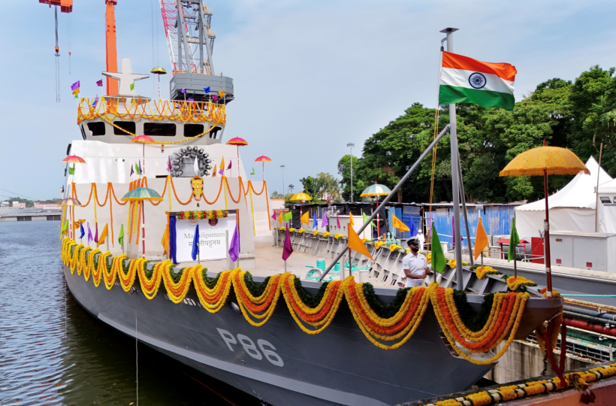
- The Indian Navy launched Machilipatnam (BY 529), the seventh Anti-Submarine Warfare Shallow Water Craft (ASW SWC), on 29 July 2026. The vessel has been built by Cochin Shipyard Limited (CSL) and represents another milestone in India’s indigenous naval shipbuilding programme under the Aatmanirbhar Bharat initiative.
- Background
- The ship derives its name from the historic port city of Machilipatnam in Andhra Pradesh, which has long been associated with India’s maritime trade and cultural heritage.
- The ASW SWC programme aims to strengthen the Navy’s coastal defence and anti-submarine warfare capabilities in the Indian Ocean Region.
- Key Highlights
- Machilipatnam has been designed to perform multiple operational roles, including:
- Underwater surveillance
- Anti-Submarine Warfare (ASW)
- Low Intensity Maritime Operations (LIMO)
- Mine warfare operations
- The vessel incorporates more than 80% indigenous content, demonstrating the growing capabilities of India’s defence manufacturing sector.
- Significance
- The launch enhances the Indian Navy’s ability to detect and counter underwater threats while promoting indigenous shipbuilding. It also contributes to strengthening maritime security and safeguarding India’s strategic interests in the Indian Ocean Region.
- Key Points
- Ship: Machilipatnam (BY 529)
- Builder: Cochin Shipyard Limited
- Type: Anti-Submarine Warfare Shallow Water Craft (ASW SWC)
- Indigenous Content: Over 80%
- Major Roles: ASW, underwater surveillance, LIMO, mine warfare
Review Questions
- The Indian Army recently operationalised five Integrated Battle Groups (IBGs) and
one Fire Support Group under which Corps?
A. I Corps
B. II Corps
C. XIV Corps
D. XVII Mountain Strike Corps
Answer: D - What is the primary objective of an Integrated Battle Group (IBG)?
A. Increase administrative staff
B. Conduct only peacekeeping operations
C. Enable rapid, self-contained and integrated combat operations
D. Replace the Indian Air Force in border operations
Answer: C - Which of the following is NOT typically an integral component of an Integrated
Battle Group (IBG)?
A. Infantry
B. Artillery
C. Engineers
D. Merchant Navy
Answer: D - The Defence Acquisition Council (DAC) approved defence acquisition proposals
worth approximately how much on 3 July 2026?
A. ₹25,000 crore
B. ₹40,000 crore
C. ₹52,000 crore
D. ₹75,000 crore
Answer: C. ₹52,000 crore
Explanation: The DAC, chaired by Defence Minister Rajnath Singh, granted Acceptance
of Necessity (AoN) for defence procurement proposals worth about ₹52,000 crore. - Which indigenous system approved by the DAC is designed to counter enemy
drones?
A. MRSAM
B. MPATGM
C. AKASH TARANG
D. V-SHORADS
Answer: C. AKASH TARANG
Explanation: AKASH TARANG is an Anti-Unmanned Aerial Vehicle (UAV) Electronic
Warfare System developed to detect, jam, and neutralize hostile drones. - The Man Portable Anti-Tank Guided Missile (MPATGM) is primarily intended to
destroy:
A. Fighter aircraft
B. Enemy tanks and armoured vehicles
C. Naval warships
D. Ballistic missiles
Answer: B. Enemy tanks and armoured vehicles
Explanation: MPATGM is a portable indigenous missile system that enhances the
infantry’s capability to eliminate mechanised threats. - The proposed Adani investment in the missile manufacturing complex is:
A) ₹1,000 crore
B) ₹1,500 crore
C) ₹2,000 crore
D) ₹2,500 crore
Answer: D) ₹2,500 crore
Explanation: Adani Defence has announced an investment of ₹2,500 crore. - INS Mahendragiri (F38), scheduled to be commissioned on 11 July 2026, belongs
to which class of warships?
A) Project 15B Destroyer
B) Project 17A Stealth Frigate
C) Project 75 Submarine
D) Nilgiri-class Corvette
Answer: B) Project 17A Stealth Frigate - INS Mahendragiri has been named after which geographical feature of India?
A) Aravalli Hills
B) Vindhya Range
C) Mahendragiri Mountain Range in the Eastern Ghats
D) Satpura Hills
Answer: C) Mahendragiri Mountain Range in the Eastern Ghats - Which organization designed INS Mahendragiri, and which shipyard built it?
A) DRDO and Cochin Shipyard Limited
B) Warship Design Bureau (Indian Navy) and Mazagon Dock Shipbuilders Limited
C) HAL and Garden Reach Shipbuilders & Engineers
D) Bharat Electronics Limited and Goa Shipyard Limited
Answer: B) Warship Design Bureau (Indian Navy) and Mazagon Dock Shipbuilders
Limited - The Octagon, recently seen in the news, is the new military headquarters of
which country?
A) Saudi Arabia
B) Türkiye
C) Egypt
D) United Arab Emirates
Answer: C) Egypt
Explanation: The Octagon is Egypt’s new State Strategic Command Headquarters
located in the New Administrative Capital. - The Octagon is in which city/region of Egypt?
A) Alexandria
B) Cairo
C) New Administrative Capital
D) Port Said
Answer: C) New Administrative Capital
Explanation: The headquarters has been built in Egypt’s New Administrative Capital,
developed to accommodate key government and military institutions. - During Prime Minister Narendra Modi’s visit to Indonesia, which missile
agreement became the highlight of the bilateral defence cooperation?
A. Akash Missile
B. Nirbhay Missile
C. BrahMos Missile
D. Pralay Missile
Answer: C. BrahMos Missile - The Astra missile is primarily classified as a:
A. Ballistic Missile
B. Cruise Missile
C. Surface-to-Air Missile
D. Beyond Visual Range Air-to-Air Missile (BVRAAM)
Answer: D. Beyond Visual Range Air-to-Air Missile (BVRAAM) - The indigenous ‘Ugram’ assault rifle has been jointly developed by DRDO’s
Armament Research and Development Establishment (ARDE) and which private
company?
A) Larsen & Toubro
B) Tata Advanced Systems Limited
C) Dvipa Defence India Private Limited
D) Bharat Forge
Answer: C) Dvipa Defence India Private Limited
Explanation: Ugram is a 7.62×51 mm indigenous assault rifle jointly developed by
ARDE (DRDO) and Dvipa Defence India Pvt. Ltd. - According to the WDMMA Global Air Power Rankings 2026, the Indian Air Force
(IAF) has been ranked:
A) 1st
B) 2nd
C) 3rd
D) 4th
Answer: C) 3rd - For how many consecutive years has the Indian Air Force retained the world’s
third position in the WDMMA rankings?
A) Three years
B) Four years
C) Five years
D) Six years
Answer: C) Five years - Netra Mk-1A is mounted on which aircraft platform?
A) Airbus A321
B) Boeing 737
C) Embraer ERJ-145
D) C-295 Transport Aircraft
Answer: C) Embraer ERJ-145 - INS Malvan, commissioned into the Indian Navy in July 2026, belongs to which
class of warships?
A) Nilgiri-class Frigate
B) Kamorta-class Corvette
C) Mahe-class Anti-Submarine Warfare Shallow Water Craft (ASW-SWC)
D) Visakhapatnam-class Destroyer
Answer: C) Mahe-class Anti-Submarine Warfare Shallow Water Craft (ASW-SWC) - Apollo Micro Systems has been shortlisted by the Indian Air Force for the
development of which indigenous programme?
A) Akash-NG Programme
B) BrahMos-II Programme
C) Indigenous Precision Range Extension Kit (IPREK)
D) Astra Mk-III Programme
Answer: C) Indigenous Precision Range Extension Kit (IPREK)
ALSO READ:
- Latest Daily Current Affairs and Defence Updates
- Latest Daily Current Affairs June 2026[DOWNLOAD PDF]
- Latest Daily Current Affairs May 2026[DOWNLOAD PDF]
- Latest Daily Current Affairs April 2026[DOWNLOAD PDF]
- Latest Daily Current Affairs March 2026[DOWNLOAD PDF]
- Latest Daily Current Affairs February 2026[DOWNLOAD PDF]
- Latest Daily Current Affairs January 2026[DOWNLOAD PDF]
- Latest Daily Current Affairs November 2025[DOWNLOAD PDF]
- Latest Daily Current Affairs October 2025[DOWNLOAD PDF]
- Latest Daily Current Affairs August 2025[DOWNLOAD PDF]
- Latest Daily Current Affairs July 2025[DOWNLOAD PDF]
- Monthly Defence Current Affairs June 2025 [DOWNLOAD PDF]
- Monthly Defence Current Affairs May 2025 [DOWNLOAD PDF]


