





In Defence Current Affairs for 02 September 2026, we will see the latest national and international current affairs news. These important current affairs will be beneficial for your upcoming NDA, CDS, CDS OTA, AFCAT, TA, Agniveer Army, Agniveer Navy, Agniveer Air Force, Women Military Police, INET, MNS, ACC exams, SCO, PCSL, CAPF, and SSB interviews, and direct entries for Army, Navy, and Air Force like SSC Tech, TGC, JAG, NCC, TES, 10+2 Cadet. Download a PDF file about current events at the end of this article. Let us now see the Current Affairs.
Current Affairs 02 September 2026
Gollala Gudi Temple Added to India’s National Monuments List
The Gollalagudi Temple, also known as Gollala Gudi, located in Palampet village of Mulugu district, Telangana, has been declared a Monument of National Importance by the Union Ministry of Culture and Tourism.
The declaration was made through a Gazette notification issued on 1 September 2026. With this addition, the number of Archaeological Survey of India (ASI)-protected monuments in Telangana has risen to 10.
Gollala Gudi Temple: Key Facts
Gollalagudi is an important example of Kakatiya-era temple architecture. The temple is identified as a Trikutalaya, meaning a temple having three sanctums.
Its architectural layout includes an east-facing mandapa connected to three garbhagrihas (sanctums). This three-sanctum arrangement is a notable feature associated with the regional temple architecture that developed during the Kakatiya period in present-day Telangana.
Connection with the Kakatiya Period
The temple is broadly attributed to the 12th–13th centuries CE, a period associated with the Kakatiya dynasty and significant developments in temple architecture in the Telangana region.
However, the exact date of construction and the temple’s original dedication have not been conclusively established. These aspects continue to be examined through archaeological and epigraphic studies.
What Does “Monument of National Importance” Mean?
In India, monuments of national importance receive legal protection under the Ancient Monuments and Archaeological Sites and Remains Act, 1958.
The Archaeological Survey of India (ASI) is responsible for the conservation and maintenance of such protected monuments. It also regulates aspects of public access and activities around these heritage sites.
ASI to Undertake Conservation Work
Following the notification, the ASI Hyderabad Circle will take charge of the temple.
The initial conservation-related work is expected to include:
- Minor repairs to the monument
- Measures to tackle waterlogging
- Development of a proper visitor pathway
- Conservation and maintenance of the historic structure
These measures are intended to protect the temple while making access safer and more organised for visitors.
Why Is This Important?
The inclusion of Gollala Gudi in the national list gives greater institutional attention to an important example of Telangana’s medieval architectural heritage.
The move is significant for:
- Heritage conservation
- Protection of Kakatiya-era architecture
- Archaeological research
- Preservation of traditional temple architecture
- Improved visitor management
- Promotion of India’s cultural heritage
World Coconut Day 2026
World Coconut Day is observed every year on 2 September to highlight the importance of coconut cultivation and its contribution to agriculture, food, trade, livelihoods and the wider economy. In 2026, the day will be observed on Wednesday, 2 September.
Coconut is popularly described as the “Tree of Life” because almost every part of the coconut palm has useful applications. Coconut water, milk, oil and flesh are widely used in food and beverages, while the husk and shell are used in several industrial and household products.
History of World Coconut Day
The first World Coconut Day celebration was held in 2009. The observance is associated with the International Coconut Community (ICC), an organisation representing coconut-producing countries in the Asia-Pacific region.
Why Is Coconut Called the “Tree of Life”?
The coconut palm is considered highly versatile because different parts of the fruit and plant can be used for different purposes:
- Coconut water – consumed as a refreshing beverage.
- Coconut milk – widely used in cooking and food processing.
- Coconut flesh/pulp – used as food and for producing coconut products.
- Coconut oil – used in food, cosmetics and various industrial applications.
- Husk – a source of coir and other fibre-based products.
- Shell – used for handicrafts, fuel and other products.
Why Is It Called “Coconut”?
The distinctive coconut shell has three dark marks, often called the “eyes.” According to the commonly cited explanation behind the name, early Europeans associated these marks with the appearance of a human face, which influenced the word “coconut.”
Significance of World Coconut Day
The observance draws attention to:
- Sustainable coconut cultivation
- The economic importance of coconut farming
- Coconut-based industries and products
- Food and nutritional uses of coconut
- Livelihoods of coconut-growing communities
- International coconut trade
Quick Revision
- World Coconut Day: 2 September
- World Coconut Day 2026: 2 September 2026
- First celebrated: 2009
- Associated organisation: International Coconut Community (ICC)
- Popular name of coconut palm: Tree of Life
- Major usable parts: Water, milk, flesh, oil, husk and shell

5th Edition of Swachh Sagar, Surakshit Sagar 2026 Launched
The fifth edition of Swachh Sagar, Surakshit Sagar (SSSS 5.0) was launched on 1 September 2026 as part of India’s efforts to tackle marine litter and promote coastal conservation.
The week-long campaign will take place from 12 September to 19 September 2026, concluding on International Coastal Cleanup Day.
About Swachh Sagar, Surakshit Sagar
Swachh Sagar, Surakshit Sagar is a nationwide campaign focused on cleaner beaches, marine litter reduction and protection of India’s coastal environment.
The 2026 campaign covers India’s approximately 11,098-kilometre coastline and involves cleanliness activities at more than 100 beach locations.
Implementation Under PRITHVI
The initiative is being implemented under the Ministry of Earth Sciences’ PRITHVI scheme. The framework includes scientific efforts related to:
- Monitoring coastal and shoreline erosion
- Assessing seawater quality
- Understanding changes in coastal environments
- Supporting ocean and coastal conservation
New Initiatives in 2026
The fifth edition introduces several new elements, including:
1. National Ocean Olympiad:
A first-of-its-kind national-level initiative aimed at encouraging young people to learn about oceans and participate in conservation efforts.
2. Dedicated Website:
A dedicated digital platform has been introduced to provide information and facilitate participation.
3. Ocean Conservation Pledge:
Citizens can participate through an online pledge supporting responsible behaviour towards marine and coastal ecosystems.
Background
The annual campaign began in 2022 and has continued as a national coastal-cleanliness initiative. The 2025 edition was conducted from 15 September to 20 September 2025, while 2026 marks its fifth edition.
Quick Revision
- Campaign: Swachh Sagar, Surakshit Sagar
- 2026 edition: 5th
- Launched: 1 September 2026
- Campaign dates: 12–19 September 2026
- Coastline covered: 11,098 km
- Beach locations: 100+
- Scheme: PRITHVI
- New initiative: National Ocean Olympiad
International Workshop on Tiger Landscapes Inaugurated
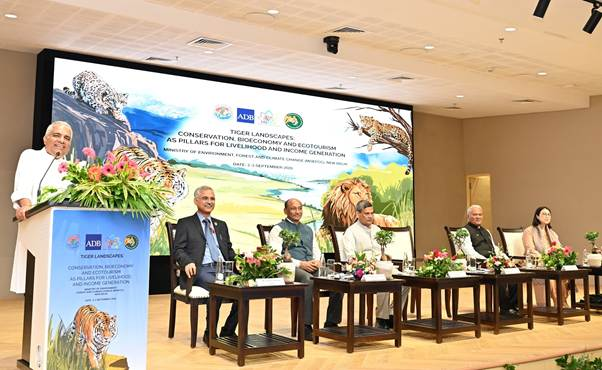
Union Minister for Environment, Forest and Climate Change Bhupender Yadav inaugurated a two-day international workshop in New Delhi on 2 September 2026.
The workshop continued until 3 September 2026 and focused on linking tiger conservation with sustainable livelihoods and economic opportunities.
Theme of the Workshop
The theme was:
“Tiger Landscapes: Conservation, Bioeconomy and Ecotourism as Pillars for Livelihood and Income Generation”
The theme highlights the need to combine wildlife conservation with sustainable economic activities that can benefit communities living around tiger habitats.
What Are Tiger Landscapes?
Tiger landscapes refer to interconnected forest and habitat areas supporting tiger populations and other forms of biodiversity.
Conserving these landscapes is important not only for tigers but also for maintaining ecological balance and protecting other species that share these habitats.
Tiger Conservation in India
India’s tiger conservation framework includes:
- Wildlife (Protection) Act, 1972
- Project Tiger
- National Tiger Conservation Authority (NTCA)
The NTCA is the statutory body responsible for strengthening and overseeing tiger conservation in India.
Organisations Behind the Workshop
The international workshop was jointly organised by:
- International Big Cat Alliance (IBCA)
- Asian Development Bank (ADB)
- National Tiger Conservation Authority (NTCA)
International Big Cat Alliance
The International Big Cat Alliance is an inter-governmental initiative dedicated to conserving seven major big-cat species:
- Tiger
- Lion
- Leopard
- Snow leopard
- Cheetah
- Jaguar
- Puma
MoU Between IBCA and ADB
During the workshop, the International Big Cat Alliance and Asian Development Bank signed a Memorandum of Understanding.
The agreement focuses on areas such as:
- Landscape conservation
- Capacity building
- Nature-positive financing
- Biodiversity and ecosystem outcomes
The partnership aims to support conservation through financing mechanisms and institutional capacity.
Quick Revision
- Workshop location: New Delhi
- Date: 2–3 September 2026
- Inaugurated by: Bhupender Yadav
- Theme: Tiger Landscapes, Conservation, Bioeconomy and Ecotourism
- Key organisations: IBCA, ADB and NTCA
- IBCA focuses on: Seven big-cat species
- MoU signed between: IBCA and ADB
India Plans 100 New Airports Under Modified UDAN
India has announced plans to develop 100 new airports over the next 10 years as part of the country’s regional aviation expansion under the Modified UDAN scheme.
The initiative is aimed at strengthening air connectivity in underserved and remote parts of the country, particularly tier-2 and tier-3 cities, Himalayan areas and island territories.
What Is UDAN?
UDAN stands for Ude Desh ka Aam Naagrik.
It is India’s regional connectivity programme designed to make air travel more accessible by improving connections between underserved and unserved locations.
The scheme supports regional aviation through measures such as:
- Development of airport infrastructure
- Expansion of regional routes
- Viability support
- Improved connectivity to smaller cities and remote areas
Modified UDAN Scheme
The Modified UDAN scheme was approved by the Union Cabinet in March 2026.
It has a central budgetary outlay of ₹28,840 crore for the period FY 2026–27 to FY 2035–36.
The programme covers airport development, route expansion and infrastructure required to strengthen regional air connectivity.
Growth in India’s Airports
India’s active airports have increased substantially over the years.
According to the provided figures:
2014 → 74 active airports
2026 → 166 active airports
The increase reflects the development of new airports, terminal upgrades and expansion of operational capacity.
100 New Airports
The planned expansion is expected to involve an investment of around ₹30,000 crore over the next decade.
The new airports are intended to improve connectivity for:
- Tier-2 cities
- Tier-3 cities
- Himalayan regions
- Remote areas
- Island territories
200 New Helipads
The Modified UDAN programme also includes plans to develop 200 new helipads.
Helipads can provide important transport links in areas where conventional airports are difficult to construct, particularly in:
- Mountainous regions
- Remote settlements
- Island areas
- Difficult terrain
Focus on Island Connectivity
Lakshadweep and the Andaman and Nicobar Islands are among the regions expected to benefit from improved air connectivity under the expansion programme.
Better regional aviation infrastructure can support tourism, emergency services, logistics, local businesses and easier movement of people.

Review Questions
1. World Coconut Day is observed every year on which date?
A. 1 September
B. 2 September
C. 5 September
D. 8 September
Answer: B. 2 September
2. World Coconut Day was celebrated for the first time in which year?
A. 2005
B. 2007
C. 2009
D. 2012
Answer: C. 2009
3. Coconut palm is popularly known as the:
A. Tree of Prosperity
B. Tree of Life
C. Tree of Knowledge
D. Tree of Health
Answer: B. Tree of Life
4. The fifth edition of Swachh Sagar, Surakshit Sagar was launched on:
A. 15 August 2026
B. 25 August 2026
C. 1 September 2026
D. 2 September 2026
Answer: C. 1 September 2026
5. Swachh Sagar, Surakshit Sagar 2026 will cover India’s coastline of approximately:
A. 7,516 km
B. 9,876 km
C. 10,500 km
D. 11,098 km
Answer: D. 11,098 km
6. Which new initiative was introduced in the 2026 edition of Swachh Sagar, Surakshit Sagar?
A. National Blue Economy Mission
B. National Ocean Olympiad
C. Coastal India Mission
D. Ocean Youth Parliament
Answer: B. National Ocean Olympiad
7. The International Big Cat Alliance focuses on the conservation of how many big-cat species?
A. Five
B. Six
C. Seven
D. Eight
Answer: C. Seven
8. How many new airports does India plan to develop under the Modified UDAN scheme over the next 10 years?
A. 50
B. 75
C. 100
D. 150
Answer: C. 100
9. Gollala Gudi Temple, recently declared a Monument of National Importance, is located in which state?
A. Andhra Pradesh
B. Telangana
C. Karnataka
D. Maharashtra
Answer: B. Telangana
10. Gollalagudi Temple is identified as which type of temple architecture?
A. Panchayatana
B. Ekakuta
C. Trikutalaya
D. Nagara
Answer: C. Trikutalaya


