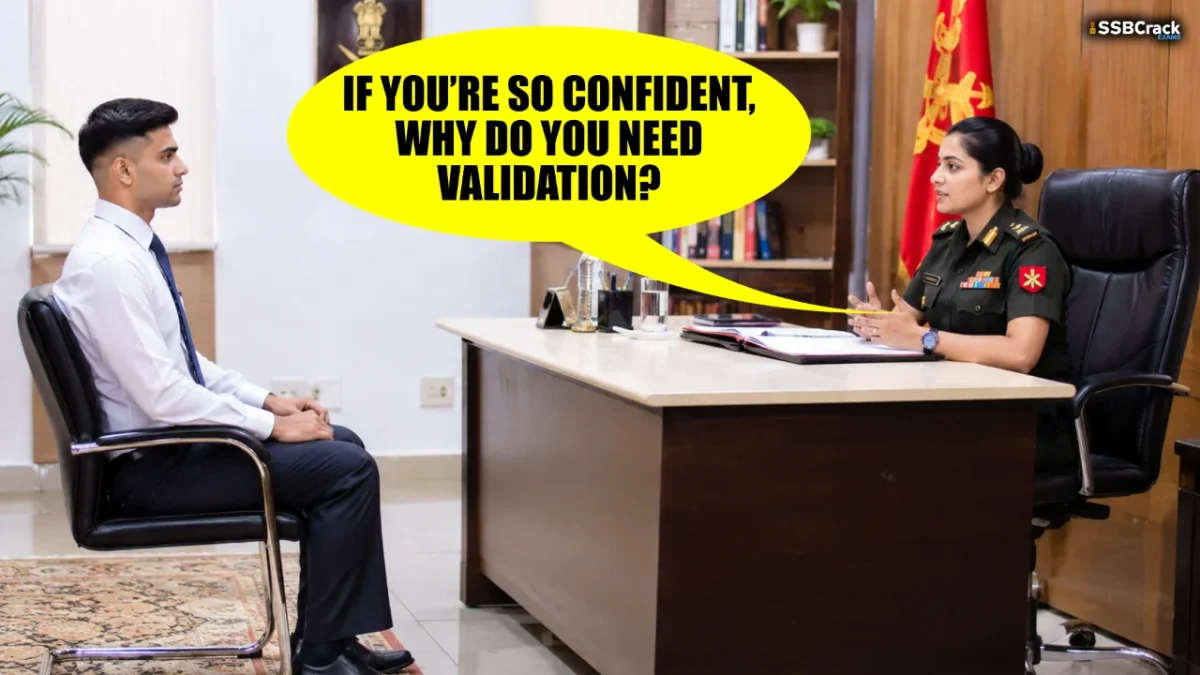
If you are preparing for the SSB Interview and you are naturally outgoing, talkative, energetic and comfortable interacting with people, then today’s article is especially for you.
Being an extrovert can certainly help you feel comfortable while meeting new people, participating in discussions and interacting with your group. But there is one important thing you should remember.
Being talkative is not the same as being a good communicator, and being confident is not the same as being a good leader.
At SSB, your personality is observed from different angles. If you are naturally very expressive, the Interviewing Officer may want to know whether you can also listen patiently, accept criticism, control your emotions, respect other people’s opinions and give others an opportunity to speak.
So, an extroverted candidate may face questions about talking too much, dominating conversations, handling disagreement, working with quieter people, controlling enthusiasm and understanding the difference between confidence and overconfidence.
In this article, we will discuss 20 important SSB Interview questions for extroverted candidates, along with why each question is asked, how you should answer it, and a sample answer.
Remember, don’t try to reduce your personality artificially. Be energetic and expressive, but make sure that your communication is purposeful, respectful and balanced.
1. Would you describe yourself as an extrovert?
Why is this question asked?
The officer wants to understand how you perceive your own personality and whether your self-assessment matches your behaviour.
How should you answer?
Be honest and explain what makes you consider yourself extroverted. Don’t simply say, “I like talking to people.”
Sample Answer
“Sir/Ma’am, yes, I would describe myself as an extrovert. I generally feel comfortable meeting new people, starting conversations and participating in group activities. I enjoy interacting with people and exchanging ideas. At the same time, I understand that I also need to listen carefully and give others space to express themselves.”
2. Do you talk too much?
Why is this question asked?
The officer may be checking whether you have self-awareness and whether you understand that excessive talking can sometimes become a weakness.
How should you answer?
Don’t automatically say “No.” Acknowledge that you can sometimes become very expressive and explain how you control it.
Sample Answer
“Sir/Ma’am, I can sometimes become very expressive when I am interested in a topic. I have realised that if I am not careful, I may speak more than necessary. So, I consciously try to listen to others and make sure that my contribution is relevant to the discussion.”
3. Do you think being extroverted gives you an advantage at SSB?
Why is this question asked?
The officer wants to see whether you understand that being outgoing does not automatically mean you will perform better at SSB.
How should you answer?
Give a balanced response. Social confidence can help, but it is not a substitute for officer-like qualities.
Sample Answer
“Sir/Ma’am, being extroverted may help me feel comfortable while interacting with unfamiliar people, but I don’t think it automatically gives me an advantage at SSB. I still have to demonstrate qualities such as teamwork, responsibility, decision-making, effective communication and the ability to listen to others.”
4. Do you find it easy to make friends?
Why is this question asked?
The officer wants to understand your social adaptability and how you develop relationships.
How should you answer?
Give a genuine answer and explain how you build friendships.
Sample Answer
“Yes, Sir/Ma’am, I generally find it easy to interact with new people. I usually start conversations through common interests, classes, sports or other activities. However, I understand that becoming friendly with someone quickly and building a trustworthy friendship are two different things. I value trust and mutual respect in close friendships.”
5. What do you do when someone is not interested in talking to you?
Why is this question asked?
The officer is testing your emotional maturity and respect for other people’s boundaries.
How should you answer?
Show that you don’t take rejection personally or force interaction.
Sample Answer
“Sir/Ma’am, I would respect the person’s preference. I may try once to understand whether they are simply busy or uncomfortable, but I wouldn’t force the conversation. Everyone has a different personality and mood, and I think that should be respected.”
6. Have you ever been told that you talk too much?
Why is this question asked?
The officer wants to see whether you accept feedback and can identify areas for improvement.
How should you answer?
If it has happened, admit it and explain what you learned from the feedback.
Sample Answer
“Yes, Sir/Ma’am. A friend and sometimes a teacher has told me that I can become very expressive when discussing something I enjoy. I took that feedback seriously. I have been trying to listen more carefully and make my points more concise instead of continuing simply because I have more to say.”
7. How do you react when someone interrupts you?
Why is this question asked?
The officer is assessing patience, emotional control and your response to disagreement.
How should you answer?
Don’t suggest that you immediately become angry or argumentative.
Sample Answer
“Sir/Ma’am, I would first allow the person to explain if the interruption is necessary. If I still need to complete my point, I would politely say that I would like to finish it and then listen to their view. I don’t think an interruption should automatically turn into an argument.”
8. Can you listen as well as you speak?
Why is this question asked?
Effective communication requires both speaking and listening. The officer wants to see whether you understand this.
How should you answer?
Give a specific example rather than simply saying “Yes.”
Sample Answer
“Yes, Sir/Ma’am. I enjoy speaking, but I also understand the importance of listening. For example, during group discussions, I try to understand everyone’s viewpoint before responding. Sometimes another person’s suggestion can improve or completely change my own approach, so I think listening is equally important.”
9. What do you do when someone disagrees with your opinion?
Why is this question asked?
The officer wants to assess your openness to different viewpoints and emotional stability.
How should you answer?
Show that disagreement does not become personal for you.
Sample Answer
“Sir/Ma’am, I first try to understand why the person disagrees. If their reasoning is strong, I am willing to change my opinion. If I still believe my point is valid, I explain it with reasons. I don’t consider disagreement to be a personal conflict.”
10. Do you dominate group discussions?
Why is this question asked?
This is particularly relevant for an extroverted candidate. The officer may want to know whether your confidence prevents quieter members from participating.
How should you answer?
Show awareness and willingness to create space for others.
Sample Answer
“Sir/Ma’am, I naturally participate actively in discussions, but I don’t want my participation to prevent others from speaking. If I notice that I have spoken several times, I try to listen and encourage others to contribute. A good group discussion should involve different viewpoints rather than one person controlling the conversation.”
11. How would you work with a very quiet team member?
Why is this question asked?
The officer wants to assess your ability to include people with different personalities.
How should you answer?
Show patience rather than trying to force the person to behave like you.
Sample Answer
“Sir/Ma’am, I would first try to understand the person’s strengths and comfort level. I would involve them by asking for their opinion when appropriate rather than putting unnecessary pressure on them. If they are comfortable sharing their ideas individually, I would also encourage that. A team should make use of everyone’s abilities.”
12. Are you comfortable being the centre of attention?
Why is this question asked?
The officer may be checking whether you seek attention or can remain focused on the task.
How should you answer?
Distinguish between being comfortable speaking publicly and seeking attention.
Sample Answer
“Sir/Ma’am, I am comfortable speaking in front of people when the situation requires it, but I don’t think being the centre of attention should be the objective. If I am presenting an idea, leading a group or addressing an issue, I am comfortable taking that responsibility. Otherwise, I don’t feel the need to attract attention.”
13. Do you enjoy public speaking?
Why is this question asked?
The officer wants to assess your communication ability and confidence.
How should you answer?
Give a genuine answer and mention where you have actually used the skill.
Sample Answer
“Yes, Sir/Ma’am. I enjoy public speaking because I like explaining ideas and interacting with an audience. I have participated in ________, where I had to speak in front of ________ people. I also understand that effective public speaking is not only about speaking confidently but also about organising thoughts clearly.”
14. What happens when you become too excited about something?
Why is this question asked?
An energetic personality can sometimes become impulsive. The officer may be checking your emotional regulation and judgment.
How should you answer?
Show that enthusiasm is useful but needs control.
Sample Answer
“Sir/Ma’am, when I am very excited about something, I naturally become more expressive and energetic. Earlier, I sometimes acted too quickly because of that excitement. I have learned to pause and consider the situation before taking an important decision. I try to use enthusiasm as motivation without allowing it to affect my judgment.”
15. Have you ever spoken without thinking?
Why is this question asked?
The officer is checking whether you recognise impulsive communication as a possible weakness.
How should you answer?
If it has happened, give a genuine example and explain what you learned.
Sample Answer
“Yes, Sir/Ma’am. There have been occasions when I responded quickly without thinking enough about how my words might be received. In one such situation, I realised that my intention was different from the way my words were understood. Since then, I try to pause for a moment before responding, especially during disagreements.”
16. What is more important—speaking or listening?
Why is this question asked?
The officer wants to test your understanding of effective communication.
How should you answer?
Don’t choose one blindly. Explain that both are important depending on the situation.
Sample Answer
“Sir/Ma’am, I think both are important, but the situation determines which one should come first. Before making a decision or responding to a problem, listening is essential because we need to understand the situation. Once we understand it, clear communication becomes important for explaining the decision or plan.”
17. What would you do if your team disagrees with your decision as a leader?
Why is this question asked?
The officer is testing leadership, confidence, flexibility and decision-making.
How should you answer?
Show that you can listen without becoming indecisive.
Sample Answer
“Sir/Ma’am, I would first listen to the team’s reasons for disagreeing. If someone presents a better solution, I would accept it. However, if a decision has to be taken quickly, I would consider the available information and take responsibility for the decision. Leadership should involve consultation, but it also requires the ability to decide when necessary.”
18. Do you prefer leading or following?
Why is this question asked?
The officer wants to know whether you understand that effective teamwork requires both leadership and cooperation.
How should you answer?
Avoid saying, “I always want to lead.” That can sound like a desire for authority rather than responsibility.
Sample Answer
“Sir/Ma’am, I am comfortable taking leadership when the situation requires it, but I am equally comfortable working under someone else’s leadership. If another person is better suited to lead a particular task, I would support that person and contribute to the team’s objective. I think leadership is about responsibility rather than position.”
19. What is one weakness of being highly extroverted?
Why is this question asked?
The officer wants to see whether you have genuine self-awareness.
How should you answer?
Mention a realistic weakness and explain what you are doing about it.
Sample Answer
“Sir/Ma’am, one possible weakness is that I can sometimes become too expressive or enthusiastic, particularly when discussing something I enjoy. I have been working on controlling this by listening more carefully, keeping my points concise and observing whether others are getting enough opportunity to speak.”
20. Why should the Armed Forces select an extroverted candidate like you?
Why is this question asked?
This question gives you an opportunity to connect your personality with the responsibilities of an officer without claiming that extroversion alone makes you suitable.
How should you answer?
Don’t say, “Because I can talk to everyone.” Focus on communication, initiative, teamwork, adaptability and responsible leadership.
Sample Answer
“Sir/Ma’am, I believe my outgoing nature helps me communicate comfortably with different people and adapt to new social environments. I am willing to take initiative and participate actively in team activities. At the same time, I understand that an officer must also listen, remain disciplined and make balanced decisions. I am working on maintaining that balance so that my confidence becomes useful for the team rather than becoming dominance.”
Important Tips for Extroverted Candidates
- Don’t confuse confidence with speaking continuously. A confident candidate knows when to speak and when to listen.
- Don’t dominate the Interview. Give the officer an opportunity to complete the question before answering.
- Listen carefully to the complete question. Don’t start answering before the officer has finished.
- Avoid unnecessarily long answers. Give complete answers, but remain relevant.
- Don’t interrupt the Interviewing Officer. Even if you think you know what is coming next, allow the question to be completed.
- Don’t try to impress the officer constantly. SSB is not a stage for showcasing how social or entertaining you are.
- Respect quieter people. Your ability to work with introverted or reserved teammates is important.
- Don’t treat every disagreement as a debate. Sometimes listening and accepting another viewpoint is the better response.
- Control your excitement. Enthusiasm is positive, but important decisions require calm thinking.
- Avoid unnecessary gestures or exaggerated expressions. Your body language should remain natural.
- Don’t claim that you can be friends with everyone. Healthy relationships also require boundaries and mutual understanding.
- Show that you can follow as well as lead. An officer must work within a team and respect the chain of command.
- Be careful with humour. Being friendly is good, but inappropriate jokes can create a poor impression.
- Accept criticism positively. Don’t become defensive simply because someone points out a mistake.
- Don’t suppress your personality. The goal is not to become quiet. The goal is to become a balanced communicator.
- Give real examples. If you claim that you are a good team player, be prepared for follow-up questions about an actual team experience.
- Know the difference between assertiveness and aggression. Assertiveness means expressing your position respectfully; aggression means trying to overpower others.
- Remember that leadership is not about attention. Leadership is about responsibility, decision-making and helping the team achieve its objective.
- Don’t memorise these answers. Use them only to understand the type of response expected and then prepare your own genuine examples.
- Focus on balance. Your extroverted nature can be an asset when combined with listening, patience, discipline, emotional control and sound judgment.
Closing Lines
So, these were 20 important SSB Interview questions for extroverted candidates.
If you are naturally outgoing and talkative, don’t think that you need to become quiet for the SSB Interview.
Your energy, confidence, communication skills and ability to interact with people can be valuable qualities.
But remember one important thing:
A good communicator is not the person who speaks the most. A good communicator is the person who knows what to say, when to say it, and when to listen.
So, if you are an extrovert, work on the balance between speaking and listening.
Be confident, but don’t become overconfident.
Be expressive, but don’t dominate.
Be energetic, but don’t become impulsive.
Be friendly, but respect boundaries.
And most importantly, don’t try to perform a personality that is not yours. The SSB is about understanding your actual personality and assessing whether you have the potential to develop into an effective officer.
So, enter the interview room with confidence, listen carefully, answer honestly and let your natural personality come through.
Keep preparing, stay confident, communicate wisely and remember—leadership is not about being the loudest voice in the room; it is about making your voice useful to the team.
All the best for your SSB journey!