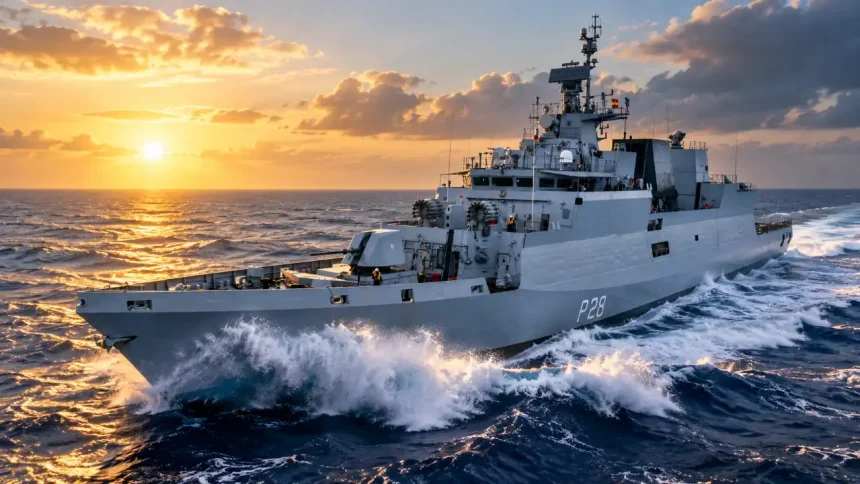
In a significant boost for India’s naval modernisation drive, the Cabinet Committee on Security (CCS) has approved a project worth over Rs 40,000 crore for the construction of eight Next Generation Corvettes (NGCs) for the Indian Navy. The clearance came in a meeting chaired by Prime Minister Narendra Modi on Wednesday, and it is being described as one of the biggest recent approvals for warship construction.
According to government officials quoted by ANI, the contracts for the eight warships are expected to be signed in the next few days with Garden Reach Shipbuilders & Engineers (GRSE), Kolkata, and Goa Shipyard Limited (GSL). GRSE, which was the lowest bidder (L1) when commercial bids were opened in May 2025, will build five corvettes. GSL will construct the remaining three at the same unit cost.
The first ship is expected to be delivered to the Navy by 2030. Officials have also said that the shipyards are exploring ways to speed up the programme and complete the deliveries earlier than planned.
What the Next Generation Corvettes Will Do
As stated by the Ministry of Defence, the NGCs will be multi-purpose warships designed for surveillance, escort duties, deterrence, Surface Action Group (SAG) operations, search-and-attack missions and coastal defence. They will be built to an in-house design developed by the Indian Navy and will incorporate newer shipbuilding technologies. The project is also linked to the government’s SAGAR (Security and Growth for All in the Region) initiative.
Recent reports have described the corvettes as ships of around 2,000 tonnes displacement with a top speed of about 30 knots. They are intended to replace the ageing Khukri-class and Kora-class corvettes currently in service.
How the Programme Reached This Stage
The Defence Acquisition Council had granted Acceptance of Necessity for the eight NGCs in June 2022, when the project was valued at about Rs 36,000 crore. GRSE was declared L1 in May 2025, and price negotiations were completed in 2026. Hydrodynamic model testing was also successfully completed by the Naval Science and Technological Laboratory (NSTL) in collaboration with the Warship Design Bureau. With the CCS approval now in place, the final major hurdle before contract signing has been cleared.
The order is expected to significantly strengthen the business prospects of both GRSE and GSL, while also supporting indigenous warship production under the Atmanirbhar Bharat framework in defence manufacturing. If the timeline holds, the first deliveries in the early 2030s will add newer multi-role surface combatants to the Navy’s fleet for littoral and open-sea operations.
The approval also fits into the Indian Navy’s wider effort to field modern platforms capable of distributed operations across the Indian Ocean Region.