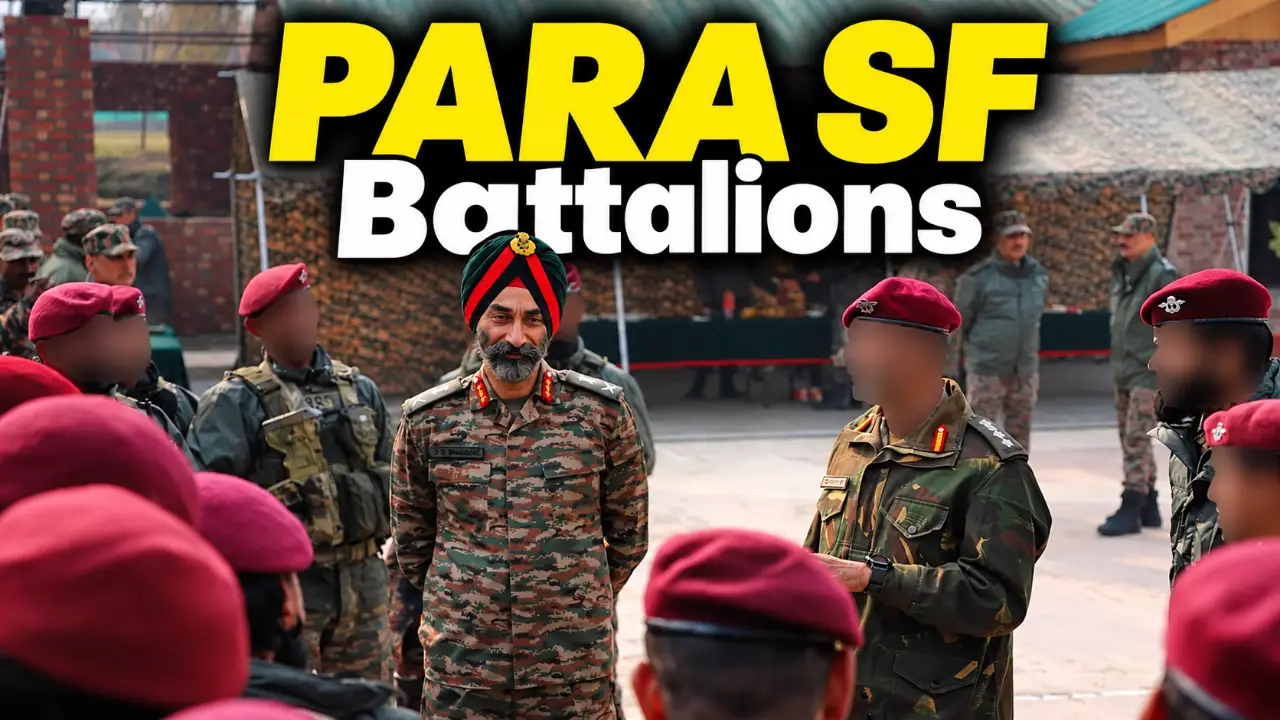
The Indian Army’s PARA Special Forces, popularly known as PARA SF, are among India’s most highly trained and respected military units. Recognised for their distinctive maroon berets, demanding selection process and specialised combat capabilities, these soldiers undertake some of the most challenging missions assigned to the Indian Army.
From the snow-covered mountains of the Himalayas to the deserts of Rajasthan and the dense jungles of Northeast India, PARA SF personnel are trained to operate in difficult environments where conventional military tactics may not be sufficient.
As of 2026, publicly available accounts identify 15 battalions within the Indian Army’s PARA (SF) organisation, including five former airborne battalions reorganised for dual airborne and specialist roles in 2022.
However, not every PARA SF battalion has the same history, operational background or specialised responsibilities.
This article explains the complete list of PARA SF battalions in 2026, their commonly reported nicknames, historical backgrounds, operational roles and the difference between airborne and Special Forces soldiers.
What Is PARA SF in the Indian Army?
PARA SF stands for Parachute Special Forces. These specialised units form part of the Indian Army’s Parachute Regiment, which has a distinguished history of airborne operations, unconventional warfare and combat service.
The Parachute Regiment was formally established on 15 April 1952, bringing together existing airborne battalions under a dedicated regimental organisation.
The origins of India’s dedicated parachute commando capability date to 1 July 1966, when the 9th Parachute Commando Battalion was raised following lessons from the 1965 India-Pakistan War.
Over the following decades, the Indian Army expanded its special operations capability by converting existing battalions and raising new units.
PARA SF soldiers are trained for specialised missions including counter-terrorism, special reconnaissance, direct action, unconventional warfare and operations in hostile environments.
Their regimental motto, “Shatrujeet,” means “Conqueror of Enemies.”
How Many PARA SF Battalions Are There in 2026?
Open-source accounts commonly list 15 PARA (SF) battalions in 2026.
These include established Special Forces battalions and five units whose airborne roles were expanded in 2022 to include specialist tasks.
The exact current classification and operational employment of individual battalions are not comprehensively disclosed through public Army documents. The following list therefore reflects widely reported designations, rather than a formally published, complete official order of battle.
Complete List of 15 PARA SF Battalions in 2026
| Battalion | Commonly Reported Nickname | Historical or Specialist Association |
|---|---|---|
| 1 PARA (SF) | Pratham / Red Devils | Urban operations and special reconnaissance |
| 2 PARA (SF) | Predators | Mountain warfare and counter-insurgency |
| 3 PARA (SF) | Russell’s Vipers | Desert warfare |
| 4 PARA (SF) | Mighty Daggers | Counter-terrorism and mountain operations |
| 5 PARA (SF) | Batalik | Airborne assault and mountain operations |
| 6 PARA (SF) | Sakht Para | Airborne assault and specialist operations |
| 7 PARA (SF) | SE7EN | Airborne assault and specialist operations |
| 9 PARA (SF) | Mountain Rats / Pirates | Mountain warfare and counter-terrorism |
| 10 PARA (SF) | Desert Scorpions | Desert warfare and reconnaissance |
| 11 PARA (SF) | Helleven / Vipers | Jungle warfare and counter-insurgency |
| 12 PARA (SF) | Dirty Dozens | Jungle and mountain operations |
| 13 PARA (SF) | Thunderbolts | Special operations and counter-terrorism |
| 21 PARA (SF) | Waghnakhs | Jungle warfare and counter-insurgency |
| 23 PARA (SF) | Devil’s Own | Airborne assault and specialist operations |
| 29 PARA (SF) | Airborne Rajputs / Warriors N Monks | Airborne assault and specialist operations |
Note: Nicknames are drawn from commonly circulated regimental and defence-community accounts. They are not all independently verified as official Army titles. Similarly, the listed roles indicate historical associations rather than exclusive or currently assigned responsibilities.
Detailed History and Roles of Every PARA SF Battalion
1. 1 PARA (SF) – Pratham
1 PARA (SF) is one of the most historically significant units associated with the Indian Army’s Parachute Regiment.
Its military lineage dates back to 1761, making it one of the oldest battalions associated with the regiment.
The battalion underwent conversion to a commando and Special Forces role beginning in the late 1970s, becoming an important part of India’s developing special operations capability.
The battalion is commonly associated with the names Pratham and Red Devils.
Its history includes participation in major Indian military campaigns, including the 1965 India-Pakistan War, during which its predecessor airborne unit participated in operations associated with the capture of the strategically important Haji Pir Pass.
Over the years, 1 PARA (SF) has developed considerable experience in specialised military operations.
2. 2 PARA (SF) – Predators
2 PARA (SF), popularly known as the Predators, traces its lineage to an infantry unit originally raised in 1797.
It subsequently became part of the Parachute Regiment before undergoing conversion to a Special Forces role around the turn of the 21st century.
The battalion is frequently associated with mountain warfare and counter-insurgency operations.
Its military history reflects the Indian Army’s gradual transition from conventional airborne infantry towards highly specialised units capable of conducting challenging missions in difficult terrain.
3. 3 PARA (SF) – Russell’s Vipers
3 PARA (SF) is commonly known as Russell’s Vipers.
Its historical lineage dates to 1813, and it eventually became part of the Parachute Regiment before conversion to a Special Forces battalion in the early 2000s.
The battalion is widely associated with desert warfare, although Special Forces units train for different operational environments.
Desert operations place exceptional demands on soldiers because of extreme temperatures, difficult navigation, limited natural cover and challenging logistical conditions.
The battalion forms part of the broader specialised capability developed by the Indian Army for operations in varied terrain.
4. 4 PARA (SF) – Mighty Daggers
4 PARA (SF), commonly referred to as the Mighty Daggers, is among the Indian Army’s best-known Special Forces battalions.
Originally raised as an airborne unit in 1961, it underwent conversion to a Special Forces role in the early 2000s.
The battalion is strongly associated with counter-terrorism, counter-infiltration and operations in mountainous environments.
Public accounts have identified personnel from 4 PARA (SF) among the Special Forces elements involved in the September 2016 surgical strikes across the Line of Control.
Its operational history reflects the significant responsibilities entrusted to Indian Army Special Forces units in demanding security environments.
5. 5 PARA (SF) – Batalik
5 PARA is particularly associated with the Batalik sector during the 1999 Kargil War.
The battalion has a distinguished airborne heritage and extensive historical experience in mountain operations.
In 2022, it was among five parachute battalions reorganised for specialist tasks while retaining their airborne responsibilities.
This development represented an important step in strengthening the Indian Army’s ability to employ airborne troops in a wider variety of operational circumstances.
The battalion is commonly associated with the nickname Batalik.
6. 6 PARA (SF) – Sakht Para
6 PARA has a distinguished history within the Indian Army’s airborne forces.
One of its most notable historical associations is Operation Cactus in November 1988, when Indian troops deployed to the Maldives following an attempted coup against the government of President Maumoon Abdul Gayoom.
The Indian military operation successfully helped restore security and protect the Maldivian government.
6 PARA is commonly associated with the nickname Sakht Para.
The battalion was also included in the 2022 reorganisation expanding specialist responsibilities among selected airborne units.
7. 7 PARA (SF) – SE7EN
7 PARA is another historically established airborne battalion of the Parachute Regiment.
It has participated in the development of India’s airborne military capabilities and has a long history of specialised military training.
The unit is popularly associated with the nickname SE7EN.
Like 5 PARA and 6 PARA, it was included in the 2022 reorganisation that expanded the roles of selected parachute battalions.
Its history illustrates the continuing importance of airborne infantry capabilities alongside the Indian Army’s developing special operations requirements.
8. 9 PARA (SF) – Mountain Rats
9 PARA (SF) holds a particularly important position in the history of India’s Special Forces.
Raised on 1 July 1966 as the 9th Parachute Commando Battalion, it was among the first dedicated commando formations of the Indian Army.
The battalion is popularly known as the Mountain Rats and is also associated with the nickname Pirates.
It has a distinguished record of military service, especially in challenging mountainous environments.
One of its notable historical operations was the Mandhol Raid during the 1971 India-Pakistan War, when Indian commandos conducted an operation against Pakistani artillery positions.
The battalion has also been associated in public reporting with the September 2016 surgical strikes across the Line of Control.
9 PARA (SF) is frequently recognised for its operational legacy and the gallantry demonstrated by its personnel.
9. 10 PARA (SF) – Desert Scorpions
10 PARA (SF), known as the Desert Scorpions, is widely associated with desert warfare.
The battalion was raised in 1967 following the development of India’s dedicated parachute commando capability.
Its most famous historical operation was the Chachro Raid during the 1971 India-Pakistan War.
During this operation, Indian commandos conducted a daring raid into Pakistani territory in the desert sector.
The mission became one of the Indian Army’s best-known examples of unconventional warfare in a desert environment.
The legacy of the Chachro Raid remains an important chapter in the history of Indian military special operations.
10. 11 PARA (SF) – Helleven
11 PARA (SF) was raised in the early 2010s as part of the expansion of the Indian Army’s Special Forces capability.
The battalion is commonly associated with the nicknames Helleven and Vipers in publicly circulated accounts.
It is frequently linked with jungle warfare, counter-insurgency and specialised operations in difficult terrain.
The raising of 11 PARA (SF) reflected the Indian Army’s growing emphasis on dedicated forces capable of responding to complex security challenges.
11. 12 PARA (SF) – Dirty Dozens
12 PARA (SF), commonly known as the Dirty Dozens, was raised in 2013 according to widely available regimental histories.
The battalion is associated with jungle warfare, mountain operations and counter-insurgency responsibilities.
Its formation helped expand the Indian Army’s special operations capacity at a time when unconventional threats and challenging border environments remained important security concerns.
Like other PARA SF battalions, it belongs to a military organisation that places exceptional emphasis on physical fitness, initiative, endurance and specialised combat skills.
12. 13 PARA (SF) – Thunderbolts
13 PARA (SF) is among the newer battalions associated with the Parachute Regiment’s Special Forces organisation.
Publicly available regimental accounts identify its raising in 2022.
The battalion is commonly associated with the nickname Thunderbolts.
Its establishment formed part of the broader expansion and reorganisation of India’s Special Forces capabilities.
As a relatively new battalion, detailed information concerning its training activities, specific responsibilities and operational history is limited in the public domain.
13. 21 PARA (SF) – Waghnakhs
21 PARA (SF), popularly known as the Waghnakhs, has a distinguished infantry background.
The battalion originated from the Maratha Light Infantry and was converted to a Special Forces role during the 1990s, with the formal conversion commonly dated to 1996.
It is particularly associated with jungle warfare, counter-insurgency and operations in Northeast India.
Public reporting has linked the battalion to Indian military operations involving insurgent groups operating near the India-Myanmar border.
The unit’s history reflects the importance of specialised training for operations in dense forests, remote terrain and challenging climatic conditions.
14. 23 PARA (SF) – Devil’s Own
23 PARA is associated with the nickname Devil’s Own.
The battalion has an infantry and airborne heritage and was among the units involved in the Indian Army’s 2022 airborne-specialist reorganisation.
Importantly, official Indian Army communications in February 2022 still identified the unit as 23 PARACHUTE, rather than 23 PARACHUTE (Special Forces).
This distinction is relevant when understanding the evolving structure of the Parachute Regiment.
The battalion’s expanded specialist responsibilities should not be confused with the longer operational history of the Indian Army’s established Special Forces battalions.
15. 29 PARA (SF) – Airborne Rajputs
29 PARA has historical links with the Rajput Regiment and is commonly associated with the names Airborne Rajputs and Warriors N Monks.
The battalion was among the selected airborne units reorganised for additional specialist responsibilities in 2022.
On 23 February 2022, 29 PARACHUTE received the President’s Colours in a ceremony conducted at the Parachute Regiment Training Centre in Bengaluru.
Its inclusion in the broader specialist reorganisation reflects the Indian Army’s continuing development of highly trained airborne formations.
What Changed in the PARA SF Battalions in 2022?
One of the most important developments in the Parachute Regiment’s recent history occurred in 2022.
Five established airborne battalions were reorganised and assigned specialist responsibilities alongside their traditional airborne roles.
These were 5 PARA, 6 PARA, 7 PARA, 23 PARA and 29 PARA.
This development is sometimes described as their conversion or redesignation to PARA (SF), although their organisation retained an important airborne component.
The distinction is significant because conventional airborne assault operations and specialised military missions can involve different organisational requirements, training structures and operational objectives.
The reorganisation increased the Army’s flexibility by enabling selected airborne formations to undertake a wider range of tasks.
Difference Between PARA and PARA SF
Although the terms PARA and PARA SF are often used interchangeably in popular discussions, their traditional military roles are not identical.
| Feature | PARA Airborne | PARA Special Forces |
|---|---|---|
| Primary concept | Airborne infantry operations | Specialised military operations |
| Traditional employment | Airborne assault and conventional infantry missions | Special reconnaissance, direct action and unconventional warfare |
| Training emphasis | Parachuting, infantry combat and airborne operations | Special Forces selection and mission-specific training |
| Typical operational organisation | Airborne infantry formations | Smaller specialised operational elements |
| Distinctive identity | Maroon beret and airborne qualification | Maroon beret, specialist qualification and Balidan Badge eligibility |
The 2022 reorganisation introduced additional overlap between these categories, making it especially important to avoid assuming that every battalion has exactly the same training history or operational role.
What Is the Balidan Badge?
The Balidan Badge is one of the most recognisable insignia associated with Indian Army PARA Special Forces personnel.
The word Balidan means sacrifice.
The badge symbolises the extraordinary commitment, endurance and dedication expected of soldiers who qualify for Special Forces service.
It is not automatically awarded to every soldier wearing a maroon beret.
The maroon beret represents the airborne tradition, while eligibility for the Balidan Badge is linked to the relevant Special Forces qualification requirements.
For defence aspirants, understanding this difference is important when identifying the various qualifications and traditions within the Parachute Regiment.
How Are PARA SF Commandos Selected?
Selection for PARA SF is widely regarded as one of the most demanding processes in the Indian Army.
Personnel generally volunteer from within the Army and must satisfy the applicable eligibility, medical and professional requirements.
Candidates are subjected to an intensive probation and assessment process designed to test physical endurance, psychological resilience, determination and suitability for specialised military operations.
The exact duration and content of probation can vary according to the entry route, battalion and prevailing training requirements.
Successful completion of initial assessment does not mean that a soldier has finished all Special Forces training. Qualification and further specialised instruction can continue over an extended period.
Training of PARA SF Commandos
PARA SF personnel undertake extensive military training that develops specialised capabilities beyond conventional infantry skills.
Areas of training may include advanced marksmanship, navigation, survival, fieldcraft, combat medicine, special reconnaissance and operations in challenging environments.
Depending on operational requirements and qualification, selected personnel may also receive training in military free-fall parachuting, mountain warfare, jungle operations, desert operations and other specialist disciplines.
Not every commando receives every qualification, and training programmes are tailored to operational responsibilities.
Much of the detailed training curriculum is not publicly disclosed.
Famous Military Operations Associated With PARA SF
1971 India-Pakistan War
India’s parachute commandos conducted several notable operations during the 1971 war.
The Chachro Raid associated with 10 PARA and the Mandhol Raid associated with 9 PARA are especially important examples in Indian military history.
Operation Cactus, 1988
During Operation Cactus, Indian airborne troops were deployed to the Maldives to counter an attempted coup.
The successful operation demonstrated India’s ability to conduct a rapid overseas military response.
Operation Pawan, 1987–1990
Indian parachute and commando personnel also participated in military operations during the deployment of the Indian Peace Keeping Force in Sri Lanka.
The campaign involved difficult conditions and complex security challenges.
Kargil War, 1999
Personnel of the Parachute Regiment participated in operations during the Kargil War, including fighting in difficult high-altitude terrain.
The Batalik sector remains closely associated with the combat history of 5 PARA.
2016 Surgical Strikes
Following the terrorist attack at Uri in September 2016, the Indian Army announced that it had conducted surgical strikes against terrorist launch pads across the Line of Control.
Public accounts have associated personnel from 4 PARA (SF) and 9 PARA (SF) with the operation.
Detailed tactical information and the complete composition of participating teams have not been publicly released.
Frequently Asked Questions About PARA SF Battalions
1. How many PARA SF battalions are there in the Indian Army in 2026?
Widely circulated open-source accounts list 15 battalions, including five former airborne battalions given additional specialist roles in 2022. The Army does not publish a complete, routinely updated public order of battle.
2. Which was the first PARA SF battalion?
9 PARA was raised on 1 July 1966 as a dedicated parachute commando battalion. However, 1 PARA has a much older regimental lineage and subsequently converted to a Special Forces role. The distinction depends on whether the question concerns the oldest military lineage or the first dedicated commando battalion.
3. Which PARA SF battalion is known as the Desert Scorpions?
10 PARA (SF) is popularly known as the Desert Scorpions and is historically associated with desert warfare.
4. Which PARA SF battalion is known as the Mountain Rats?
9 PARA (SF) is commonly known as the Mountain Rats and is associated with mountain warfare and specialised operations.
5. Which PARA SF battalion is known as the Waghnakhs?
21 PARA (SF) is popularly known as the Waghnakhs and has a strong history of jungle and counter-insurgency operations.
6. Which PARA SF battalion participated in the Chachro Raid?
The Chachro Raid during the 1971 India-Pakistan War is closely associated with 10 PARA.
7. Can a civilian directly join PARA SF?
There is generally no separate direct civilian recruitment process that guarantees placement in PARA SF. Candidates must first enter the Indian Army through an applicable recruitment route and then meet the requirements for volunteering, assessment and selection.
8. Are all PARA soldiers Special Forces commandos?
No. Airborne service and Special Forces qualification are distinct, although the 2022 reorganisation expanded the specialist roles of selected airborne units.
9. Does every PARA soldier receive the Balidan Badge?
No. The Balidan Badge is associated with successful qualification for the relevant Special Forces role and is not automatically awarded for airborne service.
10. Which is the best PARA SF battalion?
There is no publicly established official ranking declaring one PARA SF battalion the best. Different battalions have distinguished operational histories, and their specialised experience reflects the Indian Army’s varied requirements.
Conclusion
The PARA Special Forces represent a distinguished element of the Indian Army’s military capability, built on decades of airborne operations, battlefield experience, demanding training and specialised military service.
From the historic 9 PARA and 10 PARA commando battalions to the more recently raised and reorganised formations, the development of PARA SF reflects India’s evolving defence requirements.
The commonly reported list of 15 battalions in 2026 illustrates this expansion, but it is important to distinguish established Special Forces qualifications from the additional specialist responsibilities assigned to selected airborne battalions.
For defence aspirants preparing for NDA, CDS, AFCAT, SSB interviews and other military examinations, understanding the history, organisation, traditions and operational development of the Parachute Regiment provides valuable knowledge of one of the Indian Army’s most respected military institutions.
The enduring spirit of the regiment is captured in its motto: Shatrujeet — Conqueror of Enemies.
Also Read: