




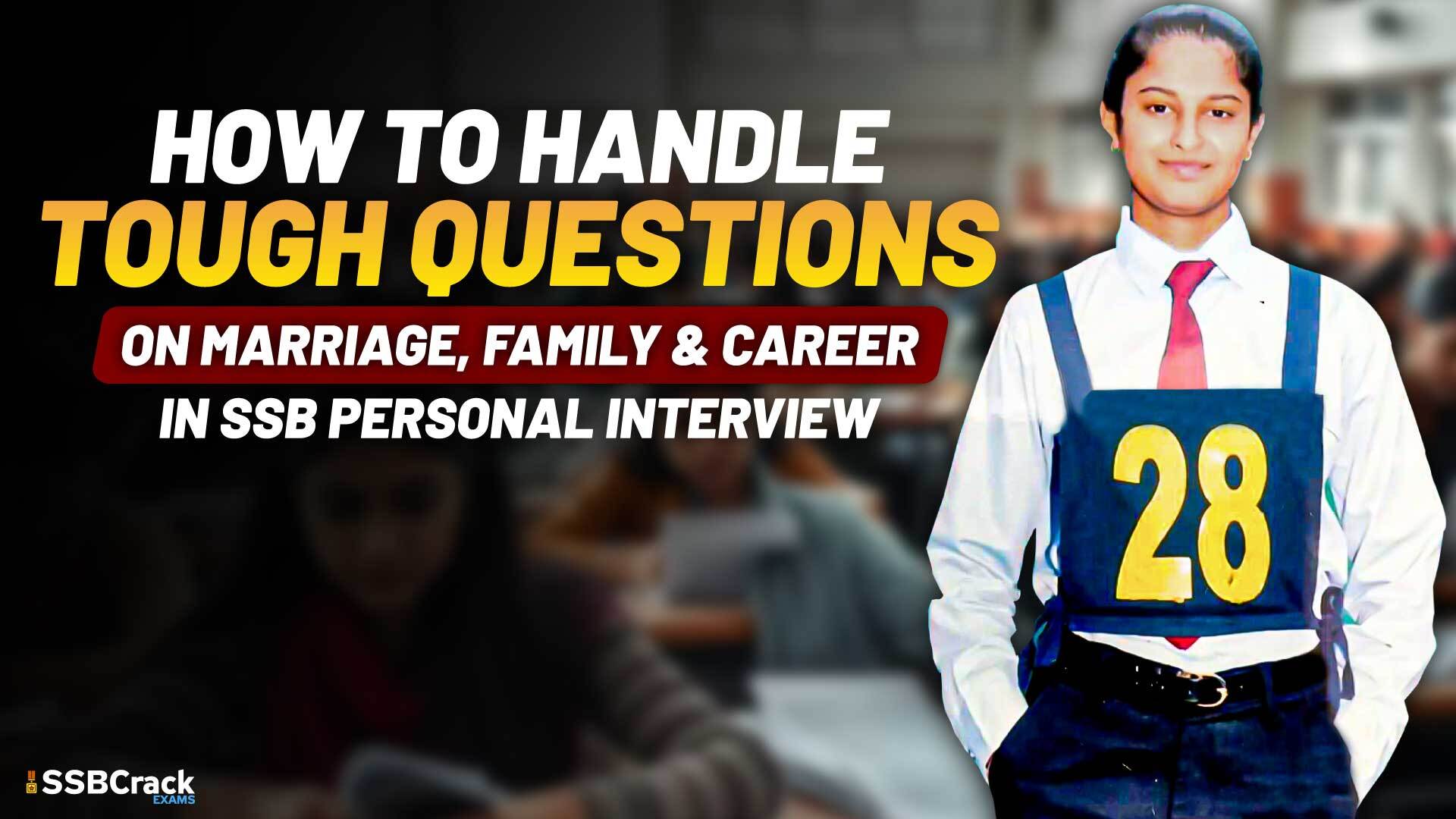
Many female aspirants feel nervous when interviewers ask about marriage, family expectations, long-term plans, or personal responsibilities.
But these questions are not meant to judge your background — they are meant to assess:
- Your clarity of thought
- Your decision-making maturity
- Your confidence in life choices
- Your ability to balance relationships and responsibility
- Your real motivation to join the Armed Forces
These are life-impacting questions, and the board wants to ensure that you have thought honestly and deeply about your future.
The Real Reason Behind These Tough Questions
The Armed Forces want officers who are:
- Mentally prepared for training and service life
- Emotionally stable and self-assured
- Not under external pressure
- Committed to a long-term military career
These questions help assess whether your decision to join is your own choice or influenced by family, society, or fear of missing out.
Common Tough Questions You May Face
During the Personal Interview, you may be asked:
- “What if your parents want you to get married soon?”
- “Will marriage affect your ability to serve in the forces?”
- “What if your future husband doesn’t want you to continue your career?”
- “How will you manage family responsibilities after joining the forces?”
- “Do your parents support your decision to join the military?”
- “Are you ready for transfers, field postings, and long working hours?”
- “How will you handle work-life balance in service?”
These are not trick questions. They are simply checking whether you are clear, confident, and stable.
The Principles of Handling These Questions Gracefully
Principle 1: Be Honest and Clear
Don’t give dramatic answers like:
“I will never marry!”
“I don’t care about family!”
These sound unrealistic and immature.
Instead show balance and clarity.
Principle 2: Show Maturity, Not Defensiveness
Avoid strong emotional reactions.
Don’t say:
“Why are you asking me these questions?”
You must stay calm, open, and rational.
Principle 3: Show That Your Career Vision Is Strong
Your answers must subtly communicate that:
- You are dedicated
- You are mentally prepared
- You understand military life
- You have long-term clarity
Principle 4: Demonstrate Emotional Intelligence
The best officers combine:
- Empathy
- Practical thinking
- Commitment
- Relationship maturity
Show that you can handle both professional and personal life thoughtfully.
Sample Answers to Tough Questions (For Female Aspirants)
These answers are balanced, realistic, and officer-like.
Q1. “What if your parents want you to get married soon?”
Model Answer:
“Sir/Ma’am, my parents are supportive of my career aspirations. Marriage is important, but right now my priority is to build a stable and meaningful career. I believe both decisions should be taken at the right time, with mutual understanding. My family respects my goals, and there is no pressure.”
Q2. “What if your future husband doesn’t want you to continue in the forces?”
Model Answer:
“I believe marriage should be a partnership built on mutual respect. I will marry someone who values my passion and supports my professional goals. I am clear about my career, and I would communicate this openly before marriage. Understanding and compatibility matter a lot to me.”
Q3. “How will you manage family responsibilities after joining the forces?”
Model Answer:
“Sir/Ma’am, time management and prioritisation are essential for every officer. I believe with discipline, planning, and family cooperation, personal and professional responsibilities can be balanced. Many women officers manage both, and they inspire me to do the same.”
Q4. “What if your family is worried about you posting in tough areas?”
Model Answer:
“It is natural for families to worry, but they also trust my training and dedication. I share my ambitions openly with them, and they understand that service involves challenges. Their support motivates me rather than stops me.”
Q5. “Will marriage or children affect your conviction to serve?”
Model Answer:
“Sir/Ma’am, life brings responsibilities, but my commitment to the uniform remains strong. I believe in planning and adapting. Women officers across the services continue to excel after marriage and motherhood. They are examples of how duty and personal life can coexist with balance.”
What NOT to Say (Avoid These Mistakes)
❌ Weak or fearful responses
❌ Emotional answers
❌ Blaming family or society
❌ Statements that sound extreme
❌ Answers showing confusion about your future
These give the impression of instability, not leadership.
Mindset to Maintain Throughout the Interview
- Be calm
- Think logically
- Speak respectfully
- Avoid rushing to answer
- Maintain eye contact
- Sit confidently
- Smile naturally
- Don’t contradict your own PIQ form
- Don’t try to justify too much
- Don’t show irritation or discomfort
Remember — the officer across the table is not testing your marriage plans;
they are testing your clarity of purpose.
Final Thoughts: Your Identity Defines Your Answer
You are a young woman who:
- Has ambition
- Has clarity
- Has emotional strength
- Has dreams bigger than society’s expectations
- Has the confidence to lead
- Has the maturity to balance life’s responsibilities
Your answers must reflect self-respect + realism + strength.
“Strength is not denying your responsibilities.
Strength is knowing you can handle them with dignity, balance, and determination.”
When you respond with clarity, confidence, and composure, you don’t just answer a question —
you prove that you are ready to wear the uniform.


