




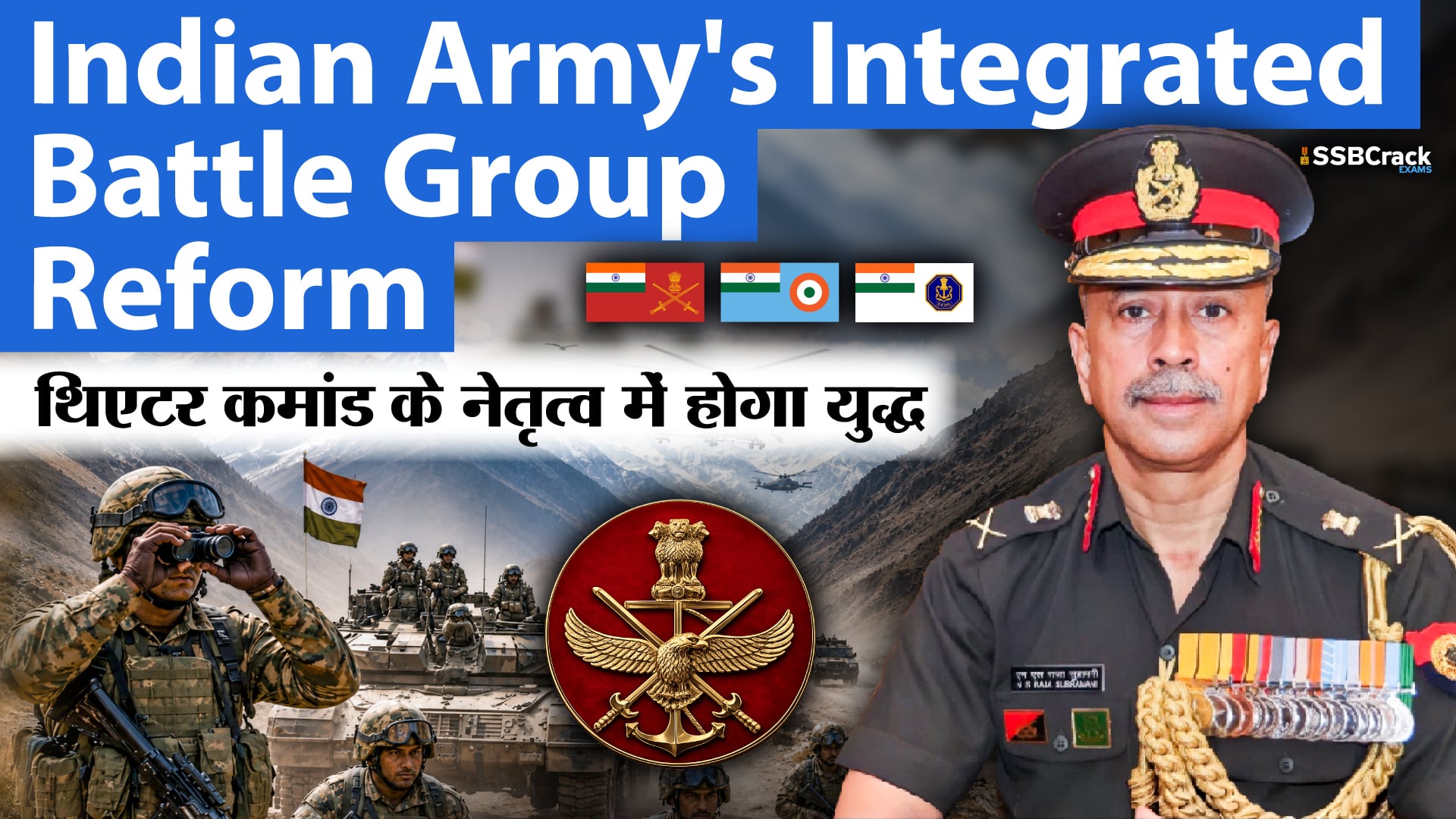
The Indian Army has initiated one of its most significant organisational reforms by raising five Integrated Battle Groups (IBGs) and one dedicated Fire Support Group (FSG).
Indian Army Creates Integrated Battle Groups in Major Military Reform
The Indian Army has initiated one of its most significant organisational reforms by raising five Integrated Battle Groups (IBGs) and one dedicated Fire Support Group (FSG). The move is aimed at transforming the Army into a faster, more agile, and technology-driven force capable of responding effectively to future security challenges. The new formations became operational on 1 July 2026 as part of the Army’s ongoing modernisation programme.
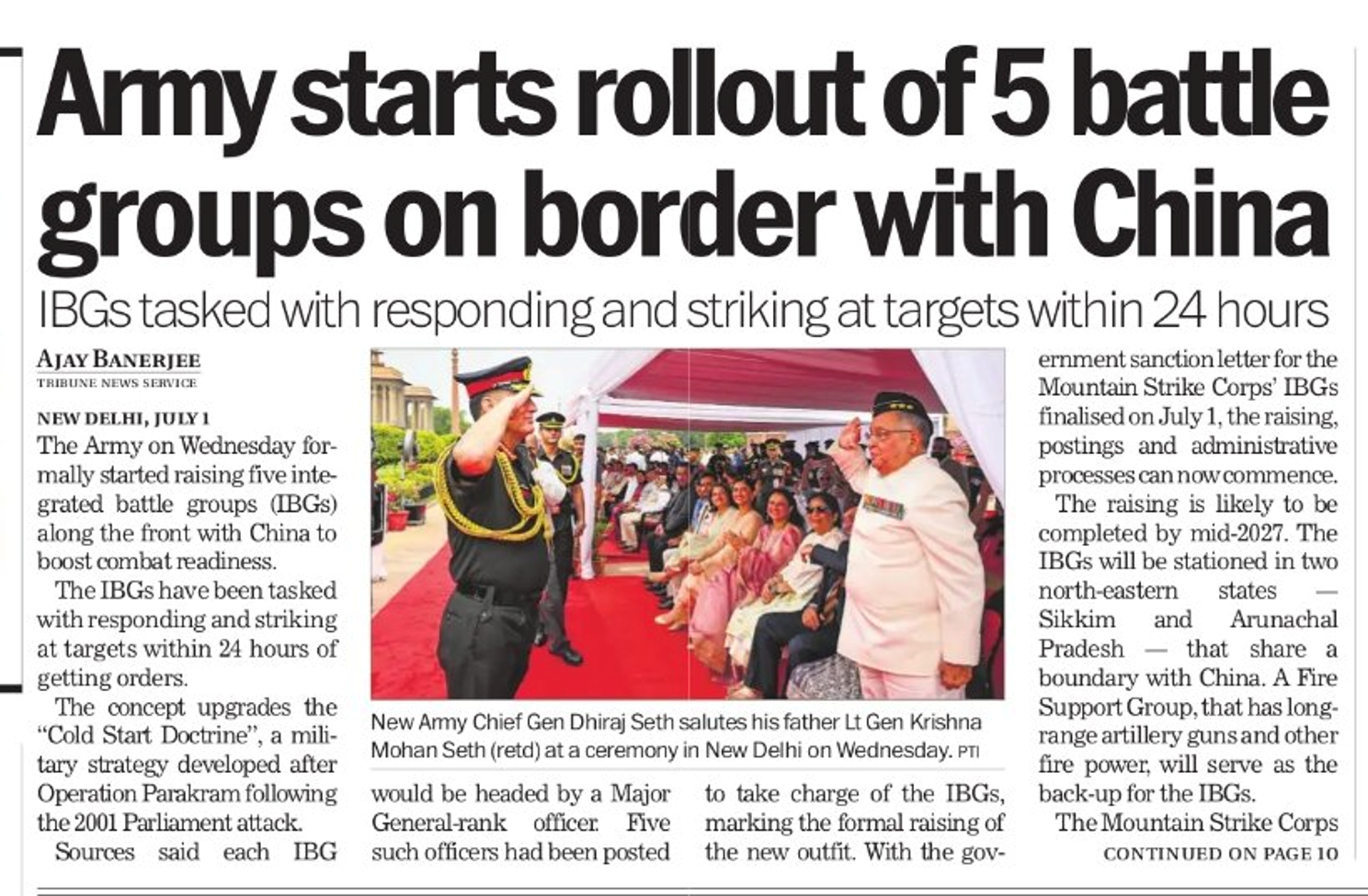
The first phase of the reform has been implemented under the XVII Mountain Strike Corps, headquartered at Panagarh in West Bengal. This corps is primarily responsible for operations along India’s northern border with China. Under the restructuring, five Integrated Battle Groups and one Fire Support Group have been established, each commanded by a Major General.
An Integrated Battle Group (IBG) is a self-contained, brigade-sized combat formation designed to operate independently with all essential combat and support elements under a unified command. Unlike the traditional structure, where infantry, armour, artillery, engineers, air defence, signals, logistics, and aviation function separately, an IBG integrates these capabilities into a single formation. This enables rapid mobilisation, quicker decision-making, and enhanced operational flexibility across different terrains.
Each IBG consists of more than 5,000 personnel and includes infantry, armoured units, artillery, engineers, air defence, signals, logistics, and surveillance assets. The formations are tailored according to the operational requirements of specific regions, making them suitable for both offensive and defensive operations. A newly introduced Chief Operations Officer, generally of Brigadier rank, will coordinate planning and execution within each IBG, ensuring greater synergy among different combat arms.
The newly created Fire Support Group (FSG) has been established to provide concentrated and precise long-range firepower to the Integrated Battle Groups. Equipped with advanced artillery systems and precision-strike capabilities, the FSG is expected to significantly improve the Army’s ability to neutralise enemy positions while supporting ground operations.
The concept of Integrated Battle Groups was first proposed to create leaner and more responsive military formations capable of rapid deployment. Unlike conventional divisions that often require several days to mobilise, IBGs are designed to deploy within a much shorter time frame and conduct independent operations. Their structure is based on the principles of flexibility, mobility, integration, and network-centric warfare.
This reform forms part of the Indian Army’s broader transformation strategy aimed at enhancing combat effectiveness while reducing administrative overheads. Alongside the introduction of IBGs, the Army is also restructuring its formations through initiatives such as Rudra all-arms brigades, Bhairav light commando battalions, Shaktimaan artillery regiments, and Divyastra drone and precision-strike units. These reforms are intended to prepare the Army for modern, technology-intensive warfare and strengthen India’s defence preparedness.
The establishment of Integrated Battle Groups marks a significant milestone in India’s military modernisation. By combining multiple combat capabilities under a unified command structure, the Army aims to achieve faster operational response, greater battlefield effectiveness, and improved readiness to address evolving security challenges in the Indo-Pacific and along India’s borders.


