




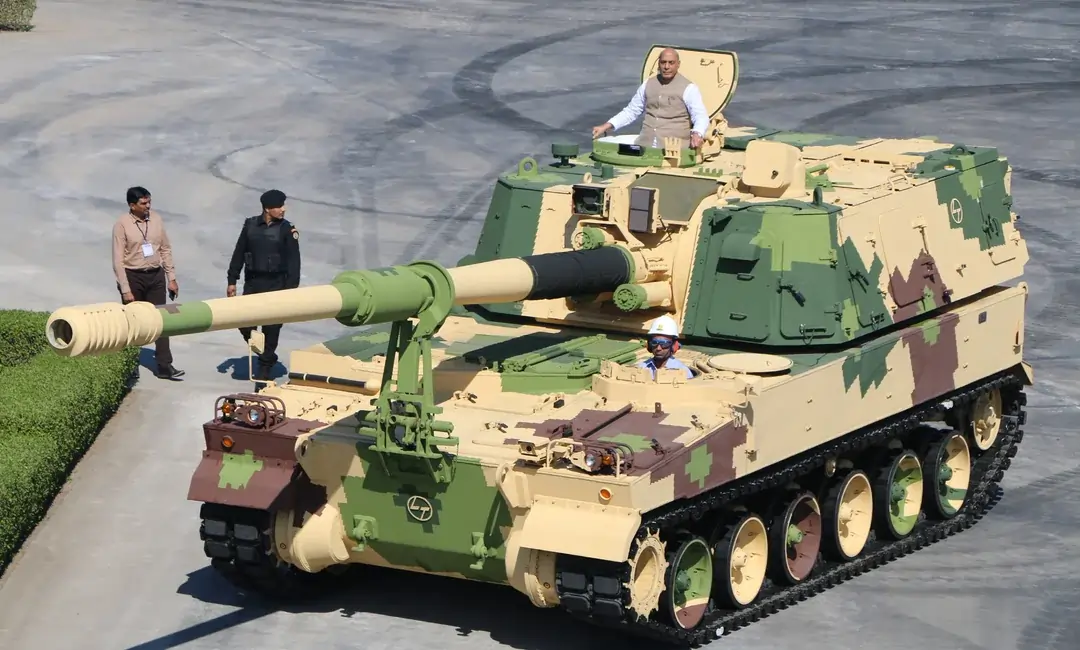
The Indian Army is set to present a proposal for a substantial artillery modernisation initiative, aimed at procuring more than 300 K9 Vajra-T self-propelled tracked howitzers, with an estimated cost of around Rs 23,000 crore. This proposal is expected to be submitted to the Defence Procurement Board (DPB) this week, marking one of the largest expansions of artillery capabilities in decades.
Defence sources suggest that this move is a strategic reinforcement of the Army’s long-range precision firepower, particularly crucial for operational requirements along the western front with Pakistan and the Line of Actual Control (LAC) with China.
Current Inventory and Background
The K9 Vajra-T, which is the indigenous variant of the South Korean K9 Thunder 155mm/52-calibre howitzer, is manufactured in India by Larsen & Toubro (L&T) under a technology transfer agreement with Hanwha Aerospace of South Korea. The howitzer features significant indigenous components and is produced at L&T’s facilities within India.
At present, the Indian Army operates about 100 K9 Vajra-T guns. The initial contract for 100 units, signed in 2017 for around Rs 4,500 crore, was completed ahead of schedule by 2021, with these systems mainly deployed in desert regions along the western border. A subsequent order for another 100 units, valued at approximately Rs 7,629 crore, was approved in late 2023/2024. If the latest proposal is greenlit, India’s total order of K9 Vajra systems would surpass 500, significantly expanding the Army’s self-propelled artillery fleet and pushing L&T’s cumulative production mandate over the 500-unit mark.
K9 Vajra-T Capabilities
The K9 Vajra-T boasts advanced capabilities as a highly mobile, tracked 155mm/52-calibre self-propelled howitzer, with the ability to engage targets at distances exceeding 40 kilometers. Notable operational features include:
- A rapid “shoot-and-scoot” capability, allowing the unit to fire and swiftly relocate, thus minimizing exposure to enemy counter-battery fire.
- High mobility and armored protection suited for diverse terrains, including arid deserts and high-altitude mountainous areas.
- Proven performance in extreme conditions, exemplified by successful trials of a cold-weather variant in Ladakh.
- Effective support to fast-moving armored formations while delivering sustained firepower across various operational scenarios.
The system has shown exceptional reliability during operations in Rajasthan’s desert regions and during high-altitude deployments in eastern Ladakh amid the 2020 standoff with China.
Strategic Rationale
Defence analysts consider this potential acquisition an essential step in reinforcing India’s artillery capabilities in response to evolving security challenges. The focus is on achieving responsive, mobile, and long-range precision strike capabilities that operate effectively in both desert plains and mountainous northern sectors.
This initiative reflects insights gained from recent military operations, highlighting the necessity for high-intensity precision fire capabilities. It aligns with the broader modernisation strategy of the Indian Army, which also includes the induction of Advanced Towed Artillery Gun Systems (ATAGS), Dhanush guns, and upgraded Pinaka multi-barrel rocket systems.
Officials have expressed confidence in the K9 Vajra-T, given its proven track record in both western and northern theatres. The additional systems are intended to mitigate existing capability gaps, enhance operational readiness, and establish a robust deterrent stance against the military advancements of potential adversaries.
Next Steps
The proposal will be formally reviewed by the DPB this week, initiating the approval process. Upon receiving clearance, the contract is expected to be awarded to L&T, thereby continuing the successful model of licensed production and technology transfer in India.
If approved, this procurement would significantly enhance the Indian Army’s capacity to deliver precise, sustained, and mobile fire support across its critical operational areas. It reflects a commitment to modernising the artillery division with combat-proven, versatile platforms capable of addressing the demands of contemporary and future conflicts.
This development aligns with the broader objective of the Indian defence establishment to elevate capability enhancement and self-reliance in key defence technologies while strategically addressing the distinct terrain and threat profiles of the western and northern borders.


