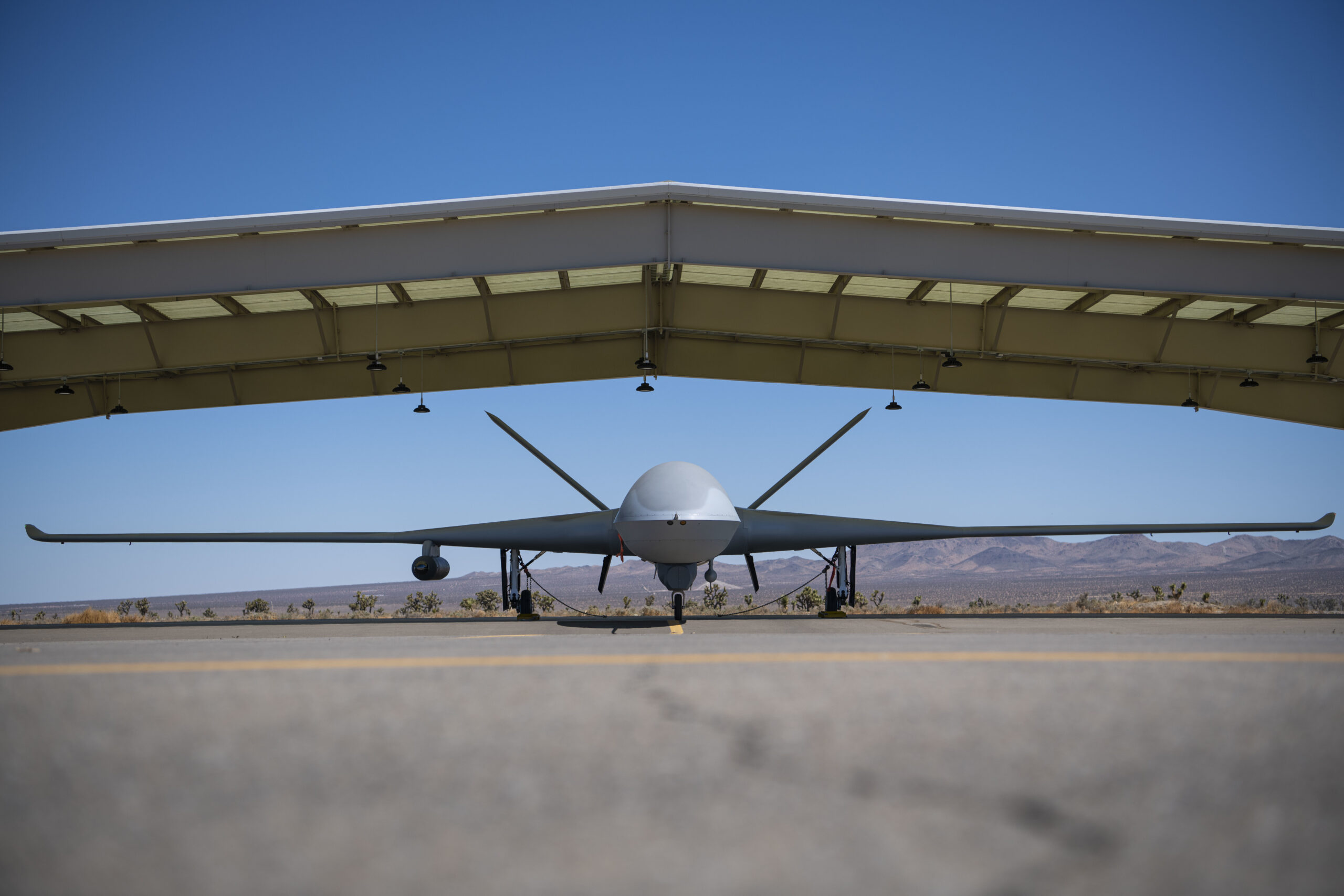
In response to vulnerabilities exposed during its use in contested airspace, the MQ-9 Reaper’s limitations prompted the development of a more advanced unmanned aerial vehicle: the MQ-20 Avenger, also known as the Predator C. Designed as a jet-powered remotely piloted aircraft, the Avenger incorporates several advanced features tailored for modern warfare, including enhanced speed, stealth, and combat adaptability.
The Avenger was conceived in the 2000s by General Atomics Aeronautical Systems (GA-ASI) as part of an effort to advance beyond its predecessors, the MQ-1 Predator and MQ-9 Reaper. These earlier models played crucial roles in counterinsurgency operations due to their long endurance and sensor capabilities. However, they fell short of requirements for higher speed and reduced radar signature needed in faced with more sophisticated threats. The Avenger addresses these shortcomings with a design that prioritizes agility and stealth, making it more suitable for operations against advanced adversaries.
Initial evaluations in 2009 posited the Avenger as a potential addition to the Reaper fleet. In the following year, GA-ASI rolled out the Sea Avenger, a variant designed for carrier-based operations, to align with the U.S. Navy’s needs for unmanned aerial capabilities. Despite not entering mass production, these designs positioned General Atomics favorably within the evolving landscape of unmanned combat systems.
The MQ-20 Avenger is powered by a Pratt & Whitney PW545B turbofan engine, enabling speeds up to 460 miles per hour and altitudes of 50,000 feet. Its fuselage, characterized by stealth capabilities and an internal weapons bay, greatly minimizes radar visibility. Additionally, the aircraft can carry up to 3,500 pounds of payload, which includes a versatile range of armaments—from AGM-114 Hellfire missiles to laser-guided bombs. The onboard technology integrates electro-optical/infrared sensors, synthetic aperture radar, and satellite communications, providing extensive long-range scouting and tracking capabilities.
Despite its advancements, the Avenger faces significant limitations, chiefly its limited production numbers. With only a few units manufactured, it lacks the economies of scale that have made the Reaper a budget-friendly option for military operations. The MQ-20’s endurance of roughly 20 hours, while formidable, is shorter than the Reaper’s 27-hour capability, which may constrain its effectiveness in long-term surveillance missions. Furthermore, emerging competition from programs like the MQ-25 Stingray for carrier-based refueling, as well as the U.S. Air Force’s Collaborative Combat Aircraft initiative, have overshadowed the Avenger.
Although it has not become a mainstay in the military fleet, the Avenger has played a significant role in technology demonstrations and experiments focused on autonomous teaming, particularly in “loyal wingman” initiatives that allow drones to operate alongside manned aircraft, thus enhancing their combined operational effectiveness.
Ultimately, the MQ-20 Avenger signifies a critical transitional phase in drone technology, bridging the gap between traditional models and future stealthy unmanned combat air vehicles. Its legacy in advancing unmanned systems and integrating modern capabilities is shaping the future landscape of aerial warfare. Despite not achieving widespread deployment, its contribution to the evolution of unmanned aerial technology is undeniable.