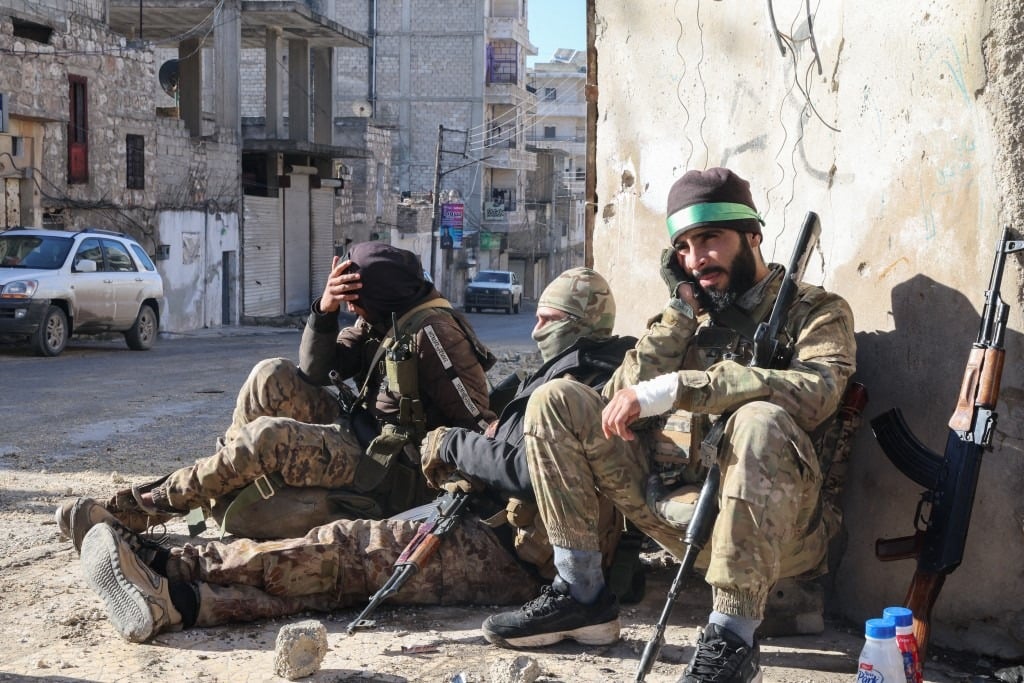
Syria’s military announced on Saturday that its forces have begun entering an area east of Aleppo, following an agreement with Kurdish forces to withdraw from the region amid escalating clashes. State television reported that operations commenced in the western Euphrates area, notably starting with the town of Deir Hafer.
Eyewitness accounts from AFP indicated that army units, including tanks, were advancing toward this key area. The military issued a statement urging civilians to avoid the operations zone until it had been fully secured and cleared of mines and remnants of war, emphasizing the need for safety in the midst of the mounting tensions.
This move comes on the heels of a significant shift in control within Aleppo, where the Syrian army managed to push Kurdish forces out last week after a series of violent confrontations. Reinforcements were subsequently deployed near Deir Hafer, prompting an ultimatum to the Kurdish-led Syrian Democratic Forces (SDF) to evacuate the territory between the town and the Euphrates River, located approximately 30 kilometers to the east.
Kurdish leader Mazloum Abdi announced on Friday that the SDF would comply with the withdrawal order, citing “calls from friendly countries and mediators.” The Syrian defense ministry expressed approval of Abdi’s announcement, stating that army troops would assume control of the area following the SDF’s exit.
Concerns for civilian safety have been high, with Syrian authorities reporting that at least 4,000 individuals had fled the Deir Hafer region in recent days as tensions surged.
In a potentially conciliatory gesture amid the unrest, Syrian President Ahmed al-Sharaa issued a decree on Friday recognizing Kurdish as a “national language.” This marked a significant development in Syria’s historical treatment of the Kurdish minority, offering a semblance of rights after decades of marginalization under past regimes. The decree acknowledges Kurds as “an essential and integral part” of Syria, and establishes Kurdish as a language that can be taught in public schools in areas with a substantial Kurdish population.
The current Islamist-led administration has ambitions to extend its control across the nation in the aftermath of the ousting of longtime leader Bashar al-Assad in late 2024. However, progress on a March agreement aimed at integrating the Kurdish autonomous governance structure in the north with the central state has faced numerous challenges and delays.
As the situation develops, the Kurdish forces maintain control over significant portions of Syria’s oil-rich north and northeast, territories seized during the prolonged civil conflict and ongoing efforts to combat the Islamic State group over the last decade.