




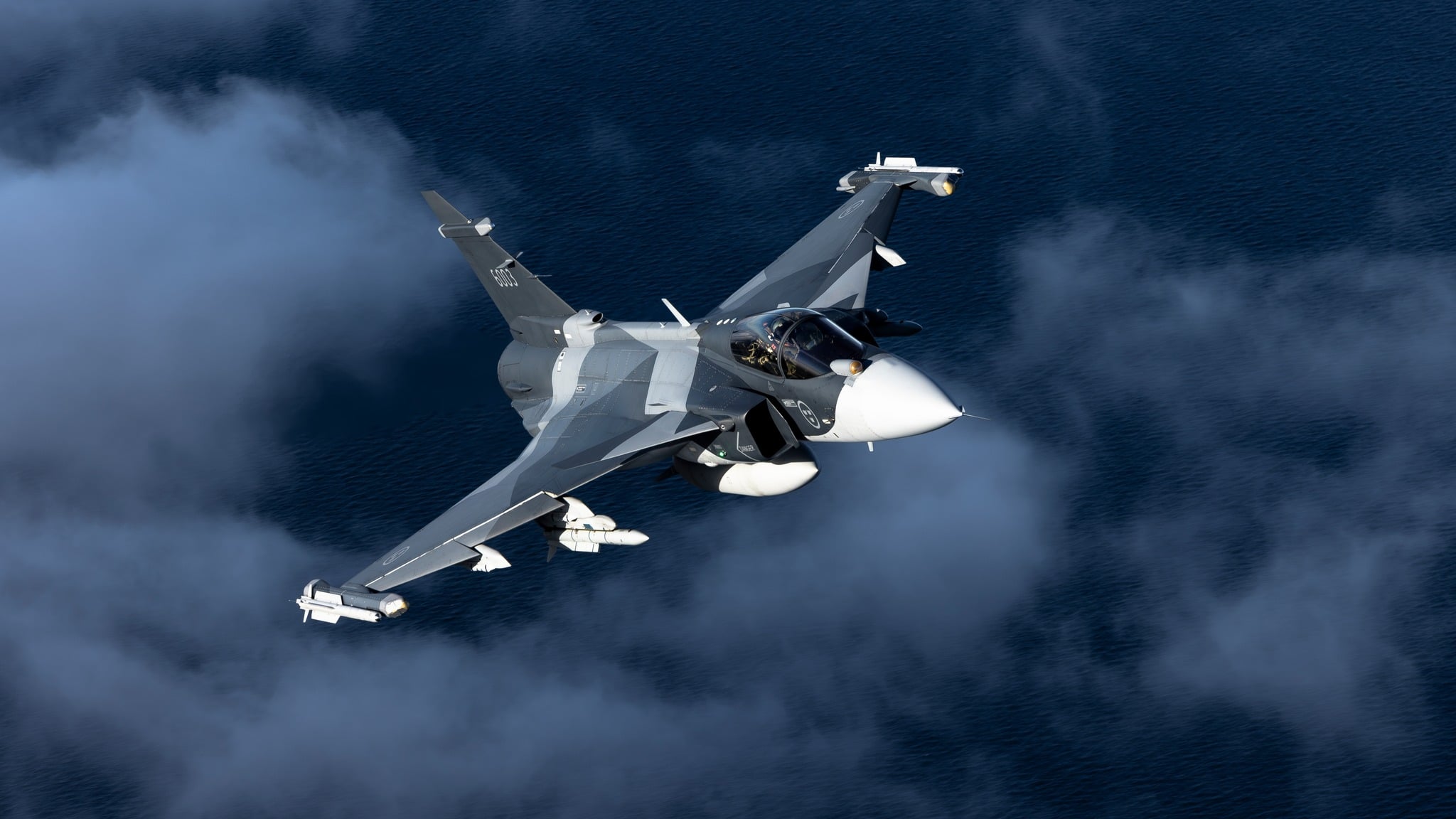
When Sweden faced the daunting task of safeguarding its airspace during the Cold War, it quickly realized its armed forces had to innovate. The country sought a fighter that blended agility, cost-effectiveness, and cutting-edge technology. This pursuit culminated in the creation of the JAS 39 Gripen, a versatile multi-role fighter capable of executing air-to-air, air-to-ground, and reconnaissance missions with unparalleled flexibility.
Designed and manufactured by Saab for the Swedish Air Force, the Gripen has become an emblem of Swedish innovation in aerospace technology. Its development has shown that even smaller air forces can operate advanced, globally relevant aircraft.
The Gripen, which stands for Jakt (fighter), Attack (strike), and Spaning (reconnaissance), is a light, single-engine fighter optimized for cost-efficient operations. It features advanced avionics, a delta-wing design, and fly-by-wire controls, providing exceptional maneuverability, short takeoff capabilities, and swift adaptability to various missions.
The genesis of the Gripen can be traced back to the 1970s when Sweden aimed to replace its aging fleet, which included the Saab 35 Draken and Saab 37 Viggen. The mission was clear. The new fighter needed to be multifunctional, able to operate from short and dispersed airfields without extensive support, and remain budget-friendly for a modest air force. The Gripen was conceived to fulfill these requirements by incorporating essential lessons from its predecessors.
Engineers drew on Draken’s agility and air defense performance while adopting operational lessons from the Viggen, such as rugged undercarriage design and short-field capabilities. With further advancements, the Gripen features digital fly-by-wire controls, a relaxed-stability airframe for enhanced maneuverability, and an integrated avionics system designed for rapid software updates.
One of the aircraft’s defining features is its ability to be quickly serviced by small ground crews, allowing for fast turnaround in deployment, which is crucial during combat. The Gripen entered service in 1997 after its maiden flight in 1988.
Throughout its evolution, the Gripen has been adapted for various operational needs. Each variant maintains its core design philosophy while addressing Sweden’s changing defense requirements:
- JAS 39A/B: Introduced in 1997, this basic multi-role platform was essential in replacing older aircraft.
- JAS 39C/D: Introduced in the early 2000s, this version focused on NATO compatibility and showcased improved avionics.
- JAS 39E/F: Emerging in the 2020s, this advanced model emphasizes network-centric warfare capabilities, extended operational range, and enhanced payload capacity.
The Gripen’s capabilities include exceptional multi-role flexibility, allowing it to switch seamlessly between different mission profiles. Its compact and agile design, advanced sensors, and modern cockpit make it a formidable contender in aerial combat. The aircraft operates effectively on short runways and is capable of executing rapid maneuvers in contested airspace.
However, the Gripen does have limitations. Its smaller airframe restricts heavy weapon loads compared to larger fighters, and while its single-engine design ensures reliability, it has less redundancy than twin-engine aircraft. Moreover, the Gripen’s internal fuel capacity results in limited range compared to more strategic fighters.
Globally, the Gripen has demonstrated its value in peacekeeping missions, NATO exercises, and air defense operations across various nations, including Brazil, South Africa, and Thailand. Its compact design allows it to operate efficiently from austere airfields, further broadening its appeal to countries with limited military infrastructure.
Looking ahead, the Gripen continues to advance with ongoing software upgrades, new munitions, and enhanced sensor technology. The latest JAS 39E/F variants are expected to further extend operational capabilities and improve integration with NATO systems, ensuring the Gripen remains a strategic asset for both small and medium air forces for years to come. Its combination of affordability, agility, and versatility positions it as a significant player in modern aerial defense.


