Every NDA, CDS or TES aspirant dreams of the olive green uniform, but commissioning is only the beginning. Once an officer or soldier joins a unit, the Indian Army keeps sending him or her back to school, and some of those schools are among the hardest military courses anywhere in the world.
These courses test far more than fitness. They push trainees through sleep deprivation, heavy loads, extreme cold, thick jungle and constant pressure to make sound decisions while exhausted. Interviewing Officers at the Services Selection Board (SSB) often ask candidates what they know about the Army’s training, and knowing these institutions also helps with lecturettes and group discussions.
Here are 10 of the toughest training courses and programmes in the Indian Army, with the key facts every defence aspirant should know. The numbering is for easy reading and is not an official ranking. Durations and course structures change from time to time, so treat timeframes as approximate.
1. Para (Special Forces) Probation
Where: Para (SF) units and the Special Forces Training School, Nahan (Himachal Pradesh)
Duration: About three months of probation, followed by further specialised training
Who attends: Volunteers from across the Army, officers and soldiers alike
Reward: Maroon beret and, later, the Balidan badge
Para (SF) selection is widely regarded as the toughest test in the Indian Army. It is entirely voluntary. During probation every candidate, including officers, is stripped of rank and is simply called a ‘probationer’. A probationer can walk away at any time, and many do.
The probation includes long speed marches with heavy loads, endurance runs, navigation in unfamiliar terrain, very little sleep or food, a long continuous stress test and training in weapons, demolition, communication and first aid. Instructors are not looking only for strength; they want people who keep thinking clearly when completely exhausted.
Only a small share of volunteers complete probation. Those who do earn the maroon beret and join a Para (SF) battalion, where training continues. The Balidan (‘sacrifice’) badge, the distinctive insignia of Indian special forces, is earned only after further training and operational experience.
2. Commando Course, Belagavi
Where: Commando Wing, Junior Leaders Wing (part of the Infantry School), Belagavi, Karnataka
Duration: About 35 days (five weeks)
Who attends: Mandatory for infantry officers; also officers and soldiers of other arms, CAPFs and friendly foreign armies
Famous motto board: “We make men out of boys”
The Commando Course at Belagavi (Belgaum) is the course most young infantry officers remember for the rest of their careers. It is compulsory for infantry officers, and soldiers who complete it usually join their battalion’s Ghatak platoon, the unit’s own strike team.
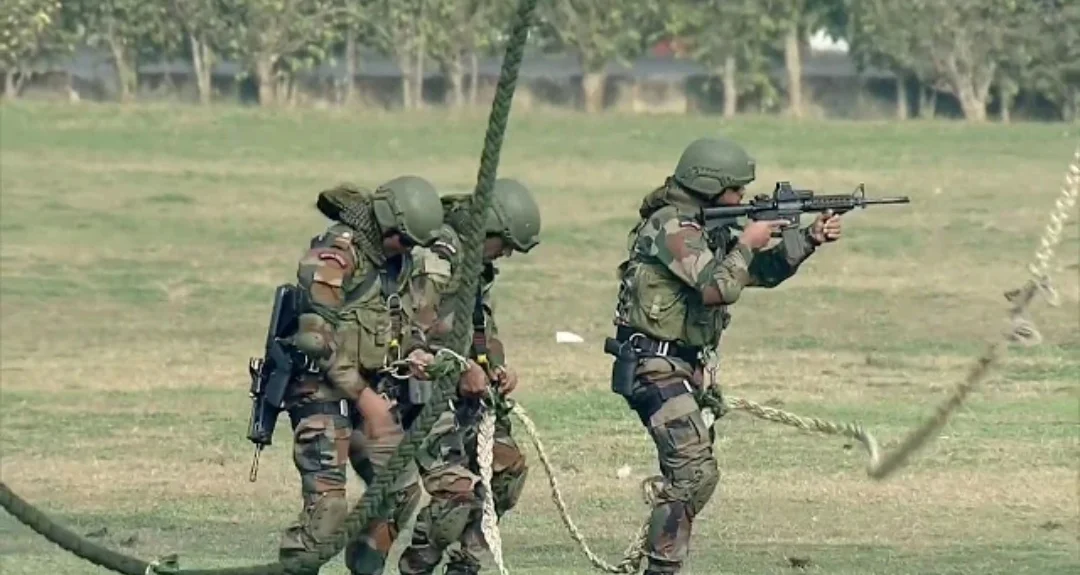
The five weeks are packed with endurance runs with full battle load, rock climbing, slithering from helicopters, unarmed combat, day and night navigation, a battle obstacle course and combat firing. Two of the most feared tests are the commando slide and the ‘Lido jump’ into water from a height. The course ends with long field exercises in which small teams operate on little or no sleep.
Captain Vikram Batra, PVC, the hero of Kargil, attended the commando course at Belgaum in early 1999, only months before the war.
3. Parachute Probation and Basic Parachute Course
Where: Parachute Regiment Training Centre, Bengaluru, and Paratroopers Training School (PTS), Agra
Duration: Around 90 days of probation, followed by a short basic parachute course of a few weeks
Jumps: Five static-line jumps, including one at night with battle load
Reward: Maroon beret and para wings
Every member of the Parachute Regiment is a volunteer. Before earning the maroon beret, a volunteer goes through a probation of about 90 days that includes physical tests at higher standards than normal units and speed marches of 10, 20, 30 and 40 km carrying a heavy load.
After probation comes the Basic Parachute Course at PTS Agra, the school run by the Indian Air Force that trains paratroopers from all three services and other forces. Trainees spend roughly two weeks in ground training, learning how to exit the aircraft, hold their body position in the air, land safely and deal with emergencies, before making their jumps.
For many, the hardest part is not physical but mental: stepping out of an aircraft for the first time. Those who complete the jumps receive their para wings, one of the proudest badges a soldier can wear.
4. Combat Free Fall Course
Where: Paratroopers Training School, Agra
Type: Military free-fall parachuting, including high-altitude techniques
Altitude: Jumps from about 5,500 feet up to around 30,000 feet
Who attends: Selected, already qualified paratroopers, mainly from special forces
The Combat Free Fall (CFF) course takes parachuting to a much more demanding level. In a basic static-line jump the parachute opens automatically. In free fall the jumper opens the parachute himself at a set height, after falling freely through the air.
Free-fall techniques let special forces enter an area quietly from high altitude. At the greatest heights jumpers need oxygen and must cope with intense cold, high speeds and the need to steer accurately to a small landing area, often with equipment and at night.
Only a select few paratroopers are trained in CFF. One mistake in the air leaves little margin, which is why the training is precise, repetitive and unforgiving.
5. Winter Warfare Course, HAWS Gulmarg
Where: High Altitude Warfare School (HAWS), Gulmarg, Jammu and Kashmir
Established: December 1948, as the 19 Infantry Division Ski School
Season: Roughly January to April
Levels: Basic and Advanced
The High Altitude Warfare School is the Army’s centre for training in snow, ice and mountains. It was set up in December 1948 by Brigadier (later General) K S Thimayya after the hard lessons of the 1947–48 war in Jammu and Kashmir, and took its present name in 1962.
The Winter Warfare course is run at Gulmarg in the snow season. Trainees learn skiing, survival in snow-bound areas, avalanche awareness and rescue, and how to move and fight in deep snow. Temperatures far below freezing, avalanche-prone slopes and thin air make every task harder.
HAWS also trains personnel from the Indian Air Force, the Navy, the CAPFs and friendly foreign armies, and its instructors regularly take part in avalanche and mountain rescue operations.
6. Mountain Warfare Course, HAWS Sonamarg
Where: HAWS training node at Sonamarg; ice-craft training at Machoi near Zojila
Season: Roughly May to October
Levels: Basic and Advanced
Key skills: Rock and ice climbing, rope work, mountain survival, glacier movement
The Mountain Warfare course is the summer counterpart of the Winter Warfare course. It is conducted at Sonamarg, with ice-craft training at Machoi on the far side of the Zojila pass.
Trainees learn rock climbing, rope techniques, crossing rivers and crevasses, ice-wall climbing and how to move tactically on steep slopes while carrying loads. Much of the training is done at high altitude, so trainees must cope with fatigue, cold and the effects of reduced oxygen.
Since much of India’s northern border runs through high mountains, these skills matter for troops posted along the Line of Control and the Line of Actual Control, including in Ladakh and on the Siachen Glacier.
7. Counter Insurgency and Jungle Warfare School, Vairengte
Where: CIJW School, Vairengte, Mizoram
Raised: 1967, as a Jungle Training School in Meghalaya; moved to Vairengte on 1 May 1970
Motto: “Fight the guerrilla like a guerrilla”
Focus: Counter-insurgency, counter-terrorism and jungle warfare
The CIJW School is one of the best-known counter-insurgency training institutions in the world. It was raised in 1967, moved to Vairengte in Mizoram on 1 May 1970 and has since trained Indian units, CAPF personnel and troops from many friendly foreign countries.
Trainees learn jungle survival, tracking, ambush and counter-ambush drills, reflex firing, identifying improvised explosive devices (IEDs) and how to operate among a civilian population without causing harm. Long field exercises simulate insurgent ambushes and IED threats in dense, humid jungle, often at night.
The school’s motto sums up its approach: to defeat guerrillas, soldiers must learn to move, live and think like them while staying disciplined and humane.
8. Siachen Battle School Pre-Induction Training
Where: Siachen Battle School, near the Siachen Glacier, Ladakh
Duration: About a month (varies)
Who attends: Officers and soldiers before deployment on the Siachen Glacier
Key skills: Endurance, ice-wall climbing, crevasse and avalanche rescue, survival
The Siachen Glacier is often called the world’s highest battlefield. No soldier is sent there without first completing pre-induction training at the Siachen Battle School.
The training covers endurance, ice-wall climbing, crevasse rescue, avalanche rescue and survival drills in extreme cold. Acclimatisation is built in, because moving to high altitude too quickly can lead to dangerous high-altitude illnesses.
In January 2023, Captain Shiva Chauhan of the Fire and Fury Corps became the first woman officer to be operationally deployed on the Siachen Glacier, at Kumar Post, after completing a month of training at the Siachen Battle School.
9. Sniper Course, Infantry School Mhow
Where: Infantry School, Mhow, Madhya Pradesh
Who attends: Selected soldiers from infantry and other units
Rifles: Dragunov SVD and the Sako TRG-42, among others
Key skills: Marksmanship, ballistics, fieldcraft, stalking, camouflage, observation
Being a good shot is only the starting point for a sniper. The sniper course at the Infantry School, Mhow, trains soldiers to hit targets at long range and also to move unseen, stay hidden for long periods and observe and report what they see.
Trainees calculate the effect of wind, distance and elevation, build ghillie suits and hides, and practise stalking exercises in which they must approach a target without being spotted by instructors. Lying still for hours in heat or cold, without making a sound, demands great patience and mental strength.
Snipers trained here serve along the Line of Control and in counter-insurgency areas, where a single well-placed sniper can keep a large area under watch.
10. Combat Aviators Course, CATS Nashik
Where: Combat Army Aviation Training School (CATS), Gandhi Nagar Airfield, Nashik Road, Maharashtra
Who attends: Army officers who volunteer for Army Aviation and clear flying aptitude and medical tests
Reward: Aviation Wings, as combat helicopter pilots
Milestone: Captain Abhilasha Barak became the Army’s first woman helicopter pilot on 25 May 2022
CATS Nashik is the premier flying training institution of the Indian Army and works under the Army Training Command (ARTRAC), Shimla. Officers who want to fly with the Army Aviation Corps must clear selection tests before attending the Combat Aviators Course.
The course combines demanding flying training with ground subjects and gunnery. Trainees must master helicopter flying, tactical flying and weapon delivery while being assessed throughout. A weak performance in the air can end a trainee’s flying career, so the pressure is constant.
On 25 May 2022, 37 officers received their Aviation Wings at CATS, and Captain Abhilasha Barak became the first woman combat helicopter pilot of the Indian Army.
What These Courses Have in Common
Although they teach very different skills, all of these courses share a few ideas. They are built to test the mind as much as the body. They teach teamwork, because no one survives a 40 km march, a glacier crossing or a jungle exercise alone. And they reward people who keep their judgment and sense of humour when tired, cold and hungry.
These are exactly the qualities assessors look for at the SSB: effective intelligence, stamina, determination, cooperation and the ability to influence a group. The Officer Like Qualities (OLQs) you show at the SSB are the same qualities you will need at Belagavi, Gulmarg or Vairengte.
Conclusion
From the probation of Para (SF) and the Commando Course at Belagavi to the snowfields of Gulmarg, the jungles of Mizoram and the ice of Siachen, the Indian Army’s toughest courses turn good soldiers into specialists who can fight in almost any terrain and climate.
For NDA, CDS and SSB aspirants, you do not need to memorise every detail. Know where these schools are, what they teach and why they matter. Start building fitness, endurance and mental toughness now, because the Army will expect them from day one.
Frequently Asked Questions
1. Which is the toughest course in the Indian Army?
There is no official ranking, but Para (SF) probation is widely regarded as the toughest, because it is voluntary, very long, strips volunteers of rank and has a high drop-out rate.
2. Is the commando course compulsory for Army officers?
The Commando Course at Belagavi is mandatory for infantry officers. Officers of other arms and services can also attend it.
3. Where is the High Altitude Warfare School?
HAWS is at Gulmarg in Jammu and Kashmir. Winter Warfare courses are held at Gulmarg and Mountain Warfare courses at Sonamarg.
4. What is the motto of the CIJW School?
The motto of the Counter Insurgency and Jungle Warfare School, Vairengte, is “Fight the guerrilla like a guerrilla”.
5. Who conducts parachute training for Indian Army paratroopers?
Basic and advanced parachute training is conducted at the Paratroopers Training School, Agra, which is run by the Indian Air Force and trains personnel from all three services.