Class 12 is the first real crossroads for anyone who dreams of wearing the uniform. Some students want to lead troops as officers, some want to become doctors or nurses in uniform, and many simply want to serve as soon as possible. The Indian Army, Indian Navy and Indian Air Force all offer clear routes for school leavers.
Yet many aspirants miss these routes because they learn about them only after the age limit has passed. Each entry has its own subjects, marks, age window and selection process.
Below are 10 ways to join the Indian Armed Forces after Class 12, covering officer, medical, nursing and Agniveer entries. Details are taken from the latest official notifications, but age windows and vacancies change every cycle, so always confirm the current notice before you apply. The order is not a ranking.
1. National Defence Academy (NDA): Army, Navy and Air Force Wings
Conducted by: UPSC, twice a year (NDA & NA I and II)
Who can apply: Unmarried men and women
Age: Roughly 16½ to 19½ years; exact birth-date window given in each notice
Education: Class 12 pass or appearing; Physics, Chemistry and Mathematics required for the Air Force and Naval wings
Selection: Written exam (Mathematics 300 + General Ability Test 600) followed by a 900-mark SSB interview and medical
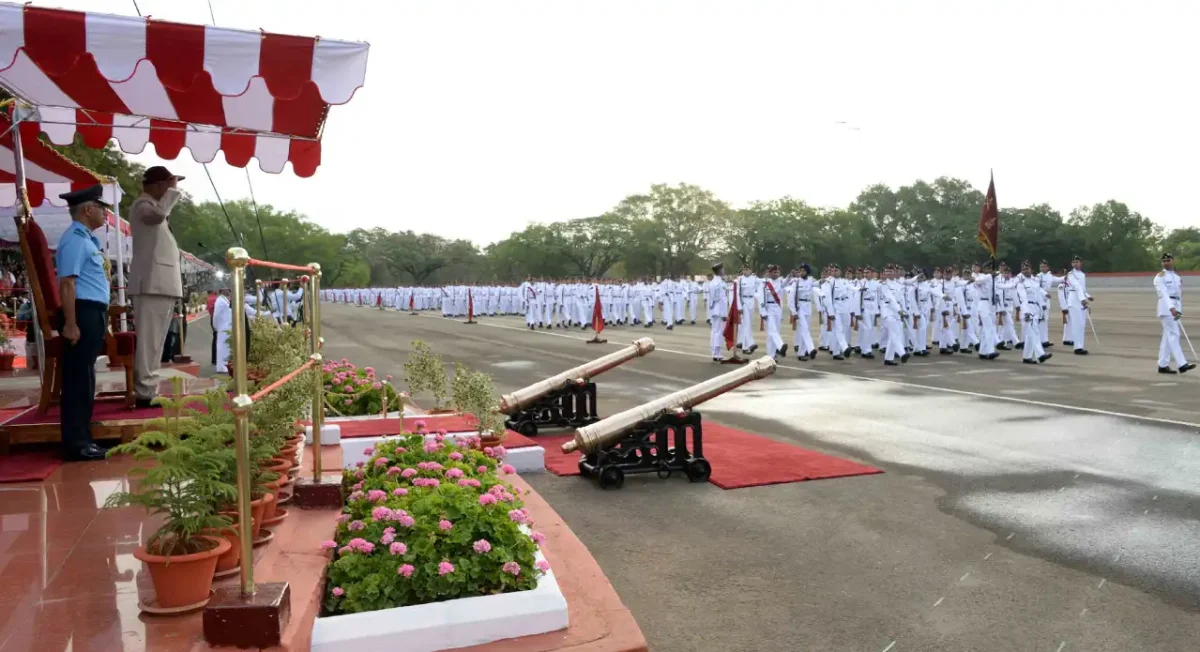
NDA is the most famous officer entry after Class 12, and for good reason. Cadets spend three years at the National Defence Academy, Khadakwasla, near Pune, and earn a degree before moving to their own service academy: the Indian Military Academy for Army cadets, the Indian Naval Academy for Navy cadets and the Air Force Academy for Air Force cadets. They are then commissioned as permanent commissioned officers.
Women have been eligible for NDA since 2021. For the NDA & NA (II) 2026 examination, UPSC notified 394 vacancies and required candidates to be born between 1 January 2008 and 1 January 2011. As per the UPSC calendar, the notice for NDA & NA (I) 2027 is due on 2 December 2026. Check our guides on the NDA 1 exam date 2027 and the NDA 1 age limit 2027 to plan your attempt.
2. Indian Naval Academy 10+2 Cadet Entry (Through the NDA & NA Exam)
Conducted by: UPSC, through the same NDA & NA written exam
Who can apply: Unmarried men and women
Education: Class 12 with Physics, Chemistry and Mathematics
Training: Four-year B.Tech programme at the Indian Naval Academy (INA), Ezhimala, Kerala
Outcome: Permanent commission in the Indian Navy
Many students do not realise that the full name of the exam is the National Defence Academy and Naval Academy Examination. The “NA” part is a separate entry called the 10+2 Cadet Entry Scheme. Cadets selected under it go straight to the Indian Naval Academy at Ezhimala for a four-year engineering degree combined with naval training.
You choose the Naval Academy in the same UPSC form, take the same written test and SSB, and are placed by merit and preference.
3. Army 10+2 Technical Entry Scheme (TES)
Conducted by: Indian Army (Directorate General of Recruiting), twice a year
Who can apply: Unmarried men
Age: 16½ to 19½ years
Education: Class 12 with at least 60% aggregate in Physics, Chemistry and Mathematics, and you must have appeared in JEE (Main) of the same year
Selection: Shortlisting on PCM percentage, SSB interview and medical; there is no separate written exam
TES is the Army’s answer for science students who want to become officers and engineers at the same time. Under TES-56 (course starting January 2027), the Army notified 90 provisional vacancies. Training lasts four years: three years of combined military and engineering training at a Cadets Training Wing (CME Pune, MCTE Mhow or MCEME Secunderabad), followed by one year at the Indian Military Academy, Dehradun, or a designated pre-commission training academy.
Cadets earn an engineering degree and are commissioned as Lieutenants with a permanent commission. Most TES officers go to technical arms such as the Corps of Engineers, Corps of Signals and the Corps of Electronics and Mechanical Engineers. Because shortlisting depends on your Class 12 PCM marks, every board mark counts, and appearing in JEE (Main) is compulsory.
4. Indian Navy 10+2 (B.Tech) Cadet Entry Scheme
Conducted by: Indian Navy, through joinindiannavy.gov.in
Who can apply: Unmarried men and women
Education: At least 70% aggregate in PCM in Class 12 and at least 50% in English (in Class 10 or 12)
Shortlisting: JEE (Main) Common Rank List, followed by SSB interview and medical
Training: Four-year B.Tech at INA Ezhimala, leading to permanent commission in technical branches
This is a second, separate path to the Indian Naval Academy that does not use the UPSC written exam at all. The Navy shortlists candidates for the SSB using their JEE (Main) All India Common Rank List. For the course starting January 2027, the Navy advertised 60 vacancies, 30 in Mechanical Engineering and 30 in Electronics and Communication Engineering, with a maximum of eight vacancies for women. The birth-date window was 2 July 2007 to 1 January 2010.
If you are preparing for JEE anyway, this entry gives you a second shot at becoming a naval officer without writing another exam. The 70% PCM requirement is only the minimum; the actual SSB call-up depends on your JEE rank.
5. MBBS at the Armed Forces Medical College (AFMC), Pune
Admission through: NEET (UG), followed by screening at AFMC
Who can apply: Unmarried men and women who are Indian citizens
Age: 17 to 24 years (as on 31 December of the admission year)
Education: Physics, Chemistry, Biology and English passed in the first attempt; at least 60% aggregate in the three sciences, 50% in each science and 50% in English; Mathematics passed in Class 10
Seats: 145 a year (115 boys and 30 girls)
If you want to become a doctor in uniform, AFMC Pune is the gateway. Students who qualify NEET (UG) and apply to AFMC are shortlisted for a further screening and interview at the college, followed by a medical examination. Students are trained as medical cadets during the 4½-year MBBS course, which is followed by a one-year internship in service hospitals.
There is a catch you must understand before you apply: every AFMC graduate has a compulsory liability to serve as a commissioned officer in the Armed Forces Medical Services, and parents or guardians sign a bond at the time of admission. The type of commission offered depends on vacancies.
6. B.Sc Nursing and Military Nursing Service (MNS)
Admission through: NEET (UG), followed by a computer-based test (ToGIGE), psychological assessment, interview and medical
Who can apply: Female candidates only
Education: Class 12 in the first attempt with Physics, Chemistry, Biology and English, and at least 50% aggregate
Seats (2026): 220 across six AFMS colleges of nursing
Outcome: Permanent or short service commission in the Military Nursing Service
The four-year B.Sc Nursing course run by the Armed Forces Medical Services is one of the most rewarding routes for women who have studied biology. For 2026, the colleges were at AFMC Pune, Command Hospital (Eastern Command) Kolkata, INHS Asvini Mumbai, Army Hospital (Research and Referral) New Delhi, Command Hospital (Central Command) Lucknow and Command Hospital (Air Force) Bengaluru.
Students receive free accommodation, rations, a uniform allowance and a stipend during training. After graduating they are commissioned as officers in the Military Nursing Service. Applications open on the Join Indian Army portal after the NEET (UG) results.
7. Agniveer in the Indian Army (Technical and Clerk/Store Keeper Technical)
Scheme: Agnipath, four-year engagement
Selection: Online Common Entrance Exam, followed by a recruitment rally with physical fitness test and medical
Agniveer (Technical): Class 12 Science with Physics, Mathematics and English and at least 50% aggregate (other technical qualifications are also accepted)
Agniveer (Clerk/SKT): Class 12 in any stream with 60% aggregate, at least 50% in each subject, and 50% in English and in Maths/Accounts/Book Keeping
Age (2027 intake): 17½ to 22 years
If you want to join the Army as soon as possible after school, the Agniveer route is the most direct. Class 12 students can apply for Agniveer (Technical) and Agniveer (Clerk/Store Keeper Technical), while Agniveer (General Duty) is open from Class 10 onwards. The recruitment cycle for the 2027 intake opened with online registration from 13 February to 1 April 2026, followed by the online exam.
On 4 November 2026, the Union Cabinet approved an important change. As before, up to 25% of Agniveers will be selected on merit for regular service after four years. The remaining Agniveers will now be offered a second engagement of two years if they are willing, and after that all of them can be enrolled as regular soldiers, subject to meeting the selection criteria. This makes the Agniveer route a far more secure long-term career.
8. Agniveer in the Indian Navy (SSR and SSR Medical Assistant)
Selection: Indian Navy Entrance Test (INET), then Stage II with physical fitness test and medical
Who can apply: Unmarried men and women (SSR); men for SSR Medical Assistant
SSR education: Class 12 with Mathematics and Physics, at least 50% aggregate (or a three-year engineering diploma)
SSR (Medical Assistant) education: Class 12 with Physics, Chemistry and Biology, at least 50% aggregate and 40% in each subject
Training: Basic training at INS Chilka, Odisha
The Navy recruits sailors after Class 12 as Agniveer (Senior Secondary Recruit), known as SSR. For the 01/2027 and 02/2027 batches, the first stage was the INET online test in May 2026, and successful candidates are called for Stage II and then trained at INS Chilka. Agniveers in the Navy receive a monthly package of ₹30,000 in the first year, with fixed yearly increases.
The SSR (Medical Assistant) entry is designed for PCB students who want to work in naval hospitals and medical teams afloat and ashore.
9. Agniveervayu in the Indian Air Force
Scheme: Agnipath, four-year engagement
Who can apply: Unmarried men and women
Science subjects: Class 12 with Mathematics, Physics and English, at least 50% aggregate and 50% in English (or a three-year engineering diploma)
Other than science: Class 12 in any stream, at least 50% aggregate and 50% in English
Selection: Online test, physical fitness test, adaptability tests and medical, conducted by CASB
The Air Force offers a route for students from every stream. Science students take the science-subjects test and arts or commerce students take the other-than-science test. For Intake 01/2027, registration ran in January and February 2026, and candidates had to be born within a fixed window set for that intake.
Agniveervayu work in technical, administrative and support roles that keep aircraft flying.
10. Sepoy Pharma in the Army Medical Corps
Who can apply: Male candidates who have done a pharmacy course after Class 12
Education: Class 12 plus a D.Pharm with at least 55% marks, or a B.Pharm with at least 50%, and registration with a State Pharmacy Council or the Pharmacy Council of India
Age: 19 to 25 years
Applied through: The Army’s annual recruitment notification on joinindianarmy.nic.in
Sepoy Pharma is a lesser-known entry for students who choose a pharmacy diploma after Class 12. Selected candidates join the Army Medical Corps and work as pharmacists in military hospitals and medical units.
How to Choose the Right Entry
Start by being honest about three things: what you want to do in uniform, your Class 12 subjects and your age. If you want to lead and command, aim for NDA, the Naval Academy, TES or the Navy B.Tech entry. If you want to heal, look at AFMC or Military Nursing. If you want to start serving quickly, the Agniveer routes are open to you.
Most importantly, do not put all your eggs in one basket. A PCM student, for example, can attempt NDA, apply for TES and the Navy B.Tech entry through JEE (Main), and sit the Agniveervayu or Navy SSR test in the same year.
Conclusion
Class 12 opens more doors into the Indian Armed Forces than most students realise. From NDA and the Naval Academy to TES, AFMC, Military Nursing and the Agniveer routes, there is a way in for almost every stream and ambition. Success comes from planning: know the age windows, keep your board marks high, stay fit and apply on time.
Pick the entries that fit you, note their notification months and start preparing now.
Frequently Asked Questions (FAQs)
1. Can girls join the Indian Armed Forces after Class 12?
Yes. Women can apply for NDA, the Naval Academy 10+2 Cadet Entry, the Navy 10+2 (B.Tech) entry, MBBS at AFMC, B.Sc Nursing (MNS), Navy Agniveer (SSR) and Agniveervayu. Some entries, such as Army TES, are currently open to men only.
2. Can arts or commerce students join after Class 12?
Yes. Arts and commerce students can apply for the Army wing of NDA, Agniveervayu (other than science subjects) and Army Agniveer (Clerk/Store Keeper Technical) if they meet the marks criteria.
3. Which entries do not have a written exam?
Army TES shortlists on Class 12 PCM marks and the Navy 10+2 (B.Tech) entry shortlists on the JEE (Main) rank, before the SSB interview. Medical entries use NEET (UG) scores for shortlisting.
4. Is JEE (Main) important for defence aspirants?
Yes. Appearing in JEE (Main) is mandatory for Army TES, and the Navy 10+2 (B.Tech) entry uses the JEE (Main) rank to call candidates for the SSB.
5. Do Agniveers become permanent soldiers?
Up to 25% are selected for regular service after four years. Under the Cabinet decision of 4 November 2026, the rest will be offered a further two-year engagement, after which all willing Agniveers who meet the criteria can be enrolled as regular soldiers.