




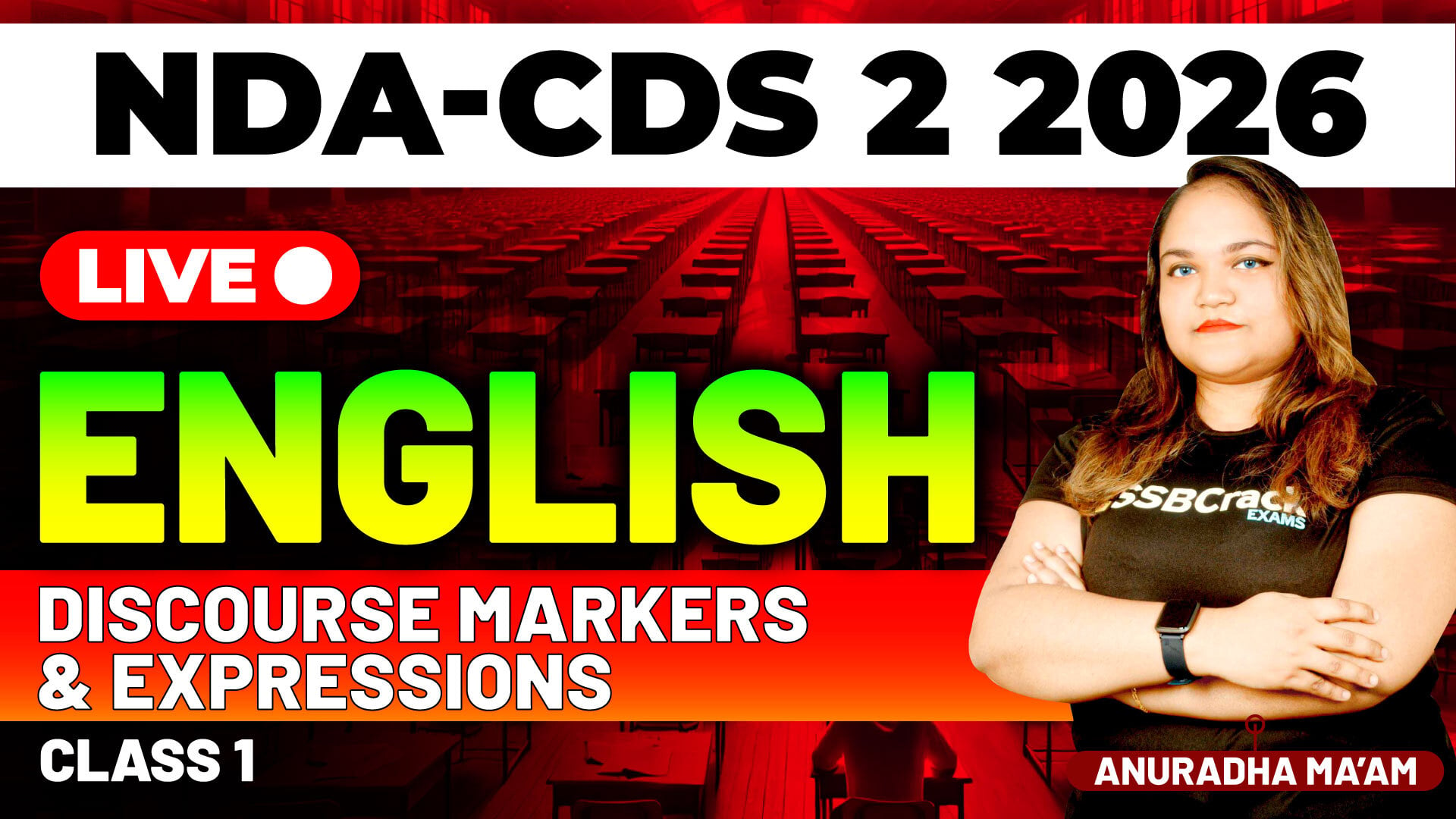
Discourse Markers & Expressions is an important topic in the English section of NDA and CDS examinations. Questions from this topic assess a candidate’s ability to understand the logical relationship between ideas, sentences, and paragraphs. Discourse markers serve as connecting words or phrases that help establish coherence and cohesion in communication. They guide readers and listeners through the flow of information by indicating relationships such as addition, contrast, cause and effect, sequence, emphasis, and conclusion.
The English Discourse Markers & Expressions Live Class 1 conducted for NDA & CDS 2 2026 aspirants focused on the fundamental concepts of discourse markers, their definitions, functions, classifications, and practical usage in sentences. The session also included examination-oriented fill-in-the-blank questions where candidates were required to identify the most appropriate discourse marker to complete a sentence or passage meaningfully.
Through conceptual understanding and extensive practice, candidates learned how discourse markers contribute to effective communication and how they are tested in competitive examinations.
Importance of Discourse Markers in NDA and CDS Examinations
Discourse markers play a significant role in reading comprehension, sentence arrangement, paragraph completion, and communication-based questions.
Questions from this topic help evaluate:
- Understanding of logical relationships
- Reading comprehension ability
- Contextual interpretation skills
- Communication proficiency
- Sentence construction skills
- Analytical thinking
Since officers in the Armed Forces must communicate clearly and understand complex information accurately, the ability to recognize and use discourse markers effectively is an essential language skill.
Objectives of the Live Class
The primary objective of the session was to familiarize candidates with the concept of discourse markers and their role in effective communication.
During the class, candidates learned how to:
- Define discourse markers.
- Understand their functions.
- Identify different categories of discourse markers.
- Analyze logical relationships between ideas.
- Select appropriate discourse markers in context.
- Solve examination-oriented fill-in-the-blank questions accurately.
The session focused on both theoretical understanding and practical application.
What Are Discourse Markers?
Discourse markers are words or phrases that connect ideas, sentences, and paragraphs in a logical manner.
They help readers and listeners understand:
- How ideas are related.
- Whether information is being added, contrasted, explained, or concluded.
- The direction of the discussion.
Common discourse markers include:
- However
- Therefore
- Moreover
- Consequently
- Furthermore
- Nevertheless
- Hence
- Meanwhile
- In addition
- As a result
These expressions make communication more organized and meaningful.
Functions of Discourse Markers
The class highlighted several important functions performed by discourse markers in written and spoken communication.
They help to:
- Connect ideas logically.
- Introduce additional information.
- Show contrast between ideas.
- Indicate causes and effects.
- Express conclusions.
- Sequence events.
- Clarify explanations.
- Emphasize important points.
Understanding these functions helps candidates select the correct marker in examination questions.
Types of Discourse Markers
The session covered the major categories of discourse markers frequently tested in competitive examinations.
Addition Markers
These markers add information to an existing idea.
Examples include:
- Moreover
- Furthermore
- In addition
- Besides
- Also
Example:
The candidate performed exceptionally well. Moreover, he completed the task ahead of schedule.
Contrast Markers
These markers indicate opposition or contrast between ideas.
Examples include:
- However
- Nevertheless
- Yet
- On the other hand
- Although
Example:
The weather was unfavorable. However, the mission was completed successfully.
Cause and Effect Markers
These markers show reasons and results.
Examples include:
- Therefore
- Consequently
- Hence
- As a result
- Thus
Example:
The roads were flooded; therefore, transportation services were disrupted.
Sequence Markers
These markers indicate the order of events or ideas.
Examples include:
- First
- Next
- Then
- Afterwards
- Finally
Example:
First, the recruits were briefed. Then, they proceeded to the training ground.
Example Markers
These markers introduce illustrations or examples.
Examples include:
- For example
- For instance
- Such as
- Namely
Example:
Many defence technologies have evolved rapidly. For example, drone surveillance has become increasingly important.
Conclusion Markers
These markers summarize or conclude information.
Examples include:
- In conclusion
- To sum up
- Overall
- In short
Example:
In conclusion, discipline remains one of the most important qualities of a military officer.
Importance of Context in Choosing Discourse Markers
A major focus of the class was understanding that discourse markers cannot be selected randomly.
Candidates learned to examine:
- The meaning of the first statement.
- The relationship between two ideas.
- Whether information is being added, contrasted, explained, or concluded.
The context of the sentence determines the appropriate discourse marker.
Fill in the Blanks Practice Session
The practical segment of the class consisted of examination-oriented fill-in-the-blank questions.
Candidates were provided with sentences containing blanks and were required to select the most suitable discourse marker from multiple options.
The practice questions tested:
- Logical reasoning
- Contextual understanding
- Vocabulary knowledge
- Reading comprehension
- Knowledge of sentence relationships
This exercise helped candidates apply theoretical concepts to actual examination-style questions.
Strategies Discussed for Solving Discourse Marker Questions
Several practical techniques were introduced during the session.
Understand the Relationship Between Sentences
Candidates were encouraged to determine whether the ideas represented addition, contrast, cause-effect, sequence, or conclusion.
Read the Entire Sentence Carefully
Understanding the complete context helps identify the correct discourse marker.
Look for Clue Words
Certain words within the sentence often indicate the required relationship.
Eliminate Unsuitable Options
Removing markers that do not fit the context improves accuracy.
Focus on Meaning Rather Than Memorization
Understanding the function of a discourse marker is more effective than rote learning.
Common Mistakes Made by Aspirants
During the practice session, several common errors were observed.
These included:
- Confusing addition markers with contrast markers.
- Ignoring contextual clues.
- Selecting markers based solely on familiarity.
- Misinterpreting cause-and-effect relationships.
- Overlooking sentence meaning.
The class demonstrated methods for avoiding these mistakes through systematic analysis.
Importance of Discourse Markers in Other English Topics
The session emphasized that discourse markers are not limited to one topic.
They are useful in:
- Reading Comprehension
- Ordering of Sentences
- Cloze Test
- Fill in the Blanks
- Paragraph Completion
- Communication-based questions
A strong understanding of discourse markers improves performance across multiple sections of the English paper.
Benefits of Regular Practice
Consistent practice of discourse marker questions offers several advantages.
It helps candidates:
- Improve logical reasoning.
- Enhance reading comprehension.
- Strengthen communication skills.
- Develop contextual understanding.
- Increase confidence in English.
- Improve examination performance.
These skills are valuable both in competitive examinations and professional communication.
Preparation Tips for NDA & CDS 2 2026 Aspirants
To perform well in Discourse Markers & Expressions questions, candidates should:
- Learn the functions of common discourse markers.
- Practice examination-oriented fill-in-the-blank questions regularly.
- Read newspapers and editorials daily.
- Analyze relationships between ideas in passages.
- Maintain a vocabulary notebook.
- Revise discourse marker categories frequently.
- Solve previous years’ question papers.
Regular practice and contextual understanding are essential for mastering this topic.
Key Learning Outcomes from the Live Class
By the end of the session, candidates had developed a better understanding of:
- Definitions of discourse markers.
- Functions and classifications.
- Logical relationships between ideas.
- Context-based selection of discourse markers.
- Examination-oriented solving techniques.
- Application of discourse markers in communication.
These skills are essential for achieving success in English language sections of competitive examinations.
Conclusion
The English Discourse Markers & Expressions Live Class 1 for NDA & CDS 2 2026 aspirants provided a comprehensive introduction to one of the most important communication-based topics in the English syllabus. Through conceptual discussions and examination-oriented fill-in-the-blank practice questions, candidates learned how discourse markers create logical connections between ideas and improve the clarity of communication.
The session highlighted that success in this topic depends on understanding the functions of discourse markers, recognizing contextual relationships, and applying logical reasoning while solving questions. With regular practice and continuous exposure to quality English content, aspirants can significantly improve their performance in Discourse Markers & Expressions and strengthen their overall preparation for NDA and CDS examinations.


