





In Defence Current Affairs for 04 July 2026, we will see the latest national and international current affairs news. These important current affairs will be beneficial for your upcoming NDA, CDS, CDS OTA, AFCAT, TA, Agniveer Army, Agniveer Navy, Agniveer Air Force, Women Military Police, INET, MNS, ACC exams, SCO, PCSL, CAPF, and SSB interviews, and direct entries for Army, Navy, and Air Force like SSC Tech, TGC, JAG, NCC, TES, 10+2 Cadet. Download a PDF file about current events at the end of this article. Let us now see the Current Affairs.
Defence Current Affairs 04 July 2026
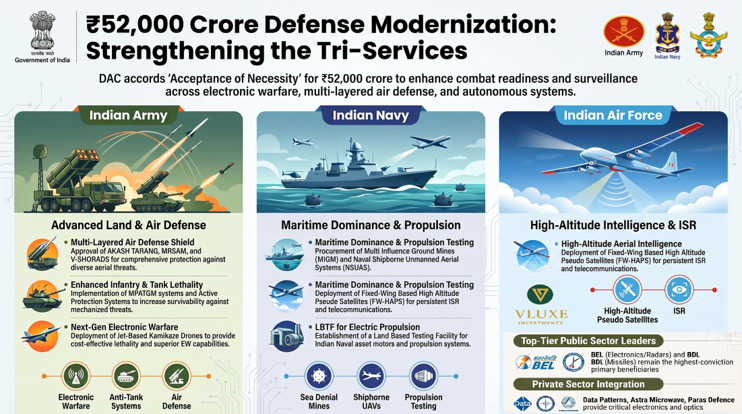
DAC Approves ₹52,000 Crore Defence Modernisation Plan to Strengthen India’s Armed Forces
In a major boost to India’s defence preparedness, the Defence Acquisition Council (DAC), chaired by Defence Minister Rajnath Singh, granted Acceptance of Necessity (AoN) for several high-value defence procurement projects on 3 July 2026. The approvals, valued at approximately ₹52,000 crore, are aimed at enhancing the operational capabilities of the Indian Army, Indian Navy, and Indian Air Force through the induction of advanced indigenous and modern defence systems.
The decision reflects the government’s continued focus on military modernization, self-reliance under the Aatmanirbhar Bharat initiative, and strengthening India’s preparedness against evolving security challenges across land, sea, and air.
What is Acceptance of Necessity (AoN)?
Acceptance of Necessity (AoN) is the first and most important stage in India’s defence procurement process. It is an in-principle administrative approval granted by the Defence Acquisition Council for acquiring military equipment and weapon systems. Once AoN is approved, the concerned procurement agencies begin the detailed acquisition process, including tendering, evaluation, trials, and contract negotiations.
Major Approvals for the Indian Army
The DAC approved several advanced weapon systems designed to improve battlefield effectiveness, air defence, and survivability of the Army.
AKASH TARANG Anti-UAV Electronic Warfare System
The Army will procure the AKASH TARANG Anti-Unmanned Aerial Vehicle (UAV) Electronic Warfare System, developed to detect, track, jam, and neutralize hostile drones.
With the growing use of drones in modern warfare, this system will provide reliable protection to military formations and critical installations against aerial threats.
Man Portable Anti-Tank Guided Missile (MPATGM)
The MPATGM is an indigenous third-generation anti-tank guided missile that significantly enhances the firepower of infantry units.
The lightweight missile enables soldiers to engage and destroy enemy tanks and armored vehicles with high precision, strengthening India’s anti-armour capabilities.
Medium Range Surface-to-Air Missile (MRSAM) System
The MRSAM Weapon System will improve the Army’s air defence network by intercepting various aerial threats, including aircraft, helicopters, drones, and cruise missiles at medium ranges.
The system provides layered air defence for vital military assets and operational formations.
Very Short Range Air Defence System (V-SHORADS)
The Army also received approval for procuring Very Short Range Air Defence Systems (V-SHORADS) equipped with advanced multi-spectral sensors.
These portable missile systems are designed to engage low-flying aircraft, helicopters, and drones while remaining resistant to electronic countermeasures.
Active Protection System for Tanks
Modern battlefields increasingly feature anti-tank guided missiles and loitering munitions. To improve the survivability of armored vehicles, the DAC approved the acquisition of Active Protection Systems (APS) for tanks.
The system automatically detects incoming projectiles and neutralizes them before impact, significantly increasing battlefield protection.
Jet-Based Kamikaze Drone System
The Army will also procure advanced Jet-Based Kamikaze Drones, also known as loitering munitions.
These drones combine high speed, extended range, electronic warfare capabilities, and precision strike ability, making them effective and cost-efficient weapons for modern combat operations.
Major Approvals for the Indian Navy
The Indian Navy received approvals for advanced underwater warfare systems, unmanned aviation, and propulsion technology.
Multi Influence Ground Mine (MIGM)
The Navy will induct Multi Influence Ground Mines (MIGM) designed to restrict enemy naval movement.
These intelligent sea mines respond to multiple signatures such as magnetic, acoustic, and pressure changes, making them difficult to evade and highly effective in protecting strategic maritime areas.
Naval Shipborne Unmanned Aerial System (NSUAS)
The DAC also approved the procurement of Naval Shipborne Unmanned Aerial Systems (NSUAS).
Equipped with sophisticated surveillance sensors, these drones will enhance maritime domain awareness, reconnaissance, target identification, and operational monitoring over vast ocean areas.
Land-Based Testing Facility (LBTF) for Electric Propulsion
Approval was granted for establishing a Land-Based Testing Facility (LBTF) dedicated to electric propulsion systems.
The facility will enable comprehensive testing and validation of motors and propulsion technologies before their integration into future naval platforms, supporting indigenous naval shipbuilding programs.
Major Approvals for the Indian Air Force
Fixed-Wing High Altitude Pseudo Satellite (FW-HAPS)
The Indian Air Force will acquire Fixed-Wing High Altitude Pseudo Satellites (FW-HAPS), a cutting-edge technology that operates in the upper atmosphere for extended durations.
These platforms function as near-space surveillance assets capable of performing:
- Persistent Intelligence, Surveillance and Reconnaissance (ISR)
- Secure telecommunications
- Remote sensing
- Long-duration monitoring of strategic regions
Unlike conventional satellites, FW-HAPS can remain over a designated area for prolonged periods while being comparatively economical and flexible.
Strategic Importance of the DAC Approvals
The latest approvals represent one of the most significant defence modernization initiatives of 2026. The acquisitions will:
- Strengthen India’s multi-layered air defence capabilities.
- Improve protection against drone and missile threats.
- Enhance the Army’s anti-armour and electronic warfare capabilities.
- Boost maritime surveillance and underwater warfare preparedness.
- Expand long-endurance intelligence and reconnaissance capabilities.
- Increase the survivability of tanks and frontline military assets.
- Promote indigenous defence manufacturing under the Aatmanirbhar Bharat initiative.
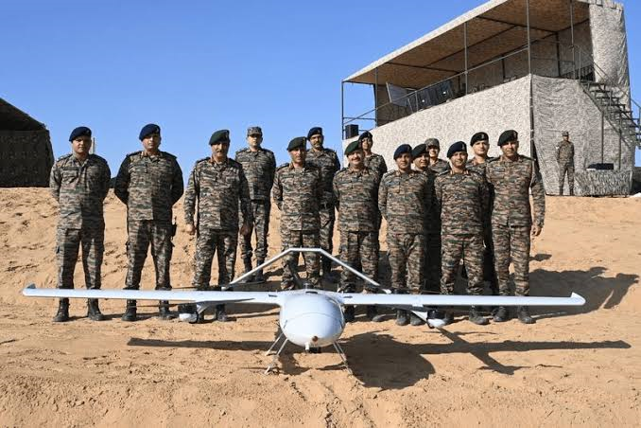
Indian Army Begins Induction of Indigenous Solar-Powered MAPSS Surveillance Drone
The Indian Army has started operating the Medium Altitude Persistent Surveillance System (MAPSS), an indigenous solar-powered unmanned aerial vehicle (UAV), marking a significant milestone in India’s defence technology and surveillance capabilities. Developed by Bengaluru-based start-up New Space Research & Technologies (NRT), the advanced drone is designed to provide long-endurance intelligence, surveillance, and reconnaissance (ISR) missions while reducing dependence on conventional power sources.
Earlier, in January 2026, the Army awarded a ₹168 crore contract to the company for the procurement of the MAPSS platform. The project was sanctioned under the Innovations for Defence Excellence (iDEX) initiative of the Ministry of Defence, which promotes indigenous innovation and encourages start-ups to develop advanced defence technologies.
A First for the Indian Armed Forces
The MAPSS is the first solar-powered surveillance UAV to be inducted by the Indian Armed Forces. Unlike conventional drones that rely mainly on batteries or tethered power systems, the MAPSS uses solar energy to recharge during flight, allowing it to remain airborne for much longer durations. This capability significantly improves persistent surveillance over sensitive border regions and strategic locations.
Advanced Features
The MAPSS has been developed with several cutting-edge technologies that enhance its operational effectiveness:
- Fully electric and solar-powered propulsion for extended endurance.
- Lightweight airframe designed for efficient long-duration flights.
- Modular payload architecture, enabling different surveillance and reconnaissance equipment to be integrated based on mission requirements.
- High mission autonomy, reducing the need for constant operator intervention.
- Ability to operate in GNSS-denied environments, making it effective even in areas where satellite navigation signals are jammed or unavailable.
Built on Proven Technology
The MAPSS has evolved from New Space Research & Technologies’ High Altitude Pseudo Satellite (HAPS) programme. The company has already demonstrated impressive endurance capabilities, including flights lasting more than 27 hours at altitudes exceeding 26,000 feet, along with another mission that remained airborne for over 24 hours under demanding environmental conditions.
These achievements demonstrate the platform’s reliability for long-duration surveillance and intelligence missions.
Boost to Indigenous Defence Innovation
The induction of MAPSS represents an important achievement for India’s indigenous defence ecosystem. It is considered the first sovereign hardware delivery under the iDEX UAV development programme, highlighting the growing contribution of Indian start-ups in strengthening national security.
New Space Research & Technologies has steadily progressed from developing swarm drone technologies to building advanced pseudo-satellite platforms, reflecting the rapid growth of India’s defence innovation ecosystem.
Dynamatic Technologies Becomes Sole Global Supplier of Critical Airbus Components
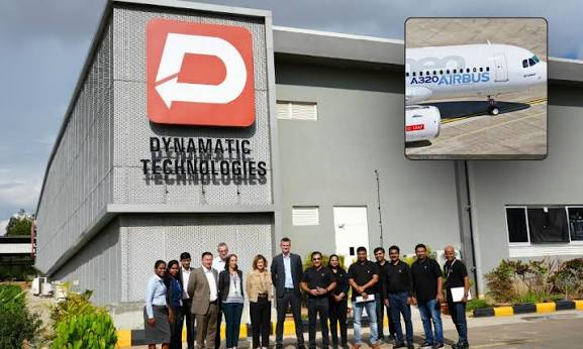
Bengaluru-based Dynamatic Technologies has achieved a major milestone in the global aerospace industry by becoming the sole Tier-1 supplier of flight-critical flap-track-beam assemblies for the Airbus A330 aircraft. The achievement strengthens India’s position in the international aerospace manufacturing sector and reflects the country’s growing capability to produce highly sophisticated aviation components under the Make in India initiative.
A Significant Achievement for India’s Aerospace Industry
The flap-track-beam assembly is one of the most critical structural components of an aircraft’s wing. Mounted along the trailing edge of the wing, it supports and guides the movement of wing flaps during take-off and landing.
These assemblies play a vital role in:
- Maintaining aircraft stability and balance.
- Improving lift during take-off.
- Reducing landing and take-off distances.
- Enhancing overall flight safety and operational efficiency.
Being selected as the exclusive supplier of such a mission-critical component demonstrates the high level of confidence that Airbus has in Dynamatic Technologies’ engineering expertise and manufacturing quality.
Exclusive Supplier for Multiple Airbus Aircraft
Dynamatic Technologies is not only the sole supplier for the Airbus A330 flap-track-beam assemblies but also holds the same position for the Airbus A320 family of single-aisle aircraft.
This exclusive partnership highlights the company’s ability to consistently meet the stringent quality standards required by one of the world’s largest aircraft manufacturers. It also reinforces India’s growing role as a trusted manufacturing hub in the global aviation supply chain.
New Export Contract for Airbus A220
Further expanding its international presence, Dynamatic Technologies has secured another major aerospace export contract to manufacture and assemble aircraft doors for the Airbus A220 family.
The agreement broadens the company’s product portfolio and deepens its participation in Airbus’ global production programmes. It also represents another important step in increasing India’s share of high-value aerospace exports.
Advanced Manufacturing Process
The production of these precision aerospace components combines advanced engineering with highly skilled craftsmanship.
The manufacturing process includes:
- High-speed robotic machining for precision manufacturing.
- Advanced quality control systems to meet international aerospace standards.
- Integration of sophisticated engineering techniques with expert manual assembly where required.
Certain precision machining operations are carried out at Airbus-linked facilities in Bristol and Swindon in the United Kingdom, ensuring the highest levels of manufacturing accuracy before final assembly.
Boost to the Make in India Initiative
Dynamatic Technologies’ success demonstrates the growing strength of India’s aerospace manufacturing ecosystem. By becoming a global supplier of flight-critical aircraft structures, the company showcases the capability of Indian firms to compete in one of the world’s most technologically demanding industries.
The achievement aligns with the objectives of the Make in India initiative by promoting advanced manufacturing, increasing exports, generating skilled employment, and integrating Indian industries into global aerospace supply chains.
Corps of Signals Dare Devils Attempt New World Record
- The Indian Army has once again showcased its exceptional courage, discipline, and professionalism through the remarkable achievement of the Corps of Signals Dare Devils motorcycle display team.
- As part of the nationwide “Wheels of Valour: Sanchar Shakti” expedition, the team successfully completed a historic world record attempt inside the iconic Atal Tunnel in Himachal Pradesh.
- The event was dedicated to the brave soldiers of the Kargil War and highlighted the spirit of patriotism, teamwork, and military excellence.
- A total of 10 riders performed on two motorcycles, covering the 9.8-kilometre tunnel in 9 minutes and 47.97 seconds.
- The record attempt took place at an altitude of approximately 10,075 feet, making it an extraordinary demonstration of endurance and precision under challenging conditions.
- The Corps of Signals is the communication arm of the Indian Army. It is responsible for establishing and maintaining secure communication networks during military operations. Besides its operational role, the Corps is renowned for its famous motorcycle display team, the Dare Devils.
- The Atal Tunnel, located beneath the Rohtang Pass in Himachal Pradesh, is one of India’s greatest engineering achievements. Stretching 9.02 kilometres, it provides year-round road connectivity between Manali and the Lahaul-Spiti region.
South Korea Targets 2nd Wave of Investment In India
- South Korea is preparing a “Second Wave” of investment in India, with shipbuilding, defence manufacturing, and industrial collaboration at the forefront.
- This marks a strategic shift from earlier Korean investments in automobiles and electronics, positioning India as a central partner in Seoul’s diversification strategy amid global instability.South Korea’s Ambassador to India, Lee Seong-ho, emphasised that the next phase of cooperation would be led by shipbuilding and industrial collaboration. He explained that such initiatives would naturally expand bilateral trade, moving beyond the first wave of Korean investments in the 1990s that focused on consumer industries like automobiles and electronics.
- Discussions are underway to expand into air defence guns, missile systems, and other advanced defence platforms. Reports indicate that the Indian Army is considering procurement of up to 300 additional K9 Vajra-T self-propelled howitzers, which would be one of its largest artillery acquisitions.
- HD Hyundai is investing USD 4 billion in a Tamil Nadu shipyard capable of producing up to 4 million gross tons annually. These projects are supported by workforce development initiatives, including a Shipbuilding Workforce Development and Technology Cooperation Centre backed by the Korea International Cooperation Agency.

Review Questions
- The Defence Acquisition Council (DAC) approved defence acquisition proposals
worth approximately how much on 3 July 2026?
A. ₹25,000 crore
B. ₹40,000 crore
C. ₹52,000 crore
D. ₹75,000 crore
Answer: C. ₹52,000 crore
Explanation: The DAC, chaired by Defence Minister Rajnath Singh, granted Acceptance
of Necessity (AoN) for defence procurement proposals worth about ₹52,000 crore. - Which indigenous system approved by the DAC is designed to counter enemy
drones?
A. MRSAM
B. MPATGM
C. AKASH TARANG
D. V-SHORADS
Answer: C. AKASH TARANG
Explanation: AKASH TARANG is an Anti-Unmanned Aerial Vehicle (UAV) Electronic
Warfare System developed to detect, jam, and neutralize hostile drones. - The Man Portable Anti-Tank Guided Missile (MPATGM) is primarily intended to
destroy:
A. Fighter aircraft
B. Enemy tanks and armoured vehicles
C. Naval warships
D. Ballistic missiles
Answer: B. Enemy tanks and armoured vehicles
Explanation: MPATGM is a portable indigenous missile system that enhances the
infantry’s capability to eliminate mechanised threats. - Which of the following systems approved for the Indian Navy is intended to
enhance maritime surveillance?
A. Multi Influence Ground Mine (MIGM)
B. Naval Shipborne Unmanned Aerial System (NSUAS)
C. Active Protection System
D. FW-HAPS
Answer: B. Naval Shipborne Unmanned Aerial System (NSUAS)
Explanation: NSUAS is equipped with advanced sensors that improve the Navy’s
situational awareness and maritime reconnaissance capabilities. - The Fixed-Wing High Altitude Pseudo Satellite (FW-HAPS) approved for the Indian
Air Force will primarily support:
A. Underwater warfare
B. Intelligence, Surveillance and Reconnaissance (ISR) missions
C. Tank protection
D. Anti-submarine warfare
Answer: B. Intelligence, Surveillance and Reconnaissance (ISR) missions
Explanation: FW-HAPS provides long-endurance ISR, telecommunications, and remote
sensing capabilities. - The indigenous Medium Altitude Persistent Surveillance System (MAPSS) has been
developed by which company?
A. Bharat Electronics Limited (BEL)
B. Hindustan Aeronautics Limited (HAL)
C. New Space Research & Technologies
D. Larsen & Toubro Defence
Answer: C. New Space Research & Technologies
Explanation: Bengaluru-based New Space Research & Technologies developed the
solar-powered MAPSS drone. - Under which Ministry of Defence initiative was the MAPSS drone project
supported?
A. Make in India
B. Innovations for Defence Excellence (iDEX)
C. Digital India
D. PM Gati Shakti
Answer: B. Innovations for Defence Excellence (iDEX)
Explanation: The MAPSS project received support under the Ministry of Defence’s
Innovations for Defence Excellence (iDEX) programme. - What is the major advantage of the MAPSS surveillance drone over conventional
battery-powered UAVs?
A. It can operate underwater.
B. It uses nuclear propulsion.
C. It is solar-powered, allowing longer endurance.
D. It carries heavy combat weapons.
Answer: C. It is solar-powered, allowing longer endurance.
Explanation: Solar-powered recharging enables MAPSS to remain airborne for
extended periods, making it ideal for persistent surveillance. - Which system approved by the DAC is designed to improve the survivability of
tanks by intercepting incoming threats?
A. MRSAM
B. AKASH TARANG
C. Active Protection System (APS)
D. NSUAS
Answer: C. Active Protection System (APS)
Explanation: APS detects and neutralizes incoming anti-tank missiles and projectiles
before they hit the tank. - The MAPSS drone is capable of operating effectively even in:
A. Deep underwater environments
B. Space missions
C. GNSS-denied environments
D. Underground tunnels
Answer: C. GNSS-denied environments
Explanation: MAPSS features advanced autonomous navigation, allowing it to operate
even when Global Navigation Satellite System (GNSS) signals are unavailable or
jammed. - India and Japan recently signed a defence co-development agreement for the
joint development of which advanced naval system?
A) BrahMos Missile
B) UNICORN Mast
C) Barak-8 Radar
D) Akash Air Defence System
Answer: B) UNICORN Mast - The UNICORN mast is primarily designed to improve which capability of naval
warships?
A) Cargo carrying capacity
B) Stealth characteristics
C) Missile range
D) Fuel efficiency
Answer: B) Stealth characteristics - What does UNICORN stand for?
A) Unified Communication Radar Network
B) Universal Combat Radio Navigation
C) Unified Complex Radio Antenna
D) Universal Complex Radar Array
Answer: C) Unified Complex Radio Antenna - During the India-Japan summit, cooperation was expanded into all of the
following sectors EXCEPT:
A) Artificial Intelligence
B) Critical Minerals
C) Healthcare
D) Cryptocurrency Regulation
Answer: D) Cryptocurrency Regulation - South Korea’s proposed “Second Wave” of investment in India primarily focuses
on:
A) Textiles and Agriculture
B) Tourism and Hospitality
C) Shipbuilding and Defence Manufacturing
D) Banking and Insurance
Answer: C) Shipbuilding and Defence Manufacturing - Which South Korean company is investing about USD 4 billion in a shipyard
project in Tamil Nadu?
A) Samsung Heavy Industries
B) Hyundai Motor Company
C) HD Hyundai
D) Hanwha Aerospace
Answer: C) HD Hyundai - The Indian Army is reportedly considering the procurement of additional
__ self-propelled howitzers from South Korea.
A) Dhanush
B) M777
C) K9 Vajra-T
D) ATAGS
Answer: C) K9 Vajra-T - Bengaluru-based Dynamatic Technologies has become the sole Tier-1 global
supplier of flight-critical flap-track-beam assemblies for which aircraft?
A) Boeing 787 Dreamliner
B) Airbus A330
C) Embraer E195
D) Dassault Falcon 8X
Answer: B) Airbus A330 - Dynamatic Technologies has also secured a contract to manufacture aircraft
doors for which Airbus aircraft family?
A) Airbus A380
B) Airbus A350
C) Airbus A220
D) Airbus Beluga XL
Answer: C) Airbus A220 - Which Government of India initiative is significantly supported by these
developments in defence manufacturing and aerospace production?
A) Digital India
B) Skill India
C) Make in India and Aatmanirbhar Bharat
D) Smart Cities Mission
Answer: C) Make in India and Aatmanirbhar Bharat
ALSO READ:
- Latest Daily Current Affairs and Defence Updates
- Latest Daily Current Affairs June 2026[DOWNLOAD PDF]
- Latest Daily Current Affairs May 2026[DOWNLOAD PDF]
- Latest Daily Current Affairs April 2026[DOWNLOAD PDF]
- Latest Daily Current Affairs March 2026[DOWNLOAD PDF]
- Latest Daily Current Affairs February 2026[DOWNLOAD PDF]
- Latest Daily Current Affairs January 2026[DOWNLOAD PDF]
- Latest Daily Current Affairs November 2025[DOWNLOAD PDF]
- Latest Daily Current Affairs October 2025[DOWNLOAD PDF]
- Latest Daily Current Affairs August 2025[DOWNLOAD PDF]
- Latest Daily Current Affairs July 2025[DOWNLOAD PDF]
- Monthly Defence Current Affairs June 2025 [DOWNLOAD PDF]
- Monthly Defence Current Affairs May 2025 [DOWNLOAD PDF]


