




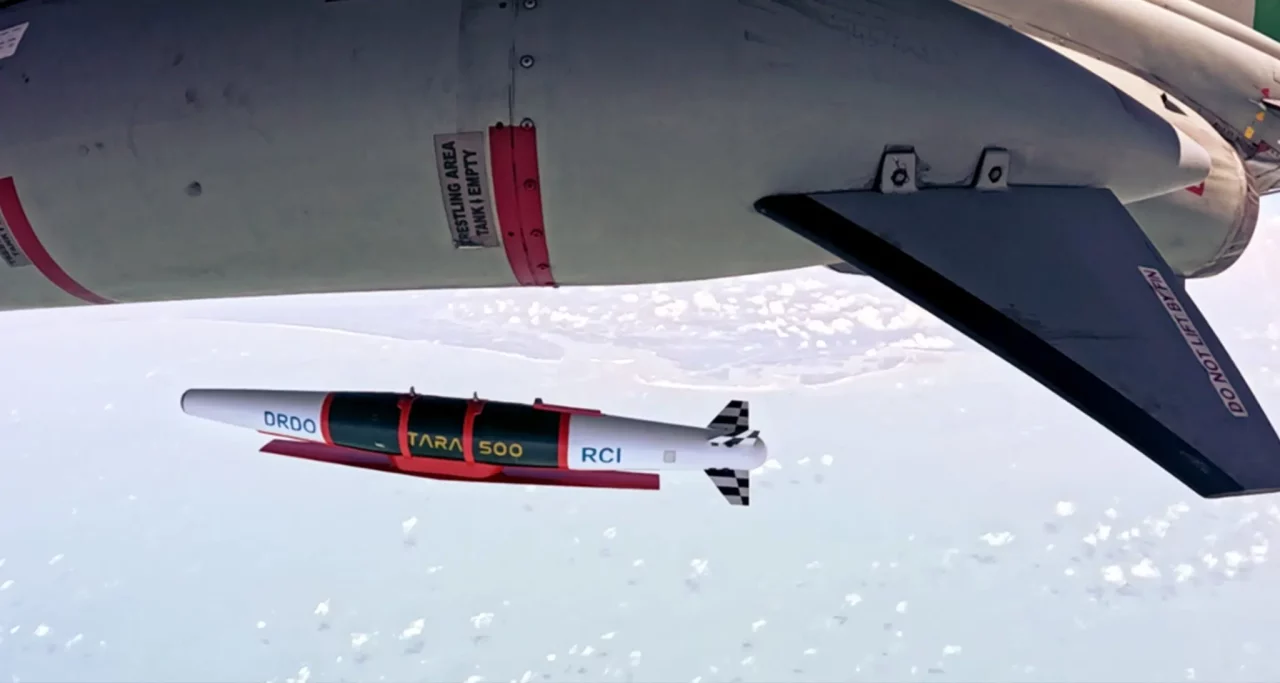
In a major leap for India’s defence sector, the Defence Research and Development Organisation (DRDO) and the Indian Air Force (IAF) have successfully completed the first flight trial of the Tactical Advanced Range Augmentation (TARA) glide weapon system off the coast of Odisha on May 7, 2026. This trial, executed from an IAF Sepecat Jaguar aircraft, employed a 500 kg bomb outfitted with the TARA modular kit, marking India’s inaugural foray into the realm of domestically developed glide munitions.
The Ministry of Defence shared this milestone in a public announcement via the Press Information Bureau the following day, igniting considerable public intrigue and discourse. Reports of noticeable glowing contrails in the skies over eastern India, West Bengal, and parts of Bangladesh, alongside the issuing of a significant Notice to Airmen (NOTAM) that established a 3,560 km restricted airspace over the Bay of Bengal, have led to rampant speculation regarding a potential long-range strategic missile test. Rumours have circulated concerning the possibility of an Agni-6 intercontinental ballistic missile (ICBM) launch.
TARA is designed to revolutionise conventional unguided warheads into precision-guided, stand-off munitions through a versatile modular range-extension kit. The system was primarily developed by DRDO’s Research Centre Imarat (RCI) in Hyderabad, in collaboration with various DRDO laboratories and industry partners, including Adani Defence and Aerospace. The innovative design integrates advanced, cost-effective technologies aimed at significantly improving accuracy, lethality, and operational range without incurring exorbitant costs.
The key technical specifications of TARA are noteworthy. The system can be deployed from altitudes ranging from 10,000 to 45,000 feet, achieving speeds close to Mach 0.8. At optimal deployment from about 42,000 feet at Mach 0.9, it offers an effective operational range of 80 to 100 km. It also features different guidance variants, including a Satellite Aided Terminal (SAT) configuration with a Circular Error Probable (CEP) of fewer than 20 metres, and a Uncooled Imaging Infrared (UC-IIR) seeker variant with a CEP under 3 metres. The system is designed to be compatible with 250 kg, 450 kg, and 500 kg class warheads.
The successful flight trial affirmed the effectiveness of TARA’s design, demonstrating its flight stability and precision in targeting. Production efforts have already kickstarted in collaboration with industry partners, facilitating a swift integration into IAF operations. This advancement is integral to India’s broader Atmanirbhar Bharat initiative, aimed at reducing dependence on foreign precision-guided munitions.
Following the successful trial, reports of unusual visual phenomena were observed along the eastern coastline, with bright, looping trails capturing the attention of local residents and social media users from Odisha to Cox’s Bazar in Bangladesh. These sightings have generated extensive speculation, with several analysts suggesting that the trails may indicate powerful ballistic or hypersonic trajectories.
Accompanying the TARA test, the Indian authorities had issued a NOTAM that designated a large safety corridor over the Bay of Bengal from May 6 to May 9, 2026. Such extensive range restrictions are typically associated with long-range ballistic missile tests, fueling speculation about potential Agni-6 activity, although no official confirmation has been made. The Agni-6 program is not fully acknowledged, but it is widely believed to represent a technological leap beyond the Agni-5 ICBM, possibly featuring multiple independently targetable re-entry vehicles (MIRVs) and hypersonic glide vehicle capabilities.
Defence analysts speculate the trails observed could stem from the TARA weapon’s release profile or an entirely separate high-altitude test conducted concurrently. Official communications have focused solely on the TARA trial, leaving strategic ambiguities regarding other activities.
The introduction of the TARA system significantly enhances the IAF’s precision strike capacity, allowing for the low-cost conversion of existing bombs into smart munitions, essential for executing surgical strikes while reducing collateral damage.
In extending its regional security framework, India’s advancements in tactical glide weapons and strategic missile systems reflect its commitment to maintaining a credible defence posture. As production and integration processes of TARA accelerate, neighbouring countries and strategic analysts are expected to closely monitor future developments.
The Ministry of Defence reiterated that TARA is India’s first fully indigenous glide weapon leveraging sophisticated yet economical subsystems, setting a benchmark for upcoming indigenous munitions programs. With successful validation now achieved, the system is poised for transition into operational deployment, further fortifying India’s defence capabilities.
This situation exemplifies the complex interplay between confirmed tactical accomplishments and speculation surrounding broader strategic systems, highlighting the intricate and evolving nature of India’s missile and munitions landscape. Further official updates are anticipated in the near future as the narrative develops.


