




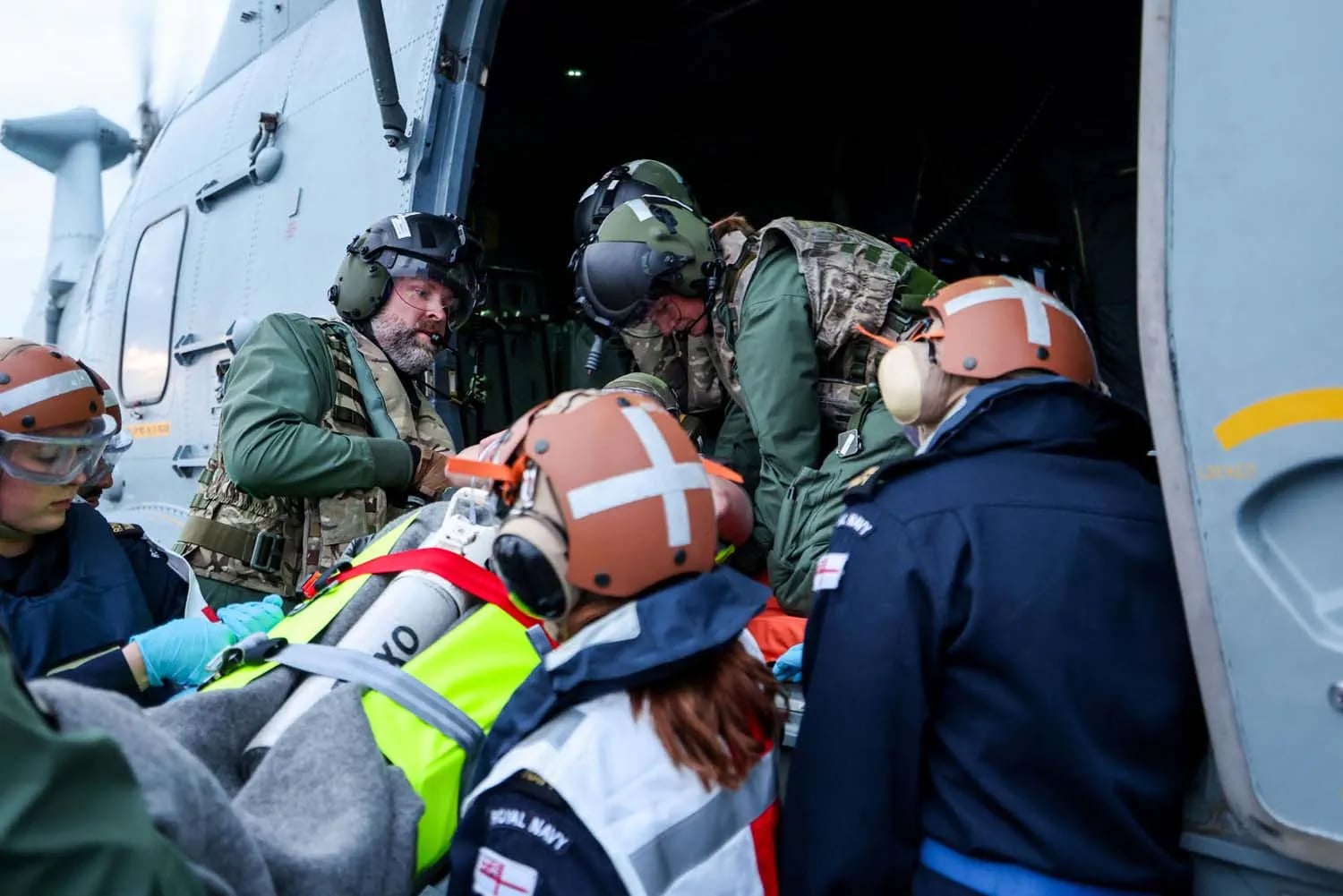
The UK Royal Navy has successfully tested new maritime emergency capabilities aimed at enhancing medical response during sea operations. These advancements include an airborne casualty response unit and a containerized treatment module designed specifically for ships lacking advanced onboard medical facilities.
These developments were showcased during a recent exercise in the Norwegian Sea. Notably, the aircraft carrier HMS Prince of Wales (R09) played a crucial role, deploying a Merlin helicopter equipped with the Maritime Medical Emergency Response Team (MMERT) to address a simulated serious injury aboard the HMS Duncan (D37), a Daring-class destroyer. The MMERT, comprising emergency medicine specialists, paramedics, and critical care nurses, is specially trained to operate under the unique challenges of maritime conditions.
During the drill, the helicopter was reconfigured for casualty transport as medical personnel treated the simulated patient before successfully transferring them back to the aircraft carrier. The Royal Navy emphasized that the primary objective of these exercises is to stabilize patients so that they can be safely flown to shore for further medical care.
In a separate initiative, British engineering firm Force Development Services recently completed the first sea trials of the Royal Navy’s Persistent Operational Deployment System (NavyPODS) aboard the HMS Protector (A173) ice patrol ship. This innovative modular system utilizes expandable 20-foot (6-meter) ISO containers, which are equipped with essential medical facilities, including power sources, oxygen generation, and sterilization equipment. This capability allows for the rapid enhancement of Role 2 medical services on vessels that do not have operating theaters or advanced medical treatment areas.
The NavyPODS design features a quieter in-house heating, ventilation, and air conditioning system, along with a shock-resistant mounting platform to safeguard medical equipment during tumultuous sea conditions. Importantly, a single operator can deploy a NavyPODS facility in about 20 minutes, significantly increasing operational efficiency.
Feedback from the clinicians involved in the sea trials has been overwhelmingly positive, indicating a successful integration of these new capabilities into the Royal Navy’s operational framework.


