




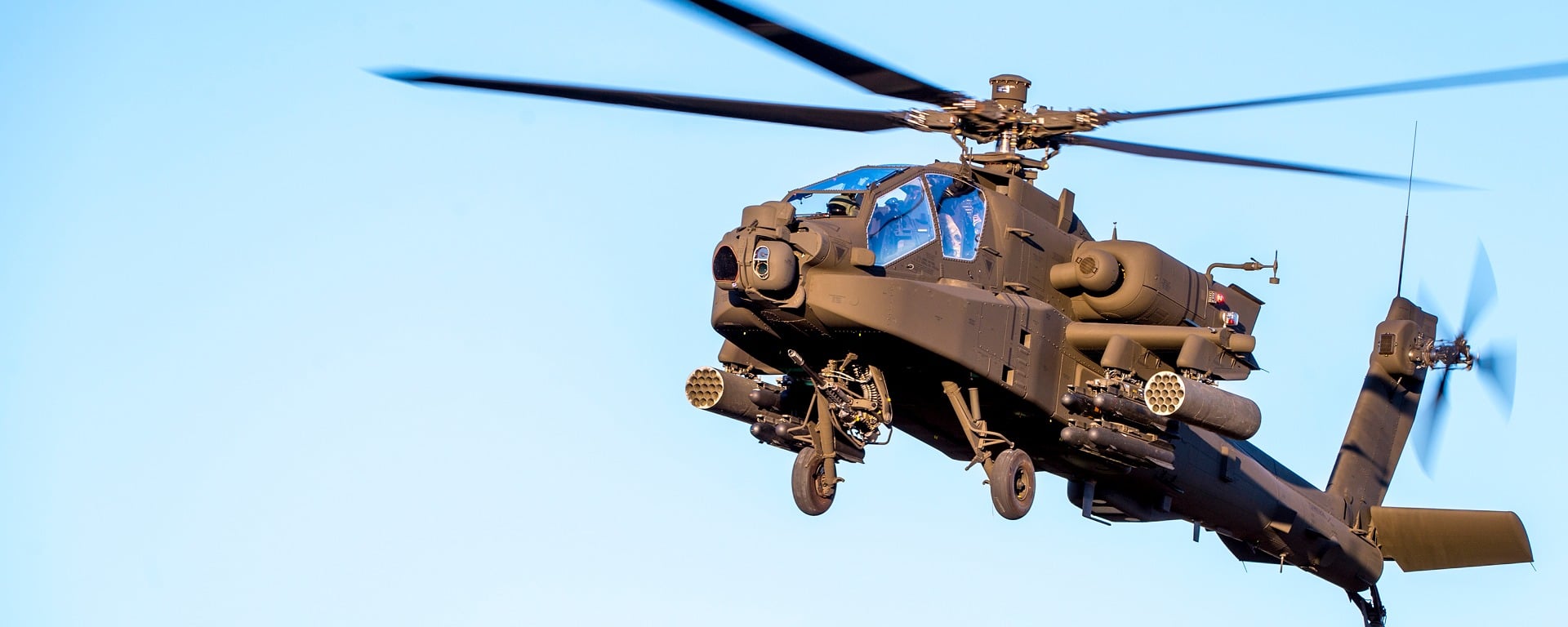
For over 40 years, the AH-64 Apache helicopter has played a pivotal role in modern warfare, showcasing a potent combination of precision firepower, advanced sensors, and tactical versatility across diverse combat environments. Its deployment ranges from the deserts of the Middle East to the skies above Eastern Europe, establishing itself as a key asset in aerial combat and a symbol of contemporary air power.
Originally developed during the Cold War, the Apache was designed with the primary objective of countering armored threats. It has significantly evolved, adapting to meet the changing dynamics of multi-domain warfare, which includes close air support, anti-armor operations, armed reconnaissance, and integrated operations between joint and coalition forces.
The Apache’s journey began in the late 1970s and 1980s when the U.S. Army sought a next-generation attack helicopter. McDonnell Douglas, which later became part of Boeing, produced the first AH-64A Apache, which was delivered to the U.S. Army in 1984. Since then, the helicopter’s design has undergone continuous evolution, incorporating advancements in capability, sensors, and weapon systems to fulfill increasingly complex battlefield requirements.
Apache variants are not merely upgrades; they represent distinct generations with significant operational enhancements. The original AH-64A served as the attack helicopter foundation, while subsequent versions, such as the AH-64D Longbow, introduced features like Longbow radar for improved target acquisition. The latest iteration, the AH-64E Guardian, boasts upgraded engines, advanced sensors, digital networking, and capabilities for manned-unmanned teaming.
In terms of firepower, the Apache carries a mix of precision-guided munitions and area-effect weapons. Its principal armament includes the 30mm M230 chain cannon, effective against infantry and light vehicles, along with hardpoints that can carry up to 16 AGM-114 Hellfire missiles and unguided Hydra 70 rockets, providing versatile operational options.
The helicopter’s advanced sensor suite is critical to its effectiveness. Systems such as the Target Acquisition and Designation Sight and Pilot Night Vision System enable detection, tracking, and engagement of targets in various weather conditions and lighting scenarios. The Longbow radar enhances these capabilities further by allowing engagement of multiple threats simultaneously while also sharing battlefield data with allied units.
In terms of mobility, the two high-performance turboshaft engines grant the Apache a cruising speed of approximately 280 kilometers (174 miles) per hour and the ability to operate at significant altitudes and ranges. The two-person crew is supported by sophisticated interfaces, including helmet-mounted displays that enhance situational awareness.
Despite its strengths, the Apache is not without limitations. In high-threat environments, modern air defense systems pose increased risks to helicopters, necessitating support for suppression of enemy air defenses. Moreover, the complexity of missions requires intense coordination between the crew, which can lead to a challenging workload.
The Apache has been utilized in a range of operations across various theaters. It played a crucial role in the Gulf War and subsequent Middle Eastern campaigns by targeting armored formations and providing close air support. Various countries, including the U.S., UK, Poland, and Israel, employ different Apache variants to enhance their military capabilities. The helicopter also contributes to peacekeeping and deterrence missions, particularly in NATO’s eastern flank.
Looking ahead, the AH-64’s evolution is set to continue. The AH-64E Guardian model features advanced digital networks, enhanced missile systems, drone control capabilities, and innovative avionics that will ensure its relevance on future battlefields throughout the 2030s and beyond. With advancements in air defense systems and the increasing prevalence of unmanned systems, the Apache’s operational doctrine is shifting towards manned-unmanned teaming, the integration of advanced stealth munitions, and alignment with allied digital fire networks. This forward-looking approach indicates the ongoing importance of the Apache helicopter in modern military operations.


