




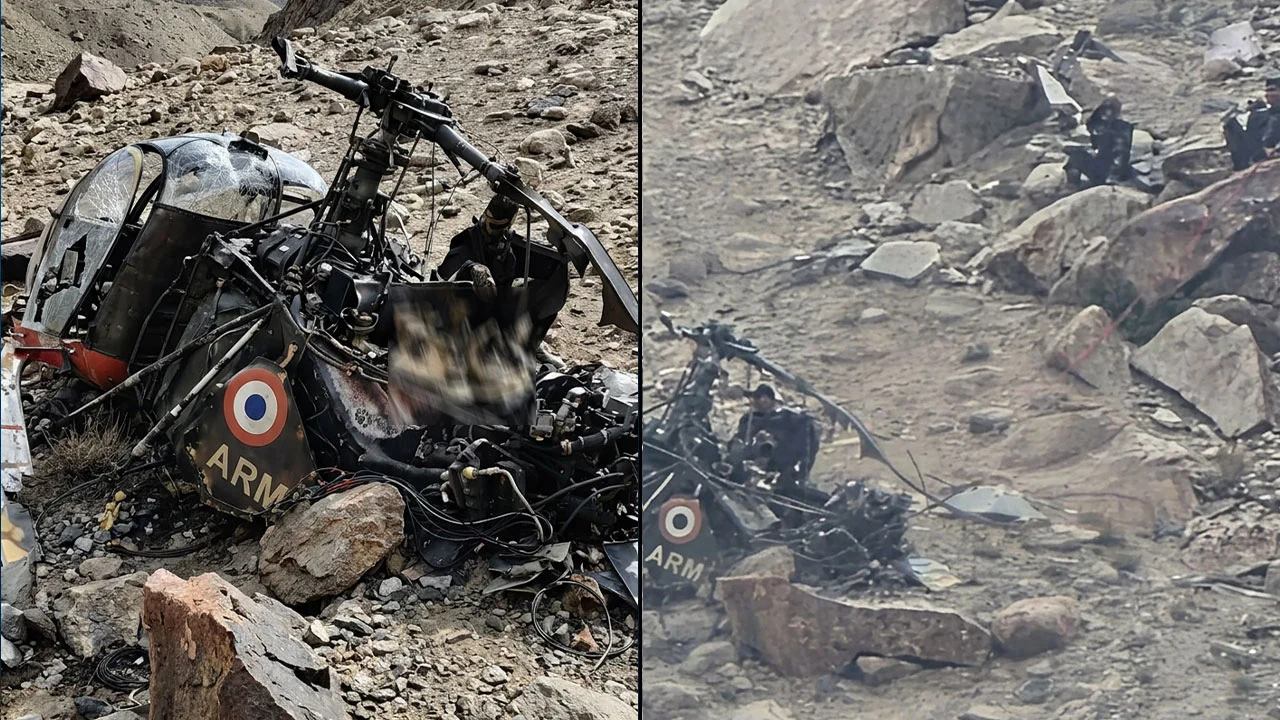
Three Indian Army officers, including a Major General, narrowly escaped serious injury during a helicopter crash in the mountainous Tangste region near Leh in Ladakh on Wednesday. Remarkably, all three occupants of the Cheetah helicopter sustained only minor injuries and were able to exit the wreckage on their own, a development that officials described as “no less than a miracle.”
The single-engine HAL Cheetah helicopter was piloted by a Lieutenant Colonel, with a Major accompanying him, while Major General Sachin Mehta, General Officer Commanding of the 3 Infantry Division, was traveling as a passenger. The mishap occurred during a routine sortie in the high-altitude terrain of Ladakh, although the specific cause of the crash is still under investigation by Army authorities, which have initiated a formal probe into the circumstances surrounding the incident.
According to officials knowledgeable about the crash, the helicopter went down in the rugged landscape of the Tangste area. The survival of all personnel on board has been described as extraordinary, especially given the challenging conditions and the operational demands placed on the aging Cheetah fleet.
The Cheetah helicopter, a license-built version of the French Alouette III, has been a vital asset for the Indian Army, particularly in high-altitude regions such as the Siachen glacier. However, the fleet has faced increased scrutiny due to a troubling history of accidents. Over the past decade, more than 15 Cheetah and Chetak helicopters have been involved in crashes, leading to multiple fatalities among the pilots.
In response to these safety concerns, the Indian Army has laid out a comprehensive modernization roadmap for its Army Aviation Corps. The plan includes phasing out the older Cheetah and Chetak helicopters over the next one to two years, replacing them with new-generation Light Utility Helicopters (LUHs) over an eight-to-ten-year timeline.
The Army is in need of approximately 250 new light utility helicopters to effectively address its operational requirements. A two-pronged procurement strategy has been devised, which involves the induction of domestically developed LUHs alongside short-term leasing options to bridge current capability gaps. Hindustan Aeronautics Limited (HAL) is expected to play a key role in this significant transition, with the Army already placing orders for six limited-series-production LUHs designed for impressive specifications, including a top speed of 220 km/h and a service ceiling of 6.5 km.
Army sources reiterated that the existing Cheetah fleet is still operational and retains a limited service life. Nonetheless, the recent incident has underscored the pressing need for fleet renewal, especially given the demanding operational context in high-altitude locales.
No fatalities were reported from the crash on Wednesday, and all three officers received medical attention for their minor injuries. The Army has conveyed that a thorough technical and operational investigation will be expedited to prevent similar occurrences in the future.
This incident underscores a broader context in which the Indian Armed Forces are increasingly prioritizing the induction of advanced rotary-wing platforms aimed at enhancing operational safety, reliability, and effectiveness across varied terrains, particularly in strategic areas like Ladakh.


