





In Current Affairs for 18 March 2026, we will see the latest national and international current affairs news. These important current affairs will be beneficial for your upcoming NDA, CDS, CDS OTA, AFCAT, TA, Agniveer Army, Agniveer Navy, Agniveer Air Force, Women Military Police, INET, MNS, ACC exams, SCO, PCSL, CAPF, and SSB interviews, and direct entries for Army, Navy, and Air Force like SSC Tech, TGC, JAG, NCC, TES, 10+2 Cadet. Download a PDF file about current events at the end of this article. Let us now see the Current Affairs.
Defence Current Affairs 18 March 2026
India Approves 23 Quantum Teaching Laboratories
India has taken a major step forward in emerging technologies by approving 23 academic institutions to set up dedicated quantum teaching laboratories under the National Quantum Mission (NQM). This decision was finalised during a high-level meeting of science ministry secretaries held in New Delhi on 16 March 2026. With around 100 additional proposals still under review, the initiative reflects strong national interest in quantum research and education.
The NQM, backed by a financial outlay of ₹6,003.65 crore for the period 2023–2031, aims to establish India as a global leader in quantum technology. Its key objectives include the development of quantum computers with capacities ranging from 50 to 1,000 qubits, creation of secure satellite-based communication systems, and advancement of high-precision quantum sensors and materials.
In parallel, India’s space and defence sectors are also aligning with these technological advancements. Upcoming missions using the Polar Satellite Launch Vehicle (PSLV) and the planned launch of a dedicated navigation satellite for the Indian Navy highlight the growing integration of quantum innovation with aerospace and strategic defence capabilities.
To support this expansion, the Department of Science and Technology (DST) is revising its manpower guidelines for research staff. These updated norms aim to better align with the Anusandhan National Research Foundation framework, ensuring improved support for scientific projects and human resource development.
Indian Air Force Plans Jaguar Retirement While Extending Mirage-2000 Service
The Indian Air Force (IAF) is preparing to gradually retire its ageing Jaguar fleet, which has been a cornerstone of its strike capabilities for over four decades. However, to maintain operational readiness during this transition, the Mirage-2000 aircraft will continue in service until approximately 2038–2039.
This decision comes as the IAF navigates delays in the induction of newer platforms such as the Tejas Mk-2 and additional Rafale jets. While efforts are ongoing to source spare parts for Jaguars from global markets, logistical challenges have accelerated plans for their phased withdrawal.
The retirement process is expected to begin between 2028 and 2031, starting with the oldest aircraft. More advanced variants, such as those upgraded with DARIN-III avionics, may remain operational for a slightly longer duration.
The Mirage-2000, inducted in the mid-1980s and widely regarded for its reliability, will play a crucial role in bridging the capability gap. Supported by the manufacturer’s continued technical assistance, the aircraft remains a dependable component of India’s air power.
The Jaguar, known for its deep-strike role, once formed the backbone of India’s low-level penetration capability. Over time, India became the largest operator of this aircraft, deploying multiple variants including trainer and maritime versions, some of which were adapted for strategic roles.
Escalation in West Asia: US-Israel Strikes and Iran’s Leadership Crisis
Tensions in West Asia have intensified significantly as the ongoing conflict involving the United States, Israel, and Iran enters a critical phase. One of the most notable developments is Iran’s confirmation of the death of a senior political figure, Ali Larijani, in an airstrike in Tehran.
Larijani, a key figure in Iran’s political establishment and a close associate of the country’s top leadership, was reportedly killed during a targeted strike. His death follows earlier reports of the loss of Iran’s supreme leadership, creating a serious power vacuum and adding to the country’s internal instability.
Meanwhile, the United States has expanded its military operations by targeting Iranian missile infrastructure near the Strait of Hormuz. The use of heavy bunker-buster bombs against fortified sites underscores the strategic importance of the region, particularly as it serves as a vital route for global energy supplies.
In response, Iran has launched missile and drone attacks targeting Israel and several countries in the region, including Saudi Arabia, Iraq, and the United Arab Emirates. These developments signal a broader regional escalation with significant geopolitical implications.
India’s D4 Anti-Drone Shield Strengthens Defence Capabilities
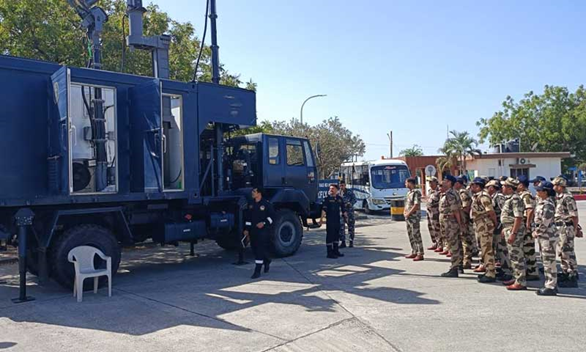
India has strengthened its defence preparedness with the induction of the indigenous D4 Anti-Drone Shield, developed by the Defence Research and Development Organisation (DRDO) and produced by Bharat Electronics Limited (BEL). This advanced counter-drone system represents a major step in enhancing protection against modern aerial threats.
The D4 system operates on a “Detect, Deter, and Destroy” framework, combining multiple technologies for comprehensive surveillance and response. It integrates radar systems, radio frequency sensors, and electro-optical and infrared tracking systems to monitor airspace in real time.
Once a threat is identified, the system employs soft-kill measures such as signal jamming and GPS spoofing to disrupt enemy drones. If necessary, it escalates to hard-kill options, including the use of directed energy weapons like high-powered lasers capable of neutralising targets over significant distances.
The deployment of the D4 system reflects India’s growing focus on self-reliance in defence technology under the “Make in India” initiative. It is being strategically installed at naval bases, coastal facilities, and other sensitive locations, particularly in response to evolving security challenges and the increasing use of drones in modern warfare.
Review Questions
- Under India’s National Quantum Mission (NQM), how many institutions have
been approved to set up quantum teaching laboratories?
A. 15
B. 23
C. 50
D. 100
ANSWER: B - What is the budget allocated for the National Quantum Mission (2023–2031)?
A. ₹3,000 crore
B. ₹4,500 crore
C. ₹6,003.65 crore
D. ₹10,000 crore
ANSWER: C - Which aircraft is the Indian Air Force planning to retire gradually?
A. Rafale
B. Tejas Mk-2
C. Mirage-2000
D. Jaguar
ANSWER: D - The D4 Anti-Drone Shield developed by DRDO follows which operational
framework?
A. Track, Target, Terminate
B. Detect, Deter, Destroy
C. Scan, Secure, Strike
D. Identify, Isolate, Eliminate
ANSWER: B - The Strait of Hormuz is strategically important because it:
A. Connects Europe and Asia directly
B. Is a major naval training zone
C. Handles a significant portion of global oil transport
D. Is the largest port in the Middle East
ANSWER: C - INS Taragiri Is Manufactured By
A. CSL
B. MDL
C. GRSE
D. None
ANSWER: B - INS Taragiri Is Made Under__ Project.
A. P75 I
B. P17A
C. P15B
D. None
ANSWER: B - Ex SURYA KIRAN Conducted b/w India &
A. Bhutan
B. Sri Lanka
C. UAE
D. Nepal
ANSWER: D - European ASRAAM Stands For
A. Advanced Short Range Air Missile
B. Advanced Short Ring Air-to-Air Missile
C. Advanced Short Range Air-to-Air Missile
D. None
ANSWER: C - Marine Engineering Training Establishment of the Indian Navy located at
A. Noida
B. Kochi
C. Pune
D. Wayanad
ANSWER: C - Where Is The Hq Of The Southern Western Command of The Indian Army?
A. Jaipur
B. Jabalpur
C. Pune
D. Mumbai
ANSWER: A - Sea Dragon Exercise Hosted By
A. USA
B. Sweden
C. France
D. None of the above
ANSWER: A - India Purchased C 130 J from
A. USA
B. Sweden
C. France
D. None of the above
ANSWER: A - College of Military Engineering (CME) Is Located At
A. Pune
B. Kamptee
C. Mumbai
D. Noida
ANSWER: A - Which Country Ranked Third Highest In The World Defence Expenditure?
A. Australia
B. USA
C. France
D. Bharat
ANSWER: D - Regimental Center Of PUNJAB REGIMENT Is In
A. Balasore, Odisha
B. Chennai, T.N.
C. Trombay, M.H.
D. Ramgarh Cantonment, Jharkhand
ANSWER: D - India Purchased IAI Searcher UAV from
A. USA
B. Sweden
C. France
D. Israel
ANSWER: D - KHARTOUM Is The Capital Of
A. Spain
B. Sri Lanka
C. Suriname
D. Sudan
ANSWER: D - HELINA Missile Has A Maximum Range Of
A. 7 kilometres
B. 8 kilometres
C. 9 kilometres
D. 10 kilometres
ANSWER: A - Joint Exercises B/w The India And France Is Called:
A. Yama
B. SLINEX
C. Indra
D. GARUDA
ANSWER: D
ALSO READ:
- Latest Daily Current Affairs and Defence Updates
- Latest Daily Current Affairs February 2026[DOWNLOAD PDF]
- Latest Daily Current Affairs January 2026[DOWNLOAD PDF]
- Latest Daily Current Affairs November 2025[DOWNLOAD PDF]
- Latest Daily Current Affairs October 2025[DOWNLOAD PDF]
- Latest Daily Current Affairs August 2025[DOWNLOAD PDF]
- Latest Daily Current Affairs July 2025[DOWNLOAD PDF]
- Monthly Defence Current Affairs June 2025 [DOWNLOAD PDF]
- Monthly Defence Current Affairs May 2025 [DOWNLOAD PDF]
- Monthly Defence Current Affairs April 2025 [DOWNLOAD PDF]
- Monthly Defence Current Affairs March 2025 [DOWNLOAD PDF]
- Monthly Defence Current Affairs February 2025 [DOWNLOAD PDF]
- Monthly Defence Current Affairs January 2025 [DOWNLOAD PDF]
- Defence Current Affairs Year End Review 2024
- Monthly Defence Current Affairs November 2024 [DOWNLOAD PDF]
- Monthly Defence Current Affairs October 2024 [DOWNLOAD PDF]
- Monthly Defence Current Affairs September 2024 [DOWNLOAD PDF]
- Monthly Defence Current Affairs August 2024 [DOWNLOAD PDF]
- Monthly Defence Current Affairs July 2024 [DOWNLOAD PDF]
- Monthly Defence Current Affairs June 2024 [DOWNLOAD PDF]


