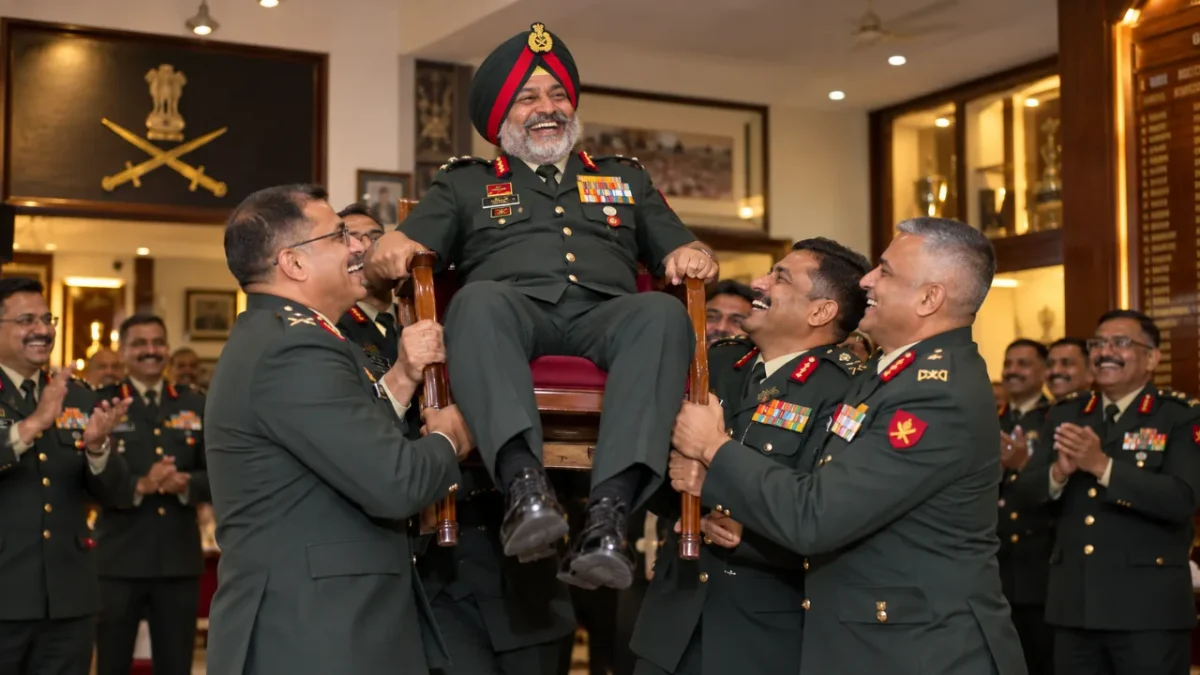
The Indian Army is known not only for its courage, discipline and battlefield achievements but also for its rich traditions that reflect the extraordinary bond between soldiers. Among these traditions is a heartwarming farewell ritual in which a retiring or departing officer is lifted on a chair by fellow officers while everyone sings the famous song, “For He’s a Jolly Good Fellow.”
For someone unfamiliar with military life, the sight of senior Army officers carrying a colleague on a chair while singing and cheering might appear unusual. However, behind this cheerful celebration lies a tradition symbolising respect, camaraderie, brotherhood and the lasting bond shared by those who have served together in uniform.
The ritual, often associated with the Indian Army’s Officers’ Mess culture, is more than a farewell celebration. It is an expression of appreciation for an officer’s service and the memories built throughout a military career.
What Is the “Jolly Good Fellow” Tradition in the Indian Army?
The “Jolly Good Fellow” tradition is a ceremonial farewell custom observed in many Indian Army Officers’ Messes, particularly during an occasion known as a “Dining Out.”
A Dining Out is organised when an officer is leaving a unit or formation due to retirement, transfer, posting or completion of an appointment. It provides an opportunity for fellow officers to acknowledge the departing officer’s contribution and celebrate their association.
During the farewell gathering, colleagues may seat the departing officer on a chair and lift it together while singing “For He’s a Jolly Good Fellow.”
The chair is sometimes gently raised, carried or swayed as the assembled officers clap, cheer and join the celebration.
The occasion is usually filled with laughter, applause and affectionate memories of the departing officer’s time in the unit.
Although the precise manner of celebrating varies between regiments, formations and individual messes, the central sentiment remains the same: honouring a colleague who has been an important part of the military family.
Why Does the Indian Army Lift Retiring Officers on a Chair?
The act of lifting an officer on a chair carries several symbolic meanings rooted in military camaraderie and regimental culture.
1. A Symbol of Respect and Honour
Throughout their careers, Army officers shoulder immense responsibilities, ranging from leading soldiers in challenging operational environments to making decisions that affect the safety and welfare of their personnel.
When fellow officers lift a retiring colleague on a chair, the gesture becomes an expression of collective respect for the officer’s service, leadership and contribution to the organisation.
Instead of an ordinary farewell handshake, colleagues celebrate the individual through a memorable tradition.
The officer who once led others is now symbolically carried by the very community with which they served.
2. Celebrating Brotherhood and Camaraderie
The Indian Army places enormous importance on camaraderie, loyalty and mutual trust.
Officers serving together often experience circumstances that create lifelong friendships. These include demanding field postings, operational deployments, difficult weather conditions, extended separation from families and shared professional responsibilities.
Such experiences build relationships that extend beyond official ranks and appointments.
The chair-lifting ceremony reflects these bonds. For a few moments, formal military hierarchy gives way to laughter and celebration as officers come together to honour one of their own.
It serves as a reminder that the relationships developed during military service do not end when an officer leaves a unit or retires.
3. Recognising Years of Dedicated Service
Retirement in the Army often marks the conclusion of several decades of service.
An officer may have spent much of their adult life serving in remote border areas, high-altitude deployments, peace stations, training establishments and operational formations.
During these years, the officer may have commanded troops, mentored junior officers, participated in military operations and contributed to the professional development of the organisation.
The “Jolly Good Fellow” ceremony provides fellow officers with an opportunity to celebrate these contributions in a personal and memorable manner.
Rather than focusing entirely on the sadness of departure, the occasion highlights the achievements, friendships and experiences of the officer’s military journey.
4. A Farewell Filled with Happiness Rather Than Sadness
Leaving an Army unit can be an emotional experience, particularly for officers who have developed strong relationships with their colleagues.
The Indian Army’s farewell traditions often combine formal respect with humour and celebration.
The familiar song, enthusiastic cheering and cheerful chair-lifting help transform an emotional goodbye into a positive memory.
The tradition acknowledges that although the officer is departing, the friendships and shared experiences will continue.
5. Preserving Regimental Traditions
Traditions form an important part of the Indian Army’s identity.
Different regiments and units maintain distinctive customs, ceremonies, battle cries, songs and mess practices that connect serving personnel with earlier generations.
The “Jolly Good Fellow” ritual represents one such custom within military mess culture.
By participating in these ceremonies, younger officers experience traditions passed down through generations of military service.
Such practices help create continuity between officers who served in different periods while reinforcing the sense of belonging that characterises regimental life.
What Is the Origin of the “Jolly Good Fellow” Tradition?
The chair-lifting ceremony is associated with the military mess traditions inherited from the British Army.
The modern Indian Army evolved from the British Indian Army, and several aspects of military ceremonial life, including formal mess dinners, dining customs and farewell gatherings, reflect that historical influence.
The song “For He’s a Jolly Good Fellow” is itself a traditional congratulatory song that became popular in Britain and other English-speaking societies.
Its melody has roots in the French song “Marlbrough s’en va-t-en guerre,” while the familiar English lyrics became widely associated with celebrations and expressions of appreciation.
Over time, the song became a familiar feature of social gatherings, military functions and farewell occasions.
Within Indian Army mess culture, singing the song while carrying a departing officer on a chair developed into a recognisable expression of affection and respect.
However, the precise date when chair-lifting became established in Indian Army messes is not clearly documented in publicly available historical records.
The broader custom is generally understood as part of the Army’s inherited mess culture rather than a formally prescribed military ceremony.
What Happens During an Army Dining Out Ceremony?
A Dining Out is among the memorable social occasions associated with an officer’s departure from a military unit.
Traditionally, the event takes place in the Officers’ Mess, which serves as an important centre of the unit’s social and professional life.
The evening may begin with a formal dinner attended by officers of the unit, and sometimes their spouses or invited guests, depending on the occasion and local customs.
Senior officers may deliver farewell speeches highlighting the departing individual’s achievements, leadership qualities and contributions.
Colleagues often recall memorable incidents, demanding assignments, humorous experiences and important moments shared during their service.
The departing officer may also address the gathering, expressing gratitude to colleagues and reflecting on the time spent with the unit.
As the formal proceedings conclude, the atmosphere may become more relaxed and celebratory.
In units that observe the chair-lifting custom, fellow officers gather around the departing officer, lift the chair and sing the traditional farewell song.
The ceremony creates a lasting memory of the officer’s final social gathering with the unit.
It is important to understand that not every Dining Out follows an identical format. Customs vary according to regimental traditions, the nature of the occasion, local instructions and the preferences of the individuals involved.
Lieutenant General KJS Dhillon’s Viral “Jolly Good Fellow” Farewell
One of the widely recognised examples of this tradition involved Lieutenant General Kanwal Jeet Singh Dhillon, popularly known as Lt Gen KJS Dhillon.
The senior Army officer retired on January 31, 2022, after a distinguished military career. His final appointment was Director General of the Defence Intelligence Agency and Deputy Chief of Integrated Defence Staff (Intelligence).
A video shared around the time of his retirement showed fellow officers lifting him on a chair while singing the familiar “Jolly Good Fellow” song.
The retiring officer could be seen enjoying the celebration and joining in the cheerful atmosphere.
The video attracted considerable attention on social media and introduced many civilians to this lesser-known aspect of Indian Army life.
For many viewers, the moment illustrated how seniority and military authority can coexist with genuine personal affection and friendship among officers.
It also demonstrated that even after holding some of the Army’s most demanding appointments, an officer’s farewell can be marked by a simple, joyful expression of camaraderie.
Is the Chair-Lifting Ritual an Official Indian Army Regulation?
The “Jolly Good Fellow” chair-lifting custom should not be confused with an official military honour such as a ceremonial Guard of Honour.
It is primarily a mess tradition rather than a universally mandatory retirement procedure prescribed for every officer.
Military units may have different ways of conducting farewell ceremonies based on their own traditions and applicable instructions.
Some units may observe the chair-lifting custom, while others may follow different farewell practices.
Similarly, it is not limited exclusively to officers retiring from military service.
The ceremony may also be performed when officers are posted out, relinquish command or leave a particular formation.
The essential purpose is to recognise a departing member of the military community and celebrate their association with the unit.
How Is This Different from the Army’s Pulling-Out Ceremony?
Another well-known Indian Army farewell tradition is the “Pulling-Out Ceremony,” in which a departing senior officer’s vehicle may be ceremonially pulled by fellow officers or personnel.
Although both practices are associated with farewells, they are distinct.
The chair-lifting tradition is generally a social custom associated with the Officers’ Mess, often performed during a Dining Out.
The Pulling-Out Ceremony, by contrast, traditionally takes place during a formal departure and involves the symbolic pulling of a vehicle carrying the departing officer.
Both convey appreciation for service, but their settings, methods and historical practices differ.
Some inherited ceremonial customs have also been subject to discussion and review within the Army, including debates over the continued relevance of certain colonial-era practices.
Consequently, neither farewell practice should be assumed to be universally followed across all Army formations.
Why Are Such Traditions Important in the Indian Army?
Military life is fundamentally different from most civilian professions.
Army personnel are required to work in environments where trust, discipline, teamwork and mutual dependence are essential.
A commanding officer is responsible not only for operational tasks but also for the welfare, morale and professional development of personnel serving under their command.
Junior officers learn from seniors, soldiers develop trust in their commanders, and colleagues build lasting relationships through shared experiences.
Military traditions help preserve these connections.
A farewell ceremony may appear simple, but its emotional significance can be profound for individuals who have spent decades serving alongside one another.
The “Jolly Good Fellow” ritual also reminds younger officers that leadership is not measured solely by rank or appointment.
The affection and respect shown by colleagues at the end of an officer’s tenure can reflect the relationships built through professional conduct, personal character and years of shared service.
What Can Defence Aspirants Learn from This Tradition?
For candidates preparing for the NDA, CDS, SSB Interview and other officer-entry examinations, understanding military traditions offers valuable insight into the culture of the Indian Armed Forces.
The Indian Army does not simply expect officers to possess academic knowledge, physical fitness and professional competence.
It also places great importance on character, integrity, teamwork, responsibility and the ability to build trust.
The “Jolly Good Fellow” tradition reflects several qualities associated with effective military leadership.
An officer’s ability to earn the respect of colleagues, support fellow personnel and contribute positively to the unit can leave an impression that lasts long after their posting or retirement.
The ceremony also illustrates the importance of relationships within the Armed Forces.
While military rank determines formal authority and responsibility, genuine camaraderie is developed through shared commitment, mutual respect and dependable leadership.
For aspiring officers, the lesson is that a successful military career is not merely about achieving promotions or holding prestigious appointments.
It is also about the people one leads, the trust one earns and the memories one leaves behind.
Conclusion
The Indian Army’s “Jolly Good Fellow” chair-lifting tradition is a distinctive expression of the warmth and camaraderie that exist alongside military discipline.
What may appear to outsiders as a playful farewell carries a deeper message of respect, gratitude and enduring friendship.
Whether an officer is retiring after decades in uniform or leaving a unit for another appointment, the ceremony celebrates a shared journey and the relationships formed along the way.
The Indian Army is built not only on weapons, training and battlefield capabilities but also on the spirit of the people who serve within it.
The “Jolly Good Fellow” tradition reflects that human dimension of military life.
An officer may leave the unit, relinquish command or retire from active service, but the bonds of brotherhood forged in uniform can last a lifetime.