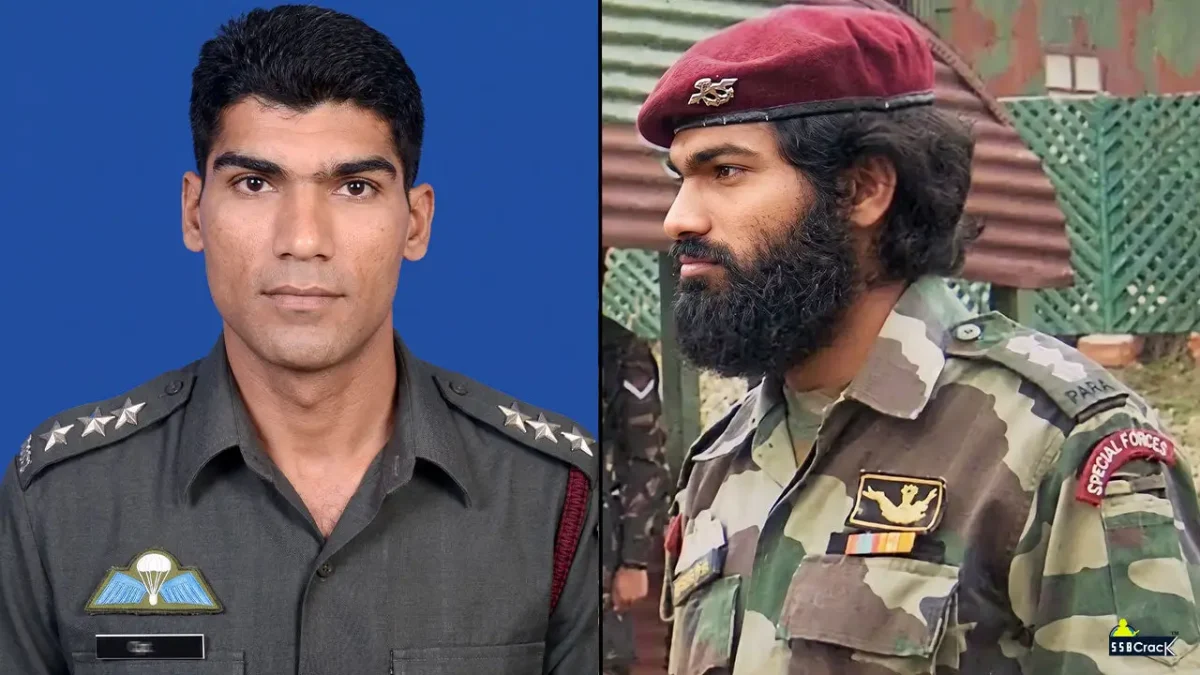
Some soldiers serve for decades and retire with a chest full of medals. Captain Harshan Radhakrishnan Nair served for a little over four years, yet his name is now spoken with the same respect as the Army’s greatest heroes. An officer of the 2nd Battalion of the Parachute Regiment (Special Forces), he laid down his life in the Lolab Valley of Jammu and Kashmir on 20 March 2007, just weeks before his 27th birthday. For his actions that night he was posthumously awarded the Ashoka Chakra, India’s highest peacetime gallantry award.
For NDA, CDS and SSB aspirants, his story is a lesson in what the Special Forces ask of a young officer: preparation, composure under fire, and the willingness to keep fighting for the team even when badly wounded.
Captain Harshan Radhakrishnan Nair at a Glance
| Detail | Information |
|---|---|
| Born | 15 April 1980, Manacaud, Thiruvananthapuram, Kerala |
| Parents | Shri K. Radhakrishnan Nair and Smt G.S. Chitrambika |
| School | Sainik School, Kazhakootam |
| Pre-commission training | National Defence Academy (101st Course, Golf Squadron) and Indian Military Academy, Dehradun |
| Service number | IC-62541 |
| Commissioned | 16 December 2002, into 2 Para (Special Forces) |
| Promoted Captain | 16 December 2004 |
| Final operation | 20 March 2007, Chhoti Margi area, Lolab Valley, Jammu and Kashmir |
| Award | Ashoka Chakra (posthumous), 2008 |
| Age at sacrifice | 26 |
Early Life in Thiruvananthapuram
Harshan Radhakrishnan Nair was born on 15 April 1980 in Manacaud, a locality in Thiruvananthapuram, Kerala, to K. Radhakrishnan Nair and G.S. Chitrambika. Those who knew him as a boy remember a disciplined, curious child who loved to read, especially books on military history and warfare. That reading slowly turned into a clear ambition: he wanted to wear the uniform.
Sainik School Kazhakootam: Where the Leader Took Shape
Harshan studied at Sainik School, Kazhakootam, one of the oldest Sainik Schools in the country and a well-known feeder to the National Defence Academy. He made the most of every opportunity the school offered.
- He captained the school’s volleyball and basketball teams.
- He was known as a strong speaker and a lover of literature.
- His performance as Brutus in a staging of Shakespeare’s Julius Caesar at the Annual Day function is still remembered by his schoolmates.
- In his final year he was appointed School Captain, and he received the Best All-Round Cadet award.
This combination of sport, academics, stage confidence and responsibility is exactly the all-round profile that selection boards look for, and it is worth noting that he built it years before he ever faced an SSB.
A Brief Detour, Then the NDA
In 1997, Harshan enrolled in the B.Tech Civil Engineering programme at NSS College of Engineering, Palakkad. Many young people would have settled into a secure engineering career from there. He did not. When the chance to join the National Defence Academy, Khadakwasla, came, he left the engineering course and joined the 101st Course, Golf Squadron.
After completing his training at the NDA, he moved on to the Indian Military Academy, Dehradun, for the final stage of officer training before commissioning.
Commission into 2 Para (Special Forces)
On 16 December 2002, Harshan was commissioned as a Lieutenant into 2 Para (Special Forces), with service number IC-62541. Joining a Special Forces battalion means surviving a tough, voluntary probation in which candidates are tested on physical endurance, mental resilience and professional skill. Only those who complete it earn the right to wear the maroon beret and the Balidaan badge.
Harshan quickly stood out. He was selected for special weapons training in Israel, an opportunity given only to officers who show unusual promise. He also completed the High Altitude Warfare Course, qualified as an underwater diver and was a strong cross-country runner. He was promoted to Captain on 16 December 2004.
Senior officers remembered him as quiet and soft-spoken, but deeply committed to his missions. The second-in-command of his battalion later recalled that Harshan was handling a large share of the training in his formation by himself, and that he had already led many anti-terrorist strikes before his final operation.
Counter-Terrorism in the Lolab Valley
In 2006, his unit was deployed to Jammu and Kashmir for counter-insurgency operations in Baramulla district and the Lolab Valley in north Kashmir. The area is known for thick forests, heavy snowfall in winter and difficult mountain terrain, which makes it a hard place to track and corner armed terrorists.
The First Encounter: 7 March 2007
On 7 March 2007, while leading a small team on patrol, Captain Harshan noticed suspicious movement in the undergrowth. He placed his men in position and then crawled forward through the dense cover to get close to a terrorist trying to stay hidden. He shot him, and when a second terrorist opened fire, he charged and killed him too. He came out of the engagement without serious injury, having eliminated both terrorists himself.
The Final Operation: 20 March 2007
Less than two weeks later, intelligence indicated that four heavily armed terrorists were hiding in a house in the Chhoti Margi area of the Lolab Valley. Captain Harshan was given charge of the operation. In the early hours of 20 March 2007, in darkness and harsh winter conditions, he and his team quietly cordoned off the house and blocked the escape routes.
At about 3:50 AM, the trapped terrorists rushed out, firing as they tried to break through the cordon. What followed, according to the official accounts, was a close-quarter fight of extraordinary courage:
- Captain Harshan shot and killed the leader of the group.
- He was hit in the thigh but refused to pull back and kept engaging the enemy.
- Despite his wound, he killed a second terrorist.
- A third terrorist then shot him in the neck. With his last strength, he threw a grenade that wounded that terrorist before he collapsed.
Captain Harshan succumbed to his injuries. His team went on to finish the operation and eliminate the remaining terrorists. Lance Naik Bhawan Singh of the unit also made the supreme sacrifice in the same encounter.
The Ashoka Chakra
For his exceptional courage, fighting spirit and supreme sacrifice, Captain Harshan Radhakrishnan Nair was posthumously awarded the Ashoka Chakra, announced on Republic Day 2008. The Ashoka Chakra is the peacetime equivalent of the Param Vir Chakra and is given for the most conspicuous bravery or self-sacrifice away from the battlefield of a declared war.
| Peacetime Gallantry Award | Order of Precedence |
|---|---|
| Ashoka Chakra | Highest peacetime gallantry award |
| Kirti Chakra | Second highest |
| Shaurya Chakra | Third highest |
Legacy
Captain Harshan’s memory is kept alive in several ways. A statue in his honour was unveiled at the Parachute Regiment Training Centre in Bengaluru on the 56th Raising Day of the Parachute Regiment, so that every young paratrooper who trains there walks past his example. His alma mater, Sainik School Kazhakootam, and its alumni have paid tribute to him, and in 2008 a memorial to him was planned in Thiruvananthapuram. Each year around 20 March, the Army and many veterans remember his sacrifice.
He is survived by his parents, who received the nation’s gratitude on his behalf.
Lessons for Defence Aspirants
- Build an all-round profile early. Sports captaincy, public speaking, stage performance and school leadership all came before his NDA selection.
- Commit to your goal. He left an engineering seat to join the NDA. Clarity about what you want is something interviewers notice quickly.
- Keep adding skills. High altitude warfare, diving, special weapons training and running all made him a more capable Special Forces officer.
- Stay calm under pressure. In both March 2007 encounters, he took quick, sensible decisions in the middle of close-range fire.
- Put the team first. Even after being wounded twice, he kept fighting so that his men could complete the mission.
- Know your gallantry awards. Questions on the Ashoka, Kirti and Shaurya Chakras, and on their famous recipients, appear often in GK papers and interviews.
FAQs
1. Which unit did Captain Harshan Radhakrishnan Nair serve in?
He served in the 2nd Battalion of the Parachute Regiment (Special Forces), commonly written as 2 Para (SF).
2. Which award did he receive?
He was posthumously awarded the Ashoka Chakra, India’s highest peacetime gallantry award, in 2008.
3. Where and when did he make the supreme sacrifice?
He was killed in action on 20 March 2007 during a counter-terrorist operation in the Chhoti Margi area of the Lolab Valley in north Kashmir. He was 26.
4. Which NDA course was he part of?
He was part of the 101st Course of the National Defence Academy, in Golf Squadron, after studying at Sainik School, Kazhakootam.
5. When was he commissioned?
He was commissioned as a Lieutenant into 2 Para (SF) on 16 December 2002 and promoted to Captain on 16 December 2004.
Conclusion
Captain Harshan Radhakrishnan Nair’s journey ran from a schoolboy reading military history in Thiruvananthapuram to the snow-covered slopes of the Lolab Valley. In little more than four years of service, he earned the respect of his men, the trust of his commanders and, finally, the Ashoka Chakra. His life shows that greatness is not measured in years served but in the choices made when it matters most. For every aspirant preparing for the NDA, CDS or SSB, his story is a reminder of the courage, character and selflessness that the uniform demands.