In Defence Current Affairs for 17 November 2026, we will see the latest national and international current affairs news. These important current affairs will be beneficial for your upcoming NDA, CDS, CDS OTA, AFCAT, TA, Agniveer Army, Agniveer Navy, Agniveer Air Force, Women Military Police, INET, MNS, ACC exams, SCO, PCSL, CAPF, and SSB interviews, and direct entries for Army, Navy, and Air Force like SSC Tech, TGC, JAG, NCC, TES, 10+2 Cadet. Download a PDF file about current events at the end of this article. Let us now see the Current Affairs.
Defence Current Affairs 17 November 2026
8th India–Myanmar Naval Exercise IMNEX-26 Concludes
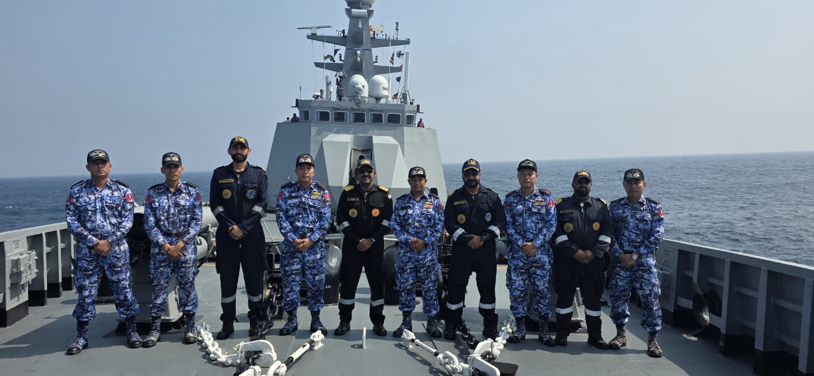
The 8th edition of the India–Myanmar Naval Exercise (IMNEX-26) successfully concluded at Visakhapatnam on 14 November 2026. The exercise featured both Harbour and Sea Phases, providing naval personnel from the two countries with opportunities to strengthen professional cooperation and improve operational coordination.
The Sea Phase, conducted in the Bay of Bengal, marked the operational culmination of the exercise. Indian Naval Ships INS Rana and INS Sumedha participated alongside Myanmar Navy Ship UMS King Sin Phyu Shin.
Harbour Phase
The Harbour Phase focused on professional exchanges and interaction between personnel of the two navies. Its activities included:
- Subject Matter Expert Exchanges (SMEEs)
- Cross-deck visits
- Professional interactions
- Sporting engagements
These activities enabled participants to share operational knowledge, experiences and best practices.
Sea Phase
During the Sea Phase, participating ships undertook coordinated maritime manoeuvres and operational drills. These activities helped refine procedures, improve tactical coordination and strengthen interoperability between the naval units.
Significance
IMNEX-26 represents an important step in enhancing maritime cooperation between India and Myanmar. The exercise also supports India’s MAHASAGAR vision (Mutual and Holistic Advancement for Security and Growth Across Regions) and its Neighbourhood First policy.
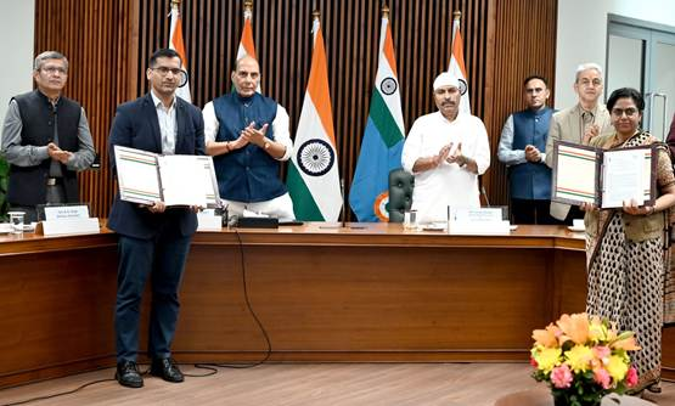
Ministry of Defence and Ministry of Social Justice Sign MoU for Senior Citizens in Cantonment Areas
The Ministry of Defence (MoD), through the Directorate General of Defence Estates (DGDE), has signed a Memorandum of Understanding (MoU) with the Ministry of Social Justice and Empowerment (MoSJE). The agreement aims to improve the welfare and support systems available to senior citizens living in Cantonment areas.
The initiative focuses on strengthening existing facilities and establishing new Day Care Centres and Senior Citizen Homes under the Atal Vayo Abhyuday Yojana (AVYAY).
Key Highlights of the MoU
Under the proposed arrangement, the Ministry of Social Justice and Empowerment will provide financial assistance through AVYAY. This support will include funding for the operation and maintenance of existing Day Care Centres and Senior Citizen Homes managed by Cantonment Boards using their own resources.
The agreement also provides for the establishment of additional Day Care Centres and Senior Citizen Homes in Cantonment areas. The Directorate General of Defence Estates has identified eight Cantonments where new day care facilities can be established.
Emphasis on Dignity and Welfare of the Elderly
Raksha Mantri Rajnath Singh highlighted that senior citizens are not merely members of families but also custodians of experience, traditions and social values. Their knowledge and guidance, he noted, would play an important role in India’s journey towards Viksit Bharat by 2047.
He stressed that older citizens deserve dignity, security, respect and a sense of belonging in recognition of their lifelong contributions to families, society and the nation.
The Defence Minister also called for continuous improvements in the quality of services provided to senior citizens. He emphasised the importance of conducting social audits of Day Care Centres and Senior Citizen Homes to evaluate their functioning and identify areas for improvement.
Significance
The MoU strengthens the institutional framework for senior citizen welfare in Cantonment areas. It also coincides with the Defence Estates Department’s centenary celebrations, marking 100 years of institutional service since its establishment in 1926.
Ten Countries Sign San Francisco Declaration on Secure Technology Supply Chains
India, the United States and eight other countries signed the San Francisco Declaration on the Secure Foundations of Enduring Prosperity on 15 November 2026. The declaration represents an important initiative to strengthen international cooperation in artificial intelligence (AI), advanced technologies and critical supply-chain security.
The document was signed during the Pax Silica Founders Retreat in San Francisco, convened by US Under Secretary of State for Economic Affairs Jacob Helberg.
Ten Original Signatories
The ten countries that signed the declaration are:
- United States
- Australia
- India
- Israel
- Japan
- South Korea (Republic of Korea)
- Qatar
- Singapore
- United Arab Emirates
- United Kingdom
Objectives of the Declaration
The declaration recognises that economic security is closely connected to national security. It seeks to strengthen the protection of sensitive technologies, strategic resources and critical infrastructure required for the development and deployment of advanced AI systems.
Modern AI capabilities depend on complex international supply chains. These include:
- Critical minerals
- Semiconductor components
- Advanced manufacturing facilities
- Electricity and energy infrastructure
- Computing infrastructure
- Communication networks
The declaration establishes a shared set of principles aimed at improving economic and technological security among participating countries.
India’s Participation in Pax Silica
India formally joined Pax Silica on 20 February 2026, becoming its tenth signatory at that stage.
The India–US declaration was signed by representatives including US Ambassador to India Sergio Gor, US Under Secretary Jacob Helberg, and India’s Ministry of Electronics and Information Technology Secretary S. Krishnan.
Significance for India
India’s participation is significant given its expanding interests in semiconductor manufacturing, electronics production, critical mineral processing, artificial intelligence infrastructure and technological research.
The initiative provides a platform for participating countries to cooperate in securing the technological foundations and supply chains that will support future economic growth and national security.

India to Announce Next-Generation Fighter Aircraft Developer for AMCA Programme
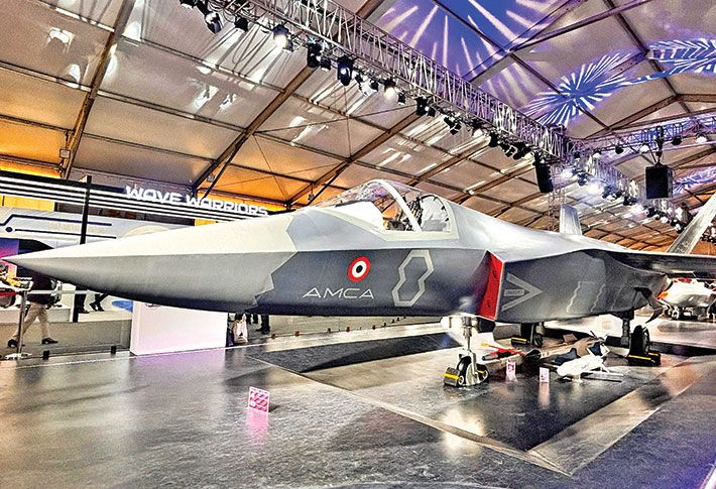
India is expected to announce the winner of the competition to develop its Advanced Multirole Combat Aircraft (AMCA) programme within a month, according to the supplied report. The selection will mark an important step towards prototype manufacturing of India’s next-generation fighter aircraft.
The high-value competition has entered its final stage, with three bidders remaining after the earlier shortlisting process. Their techno-commercial proposals are currently undergoing evaluation.
Companies Participating in the Competition
The bidders include:
- Tata Advanced Systems Limited (TASL)
- A consortium led by Larsen & Toubro (L&T)
- A consortium led by Bharat Forge
The final selection is expected to determine the organisation responsible for taking the programme forward towards prototype development and manufacturing.
Evolution of Fighter Aircraft Generations
Military fighter aircraft are generally classified into generations according to developments in their design, stealth characteristics, sensors, weapons and combat systems.
Fifth-Generation Fighter Aircraft
Fifth-generation aircraft combine advanced stealth technology, sophisticated radar systems, integrated sensors and electronic warfare capabilities.
An important example is the American F-35 Lightning II, which incorporates stealth and advanced sensor integration to improve its combat effectiveness.
Sixth-Generation Fighter Aircraft
Sixth-generation fighter concepts are expected to introduce more advanced capabilities, potentially including:
- Artificial intelligence-assisted operations
- Advanced sensor integration
- Improved stealth characteristics
- Directed-energy weapons
- Coordination with unmanned combat aircraft
These future aircraft are increasingly being conceptualised as part of interconnected combat networks rather than as independent platforms.
Global Sixth-Generation Fighter Programmes
Several countries are investing in the development of next-generation combat aviation systems.
- United States: Pursuing the Next Generation Air Dominance (NGAD) programme, centred on the F-47.
- United Kingdom, Italy and Japan: Collaborating under the Global Combat Air Programme (GCAP).
- European countries: Also pursuing their own next-generation military aviation initiatives.
Significance
The AMCA programme is an important part of India’s efforts to strengthen indigenous aerospace design, advanced fighter aircraft development and domestic defence manufacturing. The selection of a development partner will be a major milestone in moving the programme towards its prototype stage.
SURYASTRA Rocket Launcher Successfully Completes 300 km Firing Trial
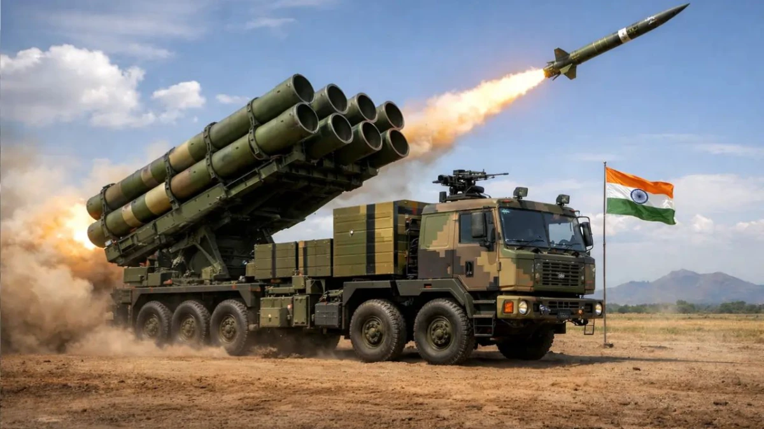
India has taken another step towards strengthening its indigenous long-range artillery capabilities with the successful completion of fresh firing trials of SURYASTRA, the country’s first indigenous Universal Rocket Launcher System (URLS). Developed by Pune-based defence manufacturer NIBE Limited, the system underwent live-fire evaluations at the Integrated Test Range (ITR), Chandipur, Odisha.
Demonstrates Strike Capability Across Four Ranges
During the trials, SURYASTRA demonstrated its ability to engage targets at four different operational ranges: 30 km, 50 km, 150 km and 300 km. The successful evaluations validated the system’s ability to undertake precision strikes across both medium and long distances.
The launcher also recorded a Circular Error Probable (CEP) of less than five metres, indicating a high level of targeting accuracy. This precision is particularly important for missions requiring effective engagement of targets while minimising unintended damage.
Technology Partnership with Israel’s ELBIT Systems
The SURYASTRA programme is based on a technology collaboration agreement signed between NIBE Limited and Israel’s ELBIT Systems in July 2025.
Under this arrangement, ELBIT’s Precise and Universal Launching System (PULS) architecture was adapted for domestic manufacturing. The collaboration aims to establish India’s capability to produce an advanced multi-calibre rocket launcher for the armed forces, while also creating possibilities for future exports.
Multi-Calibre and Modular Design
One of SURYASTRA’s major strengths is its modular architecture, which enables a single launcher platform to fire different types of rockets. It is designed to accommodate:
- 122 mm rockets
- 160 mm rockets
- 306 mm rockets
This multi-calibre capability gives military planners greater operational flexibility. Different ammunition types can be selected according to the range, target and mission requirements, reducing dependence on separate launcher systems.
Enhances Mobility and Battlefield Survivability
SURYASTRA can be mounted on high-mobility platforms, including the BEML High Mobility Vehicle (HMV). Its mobility supports the Army’s ‘shoot-and-scoot’ operational approach, under which a launcher fires its ammunition and rapidly changes position.
This capability helps reduce the time a launcher remains exposed after firing, improving its survivability against possible enemy counter-fire.
₹293-Crore Indian Army Contract
The latest firing trials build upon an Indian Army contract worth ₹293 crore, awarded to NIBE Limited in January 2026 under the government’s emergency procurement programme.
The procurement initiative was intended to speed up the induction of long-range precision rocket artillery and strengthen the Army’s ability to conduct deep-strike operations.
Strategic Significance
The successful trials of SURYASTRA represent an important development in India’s rocket artillery ecosystem. Its combination of long-range engagement capability, high precision, modular design and multi-calibre flexibility offers the armed forces a versatile platform for different operational scenarios.
The programme also highlights the role of private-sector defence manufacturers and international technology partnerships in expanding India’s domestic defence manufacturing capabilities. With its potential applications for both military requirements and exports, SURYASTRA could contribute to India’s broader objective of strengthening defence self-reliance.
Quick Revision: Important Facts
| Particular | Details |
|---|---|
| System | SURYASTRA |
| Category | Universal Rocket Launcher System (URLS) |
| Developer | NIBE Limited |
| Headquarters of developer | Pune, Maharashtra |
| Trial location | ITR, Chandipur, Odisha |
| Maximum demonstrated range | 300 km |
| Other tested ranges | 30 km, 50 km and 150 km |
| Accuracy | CEP below 5 metres |
| Technology partner | ELBIT Systems, Israel |
| Agreement signed | July 2025 |
| Technology architecture | PULS |
| Rocket calibres | 122 mm, 160 mm and 306 mm |
| Army contract | ₹293 crore |
| Contract awarded | January 2026 |
Exam Takeaway: SURYASTRA is India’s indigenous Universal Rocket Launcher System developed by NIBE Limited. Its recent trials demonstrated engagement capability up to 300 km with a CEP of less than five metres.
Review Questions
- The 8th edition of the India–Myanmar Naval Exercise IMNEX-26 concluded at
which location on 14 November 2026?
A) Mumbai
B) Kochi
C) Visakhapatnam
D) Chennai
Correct Answer: C) Visakhapatnam - Which of the following Indian Naval Ships participated in IMNEX-26?
A) INS Vikrant and INS Kolkata
B) INS Rana and INS Sumedha
C) INS Chennai and INS Shivalik
D) INS Delhi and INS Talwar
Correct Answer: B) INS Rana and INS Sumedha - The Ministry of Defence signed an MoU with which ministry to improve the
welfare of senior citizens in Cantonment areas?
A) Ministry of Health and Family Welfare
B) Ministry of Rural Development
C) Ministry of Social Justice and Empowerment
D) Ministry of Housing and Urban Affairs
Correct Answer: C) Ministry of Social Justice and Empowerment - Under which scheme will financial assistance be provided for Senior Citizen Homes
and Day Care Centres in Cantonment areas?
A) PM Jan Arogya Yojana
B) Atal Vayo Abhyuday Yojana
C) PM Awas Yojana
D) National Social Assistance Programme
Correct Answer: B) Atal Vayo Abhyuday Yojana - The San Francisco Declaration on the Secure Foundations of Enduring Prosperity
was signed during which event?
A) G20 Summit
B) Pax Silica Founders Retreat
C) BRICS Summit
D) World Economic Forum
Correct Answer: B) Pax Silica Founders Retreat - On which date did India formally join Pax Silica?
A) 15 August 2025
B) 26 January 2026
C) 20 February 2026
D) 15 November 2026
Correct Answer: C) 20 February 2026 - The Advanced Multirole Combat Aircraft (AMCA) programme is associated with
the development of which of the following?
A) Indigenous aircraft carrier
B) Next-generation fighter aircraft
C) Nuclear-powered submarine
D) Long-range missile defence system
Correct Answer: B) Next-generation fighter aircraft - The Global Combat Air Programme (GCAP) is a joint next-generation fighter
aircraft initiative involving which three countries?
A) India, France and Germany
B) USA, Australia and Japan
C) UK, Italy and Japan
D) France, Spain and Sweden
Correct Answer: C) UK, Italy and Japan - India Sold Brahmos Missile To
A. Philippines
B. Vietnam
C. Thailand
D. Japan
ANSWER: A - Agni-V Is A
A. Destroyer
B. OPV
C. IRBM
D. ICBM
ANSWER: D - Which is Not Correctly Matched:
A. IAF Day: 8 Oct
B. Indian Navy Day: 4 Dec
C. Indian Army Day: 26 Jan
D. BSF Day: 1 Dec
ANSWER: C - “Sarvatra” (Everywhere) Is The Motto Of
A. JKRIF
B. RR
C. CORPS OF ENGINEERS
D. Madras Regiment
ANSWER: C - IAF Was Formed On
A. 8 October 1932
B. 8 October 1922
C. 8 October 1942
D. 8 October 1952
ANSWER: A - SLBM Stands For
A. Submarine-launched Ballistic Misery
B. Submarine-launched Ballistic Missile
C. Submarine-launched Ballet Missile
D. Solar-launched Ballistic Missile
ANSWER: B - Lima Is The Capital Of
A. Poland
B. Qatar
C. UAE
D. Peru
ANSWER: D - “The Epic Battle of Longewala” Book Is Written By
A. Arun Kumar
B. Ashish Ghatak
C. Ramesh Kandula
D. Air Marshal Retd Bharat Kumar
ANSWER: D - Joint Exercises B/w The India And UK Is Called:
A. Yama
B. SLINEX
C. Indra
D. Konkan Shakti
ANSWER: D - Where Is The Hq of The South Western Command of The Indian Army?
A. Jaipur
B. Vishakhapatnam
C. Pune
D. Mumbai
ANSWER: A - Merkava Mk.4 Is The Tank Of
A. Germany
B. Israel
C. USA
D. India
ANSWER: B - Exercises B/w The India and Egypt Is Called:
A. SLINEX
B. Indra
C. Yudha Abhyas
D. Ex CYCLONE
ANSWER: D - Where Is The Hq of The Training Command of The IAF?
A. Bengaluru
B. Vishakhapatnam
C. Shillong
D. Mumbai
ANSWER: A
ALSO READ:
- Latest Daily Current Affairs and Defence Updates
- Latest Daily Current Affairs October 2026[DOWNLOAD PDF]
- Latest Daily Current Affairs September 2026[DOWNLOAD PDF]
- Latest Daily Current Affairs August 2026[DOWNLOAD PDF]
- Latest Daily Current Affairs July 2026[DOWNLOAD PDF]
- Latest Daily Current Affairs June 2026[DOWNLOAD PDF]
- Latest Daily Current Affairs May 2026[DOWNLOAD PDF]
- Latest Daily Current Affairs April 2026[DOWNLOAD PDF]
- Latest Daily Current Affairs March 2026[DOWNLOAD PDF]
- Latest Daily Current Affairs February 2026[DOWNLOAD PDF]
- Latest Daily Current Affairs January 2026[DOWNLOAD PDF]
- Latest Daily Current Affairs November 2025[DOWNLOAD PDF]