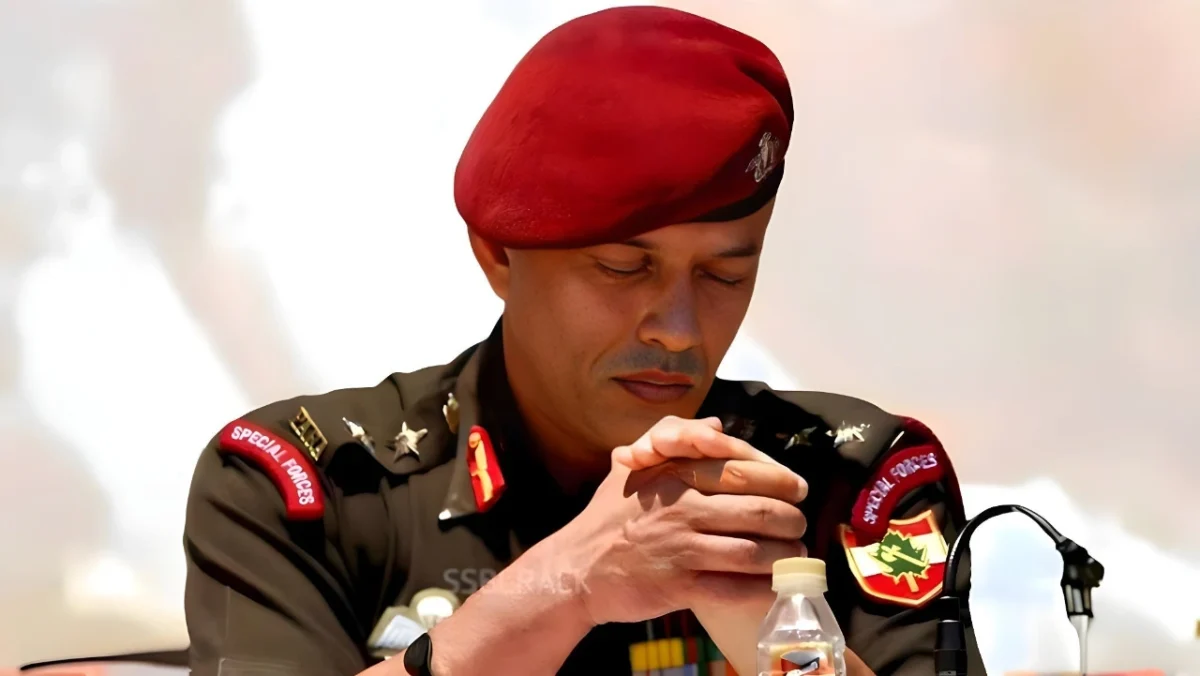
Most officers would be proud to earn one gallantry award in a full career. Brigadier Saurabh Singh Shekhawat, KC, SC, SM, VSM, earned three, along with a Vishisht Seva Medal, while serving with the 21st Battalion of the Parachute Regiment (Special Forces). He is widely described as the Indian Army’s most decorated officer of his generation, and he is also one of its finest mountaineers, with three ascents of Mount Everest to his name.
For NDA, CDS and SSB aspirants, his journey is a powerful case study. It shows what happens when physical toughness, careful planning and a refusal to quit are applied both on the battlefield and on the world’s highest peaks.
Brigadier Saurabh Singh Shekhawat at a Glance
| Detail | Information |
|---|---|
| Born | 18 October 1970, Alwar, Rajasthan |
| Service number | IC-52871 |
| Commissioned | 11 June 1994, from the Indian Military Academy, Dehradun |
| Parent battalion | 17th Battalion, the Maratha Light Infantry |
| Special Forces unit | 21 Para (Special Forces), which he later commanded |
| Gallantry awards | Kirti Chakra, Shaurya Chakra, Sena Medal (Gallantry) |
| Distinguished service award | Vishisht Seva Medal (VSM) |
| Everest summits | 2001, 2003 and 2005 |
| Promoted Brigadier | March 2020 |
| Retired | 2024, after about 30 years of service |
Early Life in Alwar
Saurabh Singh Shekhawat was born on 18 October 1970 in Alwar, Rajasthan. His father is Jaswant Singh Shekhawat, and his mother, Shraddha Chauhan, holds a PhD and a DLitt. He grew up in a family that valued education and discipline, two qualities that would shape both his military and mountaineering careers.
He is married to Dr Renuka Shekhawat, a professor of Sanskrit at the University of Rajasthan.
Commissioning and the Move to 21 Para (SF)
Shekhawat trained at the Indian Military Academy, Dehradun, and was commissioned as a second lieutenant on 11 June 1994 into the 17th Battalion of the Maratha Light Infantry. Soon afterwards he joined 21 Maratha Light Infantry, a battalion that was being converted into a special forces unit, 21 Para (Special Forces).
Life in a special forces battalion is very different from regular infantry service. Every member must clear a voluntary and punishing probation, and then train for parachuting, small-team raids, surveillance and operations in difficult terrain. 21 Para (SF) has been heavily involved in counter-insurgency operations in India’s Northeast, and it was there that Shekhawat would earn his highest award.
His promotions followed the regular time-scale of the Army: lieutenant in 1996, captain in 1999, major in 2004, lieutenant colonel in 2007 and colonel in January 2010. He later commanded 21 Para (SF) and was promoted to Brigadier in March 2020.
The Shaurya Chakra on Mount Everest
Shekhawat’s first gallantry award came not from combat but from courage against nature. As a captain, he was a member of the 2001 Army Everest Expedition. Early in the expedition he fell ill and had to be evacuated from the Everest region. Many climbers would have ended their attempt there.
Instead, he recovered, returned to Base Camp, re-acclimatised and rejoined his team at Camp III on 29 April 2001. He reached the South Col on 21 May, and the team began its summit attempt on the night of 22 May. Moving along the exposed ridge in extremely bad weather, he kept helping and encouraging the other climbers. At the difficult Hillary Step, despite the cold, lack of oxygen, high winds and his recent illness, he helped his teammates over the most dangerous stretch.
He reached the summit of Mount Everest at 0830 hours on 23 May 2001. For gallantry in these high-risk conditions, he was awarded the Shaurya Chakra, with the award effective from 21 May 2001.
Sena Medal and Vishisht Seva Medal
Over the next few years Shekhawat added two more honours. He was awarded the Sena Medal (Gallantry) for acts of exceptional courage in operations, and the Vishisht Seva Medal for distinguished service of a high order, announced on Republic Day 2006.
Holding a gallantry award and a distinguished service award together is uncommon at the rank he held then. It reflects an officer who was trusted both in operations and in planning and leadership roles.
The Kirti Chakra: The Manipur Island Raid of 2008
Shekhawat’s most celebrated action came in 2008, when he was a lieutenant colonel and team leader of 21 Para (SF) in Manipur. Within days of arriving, he built an intelligence network to locate a terrorist camp in Bishnupur district, an area that had been a safe haven for militants.
He then spent 45 days on continuous surveillance, planning and training before launching the operation. On the night of 8–9 September 2008, guided by his surveillance detachment, he moved boats and divers through weed-choked waters and placed his groups close to the target island without losing surprise.
At daybreak, after the sentries had been silenced, he and the assault group swam to the island. The terrorists opened heavy fire. Shekhawat led his men in returning fire and closing in, and his accurate shooting killed two terrorists. When other militants fired heavy weapons from a flank and pinned his men down in the open, he and his buddy deliberately ran into the open, drawing the fire onto themselves. He eliminated another terrorist, diverted the enemy’s attention and prevented casualties among his own men, allowing the rest of the assault group to move forward and neutralise the camp.
For his resolute leadership, raw courage and presence of mind in close combat, he was awarded the Kirti Chakra, India’s second-highest peacetime gallantry award, announced on Republic Day 2009.
Operations and Overseas Service
Beyond these headline actions, his medal set tells the story of a wide-ranging career. It includes the Operation Vijay Star and Operation Vijay Medal from the Kargil period, the Operation Parakram Medal, the Siachen Glacier Medal, the High Altitude Service Medal and the Special Service Medal. He also served with the United Nations, and holds the medal for MONUSCO, the UN peacekeeping mission in the Democratic Republic of the Congo, along with the Videsh Seva Medal.
A Mountaineer Without Equal in Uniform
Shekhawat’s mountaineering record is remarkable even by Army standards. His key achievements include:
- Mount Everest three times, in 2001, 2003 and 2005
- Kilimanjaro, the highest peak in Africa
- Mont Blanc, the highest peak in the Alps and Western Europe
- Leading the joint Indo-Kazakh team to Marble Wall Peak in Kazakhstan in October 2009
- Leading a 55-member Indian Army expedition to Shahi Kangri in June 2022
In all, he has climbed 14 major peaks around the world, some of them more than once. The same qualities that made him effective in special operations, such as patience, planning, endurance and care for the team, are exactly what high-altitude climbing demands.
Awards and Decorations
| Award | Reason |
|---|---|
| Kirti Chakra | Leadership and gallantry in the 2008 anti-terrorist operation in Bishnupur, Manipur |
| Shaurya Chakra | Gallantry during the 2001 Army Everest Expedition |
| Sena Medal (Gallantry) | Acts of exceptional courage in operations |
| Vishisht Seva Medal | Distinguished service of a high order |
| Operation Vijay Star and Operation Vijay Medal | Service during the Kargil period |
| Siachen Glacier Medal | Service on the Siachen Glacier |
| MONUSCO Medal | UN peacekeeping service in the Democratic Republic of the Congo |
Retirement and Legacy
After about three decades of service, Brigadier Shekhawat retired from the Indian Army in 2024. In a widely shared video interview in 2021, he summed up his attitude by describing the Special Forces as his religion, a line that captured how completely he identified with the maroon beret.
His career was not free of difficulty. He spoke openly about setbacks in his promotion, and he waited years before being promoted to Brigadier in 2020. Yet he stayed in uniform and continued to lead from the front, including taking a large Army team to Shahi Kangri in 2022.
Lessons for Defence Aspirants
- Setbacks are not the end. He was evacuated sick from Everest in 2001 and still went back to summit and earn the Shaurya Chakra.
- Preparation wins the fight. The Manipur raid came after 45 days of surveillance, planning and training. Courage works best on top of hard groundwork.
- Lead from the front. In both the Hillary Step and the island assault, he put himself at risk to help his team succeed.
- Fitness is a career-long asset. Three Everest summits and an expedition in his fifties show what consistent training can build.
- Know your awards. The difference between the Kirti Chakra, Shaurya Chakra and Sena Medal is a common question in GK papers and SSB interviews.
FAQs
1. Which Para SF unit did Brigadier Saurabh Singh Shekhawat serve in?
He served with 21 Para (Special Forces), which was converted from 21 Maratha Light Infantry, and he later commanded the battalion.
2. What gallantry awards does he hold?
He holds the Kirti Chakra, the Shaurya Chakra and the Sena Medal (Gallantry). He has also been awarded the Vishisht Seva Medal for distinguished service.
3. Why did he receive the Kirti Chakra?
He received it for leading a 21 Para (SF) operation against a terrorist camp on an island in Bishnupur district, Manipur, on the night of 8–9 September 2008.
4. How many times has he climbed Mount Everest?
He has summited Mount Everest three times, in 2001, 2003 and 2005. His 2001 climb earned him the Shaurya Chakra.
5. Where did he get his commission?
He was commissioned from the Indian Military Academy, Dehradun, on 11 June 1994 into the 17th Battalion of the Maratha Light Infantry.
Conclusion
Brigadier Saurabh Singh Shekhawat’s life runs from a family home in Alwar to the Indian Military Academy, from the weed-filled waters of Manipur to the Hillary Step on Everest. Three gallantry awards and a Vishisht Seva Medal tell only part of the story. The rest lies in the quieter qualities behind them: the patience to plan for 45 days, the grit to return to a mountain after being evacuated from it, and the willingness to stand up in the open so that his men could live. For every aspirant preparing for the NDA, CDS or SSB, he is a reminder that the maroon beret is earned every single day.