




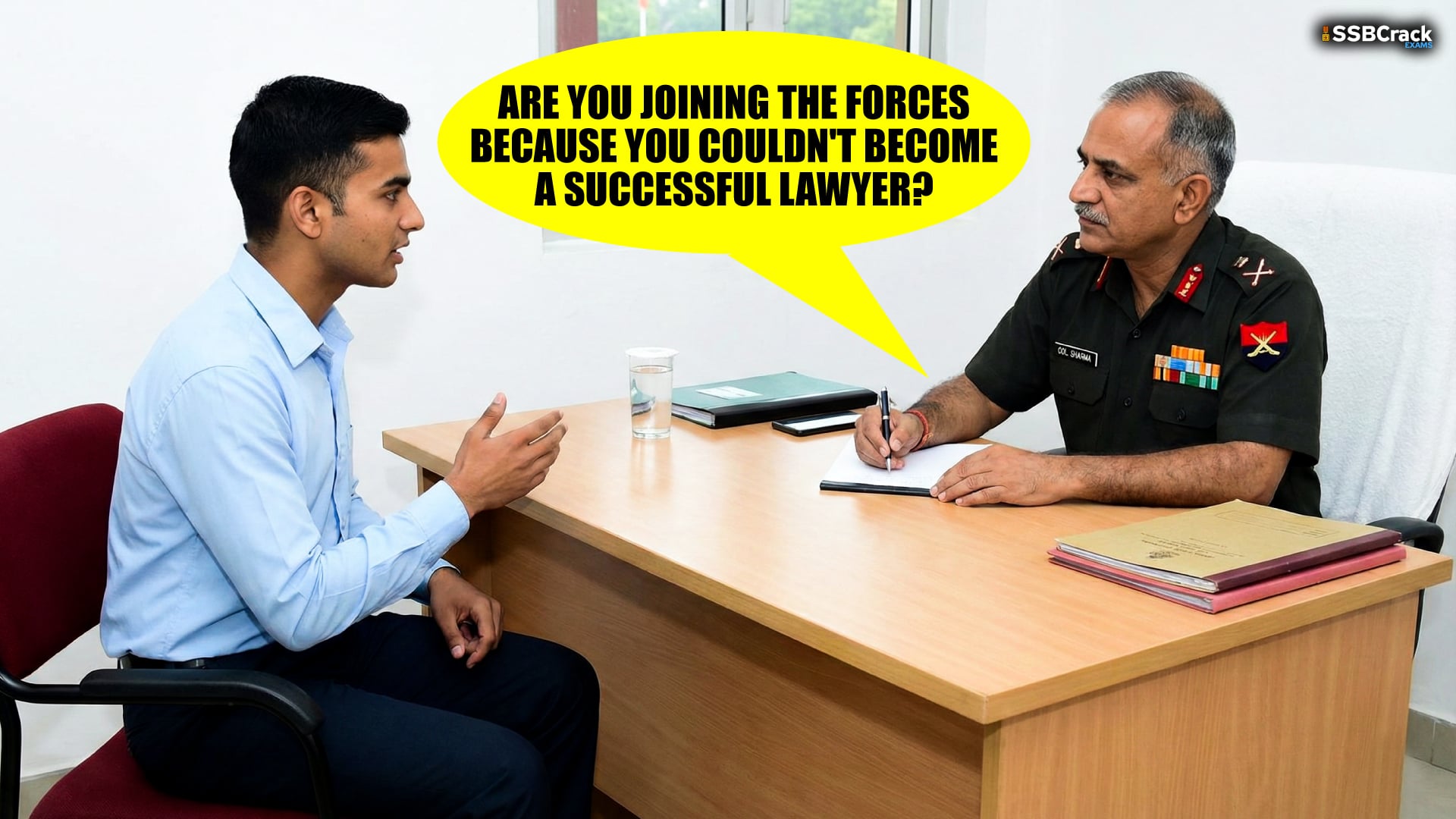
Law graduates appearing for the SSB Interview are often asked questions that test not only their legal knowledge but also their sense of justice, reasoning ability, communication skills, ethics, leadership, and decision-making.
The interviewer may ask why you chose law, why you want to join the Armed Forces, how your legal education will help you as an officer, and whether you understand discipline, responsibility, and national security beyond textbooks.
A law degree can become a strong advantage in the SSB Interview if you present it correctly. It shows that you can think logically, analyse situations, understand rules, respect procedure, and communicate clearly.
In this video, we will discuss 20 important SSB Interview questions for law graduates, along with why each question is asked, how to answer it, and a sample answer.
1. Why do you want to join the Armed Forces after law?
Why it is asked:
To check your motivation and whether you are genuinely interested in a military career or simply looking for a secure job after graduation.
How to answer:
Connect law with leadership, discipline, justice, responsibility, national service, and decision-making. Avoid saying that you could not find a good legal job.
Sample Answer:
I want to join the Armed Forces because I am looking for a career that combines leadership, discipline, service, and responsibility. Law has taught me the importance of justice, procedure, ethics, and decision-making. In the Armed Forces, these qualities are equally important because an officer has to lead people, maintain discipline, follow rules, and take fair decisions even under pressure. I believe my legal background can help me become a more balanced and responsible officer.
2. Why did you choose law as your graduation subject?
Why it is asked:
To understand your interest, decision-making ability, and whether you are serious about the field you studied.
How to answer:
Mention genuine reasons such as interest in justice, society, Constitution, public service, debating, reasoning, or problem-solving.
Sample Answer:
I chose law because I was interested in understanding society, rights, duties, justice, and governance. Law is not only about courts; it teaches how rules regulate human behaviour and how disputes can be resolved logically and fairly. During my graduation, I developed better communication, analytical thinking, reading habits, and confidence in presenting my views.
3. How can your legal knowledge help you as an officer?
Why it is asked:
To check whether you can connect your academic background with military life.
How to answer:
Talk about discipline, rules, military law, human rights, administration, decision-making, documentation, and fair leadership.
Sample Answer:
My legal knowledge can help me as an officer because the Armed Forces function on discipline, rules, procedures, and responsibility. A legal background helps in understanding orders, regulations, rights, duties, and administrative procedures. It also improves logical thinking and fair decision-making. As an officer, I would have to lead men, resolve issues, maintain discipline, and ensure that decisions are just and practical.
4. Why should the Armed Forces select a law graduate like you?
Why it is asked:
To assess your self-awareness, confidence, and understanding of what you bring to the organisation.
How to answer:
Mention qualities like reasoning, communication, leadership, ethics, confidence, decision-making, and sense of responsibility.
Sample Answer:
The Armed Forces should select me because I bring a combination of legal awareness, communication skills, reasoning ability, discipline, and willingness to lead. Law has trained me to analyse facts, listen to different sides, and take balanced decisions. I also understand the importance of rules and responsibility. With proper military training, I believe I can develop into an officer who is firm, fair, and dependable.
5. What is the connection between law and the Armed Forces?
Why it is asked:
To test your awareness of military rules, military justice, and the legal framework under which the Armed Forces operate.
How to answer:
Mention military law, discipline, court martial, rules of engagement, international law, human rights, service rules, and constitutional responsibility.
Sample Answer:
Law and the Armed Forces are closely connected because the military works under a strong legal and disciplinary framework. There are service rules, military laws, rules of engagement, court martial procedures, and constitutional duties. Even during operations, officers must follow lawful orders and respect national and international obligations. Law ensures that discipline, justice, and accountability are maintained within the organisation.
6. What do you understand by military law?
Why it is asked:
To check your basic awareness of the legal system that governs military personnel.
How to answer:
Give a simple answer. Do not try to sound like an expert unless you know details. Mention discipline, conduct, offences, trials, and service rules.
Sample Answer:
Military law is the legal framework that governs the conduct, discipline, duties, and offences of military personnel. It ensures that members of the Armed Forces follow rules and maintain discipline. It also provides procedures for dealing with misconduct or offences through military justice systems such as court martial. Its main purpose is to maintain order, discipline, and operational effectiveness.
7. What is the difference between civil law and military law?
Why it is asked:
To test conceptual clarity and your ability to explain legal differences in simple language.
How to answer:
Explain that civil law applies to civilians and normal society, while military law applies to service personnel and focuses strongly on discipline and operational requirements.
Sample Answer:
Civil law generally applies to citizens and deals with rights, disputes, contracts, property, family matters, and other civilian issues. Military law applies to members of the Armed Forces and is focused on discipline, duty, conduct, and operational efficiency. Both aim to ensure justice, but military law has a stronger emphasis on discipline and command structure because the Armed Forces must function effectively in demanding situations.
8. What is the importance of discipline in the Armed Forces?
Why it is asked:
To see whether you understand the foundation of military life.
How to answer:
Connect discipline with teamwork, obedience to lawful orders, operational success, trust, safety, and leadership.
Sample Answer:
Discipline is the backbone of the Armed Forces. It ensures that every person follows orders, respects the chain of command, and performs duties with sincerity. In military operations, even a small mistake can affect lives and mission success. Discipline creates trust, coordination, and readiness. It does not mean blind action; it means controlled, responsible, and lawful conduct.
9. What do you understand by justice?
Why it is asked:
To assess your moral thinking, fairness, and maturity as a law graduate.
How to answer:
Give a balanced answer. Justice should include fairness, truth, law, responsibility, and protection of rights.
Sample Answer:
Justice means giving every person what is fair and lawful after considering facts, circumstances, rights, and duties. It is not only punishment; it is also about fairness, truth, and balance. A just decision should protect the innocent, hold the guilty accountable, and maintain trust in the system. As a future officer, I believe justice also means being fair to subordinates and taking decisions without bias.
10. What is the importance of the Constitution of India?
Why it is asked:
To check your awareness as a citizen and law graduate.
How to answer:
Mention that the Constitution is the supreme law of India. It defines rights, duties, governance, institutions, and democratic values.
Sample Answer:
The Constitution of India is the supreme law of the country. It defines the structure of government, fundamental rights, duties, directive principles, and the powers of different institutions. It protects democracy, equality, justice, liberty, and national unity. For every citizen and especially for a person in uniform, respecting the Constitution is extremely important because the Armed Forces serve the nation under constitutional authority.
11. What are Fundamental Rights and Fundamental Duties?
Why it is asked:
To test your basic legal awareness and understanding of citizen responsibility.
How to answer:
Explain both in simple words. Rights protect citizens; duties remind citizens of their responsibilities toward the nation and society.
Sample Answer:
Fundamental Rights are basic rights guaranteed by the Constitution to protect individual freedom, equality, and dignity. They include rights such as equality before law, freedom of speech, protection of life and liberty, and freedom of religion. Fundamental Duties are responsibilities of citizens towards the nation, such as respecting the Constitution, national symbols, unity, public property, and scientific temper. Rights and duties together create responsible citizenship.
12. What is the difference between rights and duties?
Why it is asked:
To check whether you understand balance and responsibility, not just legal entitlement.
How to answer:
Say that rights are protections or freedoms, while duties are responsibilities. A good citizen respects both.
Sample Answer:
Rights are protections and freedoms given to individuals, while duties are responsibilities expected from them. For example, freedom of speech is a right, but using it responsibly and respecting others is a duty. Rights and duties must go together. In the Armed Forces, this balance is even more important because an officer must protect rights but also ensure discipline and responsibility.
13. What is your favourite law subject and why?
Why it is asked:
To check your academic interest and whether you can explain a subject confidently.
How to answer:
Choose a subject you genuinely know. Be ready for follow-up questions. Connect it with society or military relevance.
Sample Answer:
My favourite subject is Constitutional Law because it explains how the country is governed and how rights, duties, and institutions function. It gives a clear understanding of democracy, justice, equality, and the rule of law. I like this subject because it is directly connected with citizenship, governance, and national responsibility.
14. Which law subject did you find difficult?
Why it is asked:
To check honesty, self-improvement, and attitude toward weaknesses.
How to answer:
Mention a real subject, explain why it was difficult, and show how you improved.
Sample Answer:
I found Jurisprudence difficult in the beginning because it involved legal theories and abstract concepts. Initially, it was not as straightforward as procedural or criminal law. I improved by reading basic explanations, discussing topics with classmates, and connecting theories with real examples. This helped me understand the subject better and also improved my patience.
15. What is the role of an officer in maintaining discipline?
Why it is asked:
To assess leadership understanding and whether you can be firm and fair.
How to answer:
Mention personal example, clear communication, fairness, timely correction, motivation, and respect for rules.
Sample Answer:
An officer maintains discipline first by setting a personal example. He should be punctual, honest, responsible, and clear in his conduct. He must communicate expectations properly, correct mistakes in time, and treat everyone fairly. Discipline should not be maintained only through fear; it should come from trust, respect, training, and belief in the purpose of the organisation.
16. If your friend breaks a rule, what will you do?
Why it is asked:
To test integrity, loyalty, fairness, and decision-making.
How to answer:
Do not say you will blindly support your friend. Say you will understand the situation, advise correction, and act according to seriousness of the matter.
Sample Answer:
First, I would understand what rule was broken and whether it was intentional or accidental. If it is a minor mistake, I would advise my friend to correct it and not repeat it. If it is serious and affects discipline, safety, or integrity, I would not hide it. Friendship is important, but rules and responsibility are more important, especially in the Armed Forces.
17. What will you do if you receive an unlawful order?
Why it is asked:
To check legal awareness, moral courage, and understanding of lawful command.
How to answer:
Be careful and balanced. Mention respect for the chain of command, but also say that orders must be lawful. Seek clarification if doubtful.
Sample Answer:
In the Armed Forces, following orders is very important, but orders must also be lawful. If I feel that an order is unlawful or clearly against rules, I would respectfully seek clarification through the proper channel. I would not act impulsively or disrespectfully. My aim would be to uphold discipline, legality, and the honour of the organisation.
18. Why not become a lawyer or judge instead of joining the Armed Forces?
Why it is asked:
To test whether your career choice is clear and whether you are genuinely motivated for military life.
How to answer:
Respect the legal profession but explain that your personality and goals are more aligned with uniformed service.
Sample Answer:
Becoming a lawyer or judge is a respected career, and my legal education has given me a strong foundation. However, my interest is more towards a life of leadership, discipline, physical activity, teamwork, and national service. The Armed Forces offer a unique opportunity to take responsibility early and serve the country directly. I believe my legal background will support me in becoming a fair and responsible officer.
19. What are your strengths as a law graduate?
Why it is asked:
To check self-awareness and whether your strengths match officer-like qualities.
How to answer:
Mention communication, reasoning, confidence, listening ability, fairness, public speaking, and decision-making.
Sample Answer:
My strengths as a law graduate are logical reasoning, communication skills, confidence, patience, and the ability to look at both sides of a situation. Law has trained me to analyse facts before forming an opinion. It has also improved my public speaking and ability to present ideas clearly. I believe these qualities will help me as an officer while leading people and taking decisions.
20. What are your weaknesses?
Why it is asked:
To test honesty, self-awareness, and willingness to improve.
How to answer:
Mention a manageable weakness and show improvement. Avoid saying things like anger, dishonesty, laziness, or lack of discipline.
Sample Answer:
Earlier, I used to overthink before taking decisions because legal studies trained me to examine many angles of a situation. Sometimes this affected my speed. I have improved by setting time limits, identifying the most important facts, and taking practical decisions without unnecessary delay. Now I try to maintain a balance between careful thinking and timely action.
Conclusion
Law graduates are not selected in the SSB Interview only because they know legal terms or sections. They are selected when they show officer-like qualities such as honesty, responsibility, balanced judgment, discipline, communication skills, courage, and leadership potential.
Your legal background can become a strong advantage if you connect it with fairness, decision-making, respect for rules, and service to the nation.
So, prepare your legal basics, understand your motivation clearly, stay natural in your answers, and remember that the SSB is not looking for perfect answers. It is looking for a genuine personality with the potential to become a responsible officer.


